
Our B2B manufacturing web design process starts with understanding your buyers before we design a single page. We know what a procurement officer looks for when they visit an industrial website, what makes them submit an RFQ, and what makes them leave. Everything we build is engineered around that knowledge.
Most web design agencies start with what the website will look like. We start with what it needs to do. A manufacturing website has a very specific job: help a buyer quickly understand your capabilities, feel confident in your quality and credibility, and take the next step without friction.
That job shapes everything: the structure, the content, the industrial UX design, and the technical build. We have worked on enough manufacturing websites to know that the biggest problems are almost never visual. They are structural.
Key capability details sit three clicks deep, so procurement officers leave before they find them.
Information architecture that puts capabilities, certifications, and inquiry paths in front of buyers within the first 90 seconds of a visit.
RFQ forms ask the wrong questions and add friction at the exact moment buyers are ready to act.
RFQ forms built around manufacturing procurement, with the right fields in the right order and as few steps as possible.
Service pages describe your process instead of your results. Buyers want to know what working with you achieves, not how you work.
Outcome-first service pages written for procurement officers, with capabilities, certifications, tolerances, and next steps up front.
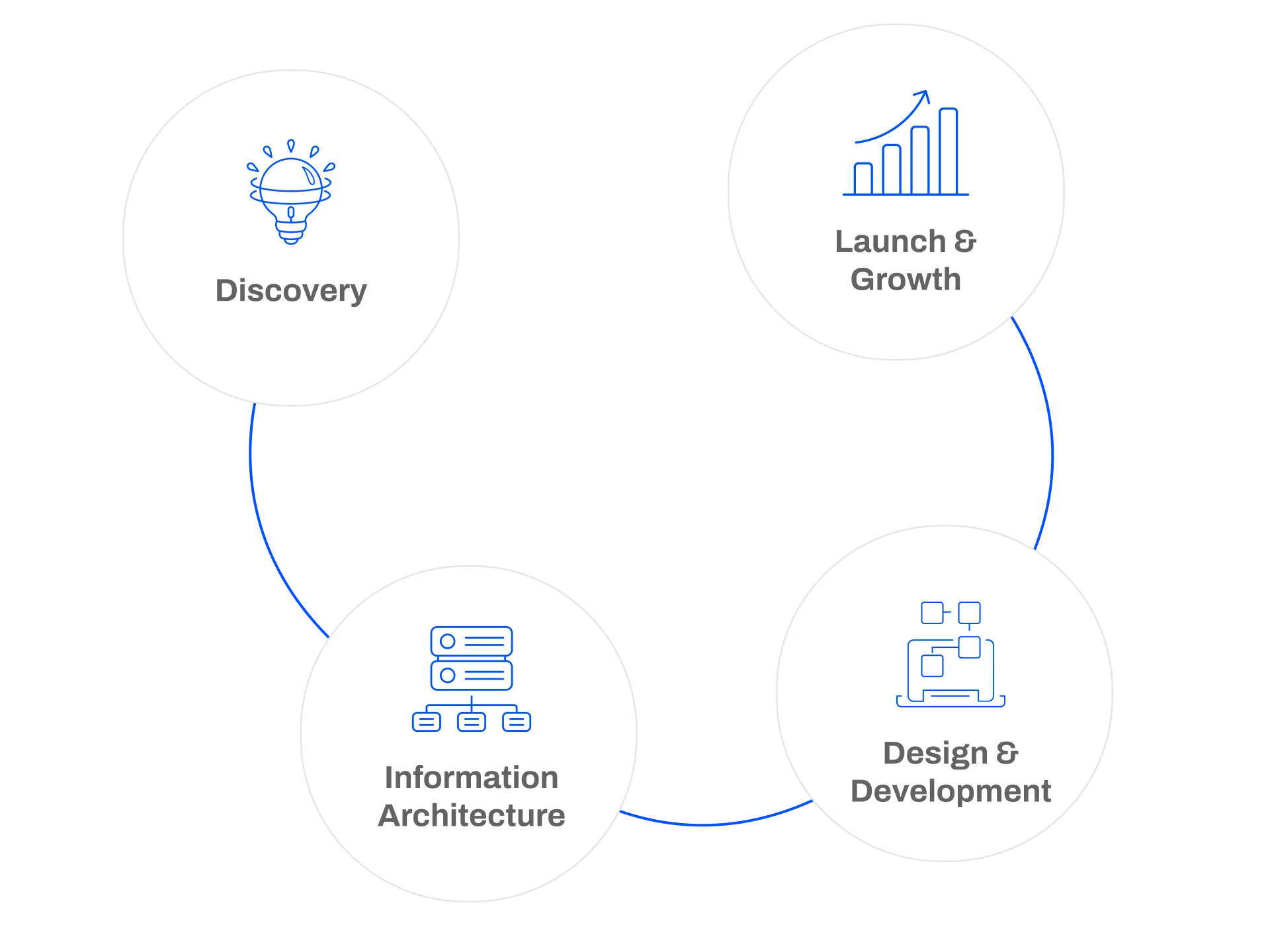
Every B2B manufacturing web design project we take on follows the same four-phase structure. We confirm it at kickoff and keep to it throughout. Each phase feeds directly into the next, with no wasted time or rework.
We start by examining everything: your current industrial website, your top competitors, the search terms your buyers use when they evaluate suppliers, and the places where your site fails to turn visits into inquiries. We review your site the way a procurement buyer would, not the way a marketer would.
3 buyer roles defined
50–120 target terms
5 competitors audited
Priority issues identified
Before we design a single page, we map the full content structure of your manufacturing website: every page, every section, and every path through the site. We decide what goes where based on how buyers actually evaluate suppliers, not on what looks tidy in a menu.
We design every page in Figma before a single line of code is written. You review and approve the high-fidelity design, including every component, interaction, and layout, before development begins. There are no expensive surprises during the build, because every decision is settled during design.
Primary / Secondary / Neutral
8 pixel grid system
Readable first
Launch is not the end of the project. It is where the measurable part begins. We set up full tracking from day one, covering RFQ form submissions, keyword rankings, page performance, and conversion rates, so we have a solid baseline to build on.
Primary KPI
Weekly tracked
AEO monitoring
Page performance
Ranking in Google is still necessary, but it is no longer enough. More procurement teams now start supplier research in AI tools such as ChatGPT, Gemini, and Perplexity. Our industrial SEO work makes sure your manufacturing website ranks in traditional search and gets cited in AI-generated answers. We call this Answer Engine Optimization (AEO) for manufacturers.

A quick look at the focus and standards behind every project.
Years spent designing for B2B industrial and manufacturing companies, so our clients face no learning curve.
We focus on complete digital overhauls that need high-fidelity UX and complex WordPress builds.
Experience across CNC machining, robotics, laser cutting, pharmaceutical machinery, and related industries.
SEO-ready, mobile-responsive WordPress sites built with Elementor Pro.
Whether you need a high-fidelity manufacturer website or an industrial SEO strategy to outrank your competitors, Pixerts is the specialist partner to build it.

About eight weeks. Week 1 is discovery and audit, weeks 2 to 3 cover information architecture, weeks 4 to 7 are design and build, and launch follows in week 8.
You review and approve a high-fidelity Figma design of every page before development begins, so nothing about the build comes as a surprise.
Three defined buyer roles, a keyword map of 50 to 120 target terms, an audit of five competitors, and a list of the priority conversion issues on your current site.
You can continue with a monthly SEO, Google Ads, or AEO program. Or you can take a full handover with CMS documentation, team training, and a prioritized growth roadmap.
Yes, if your content is structured for it. Every site we build includes schema markup and AEO setup, and on monthly programs we track citations in ChatGPT, Perplexity, and Google AI Overviews.