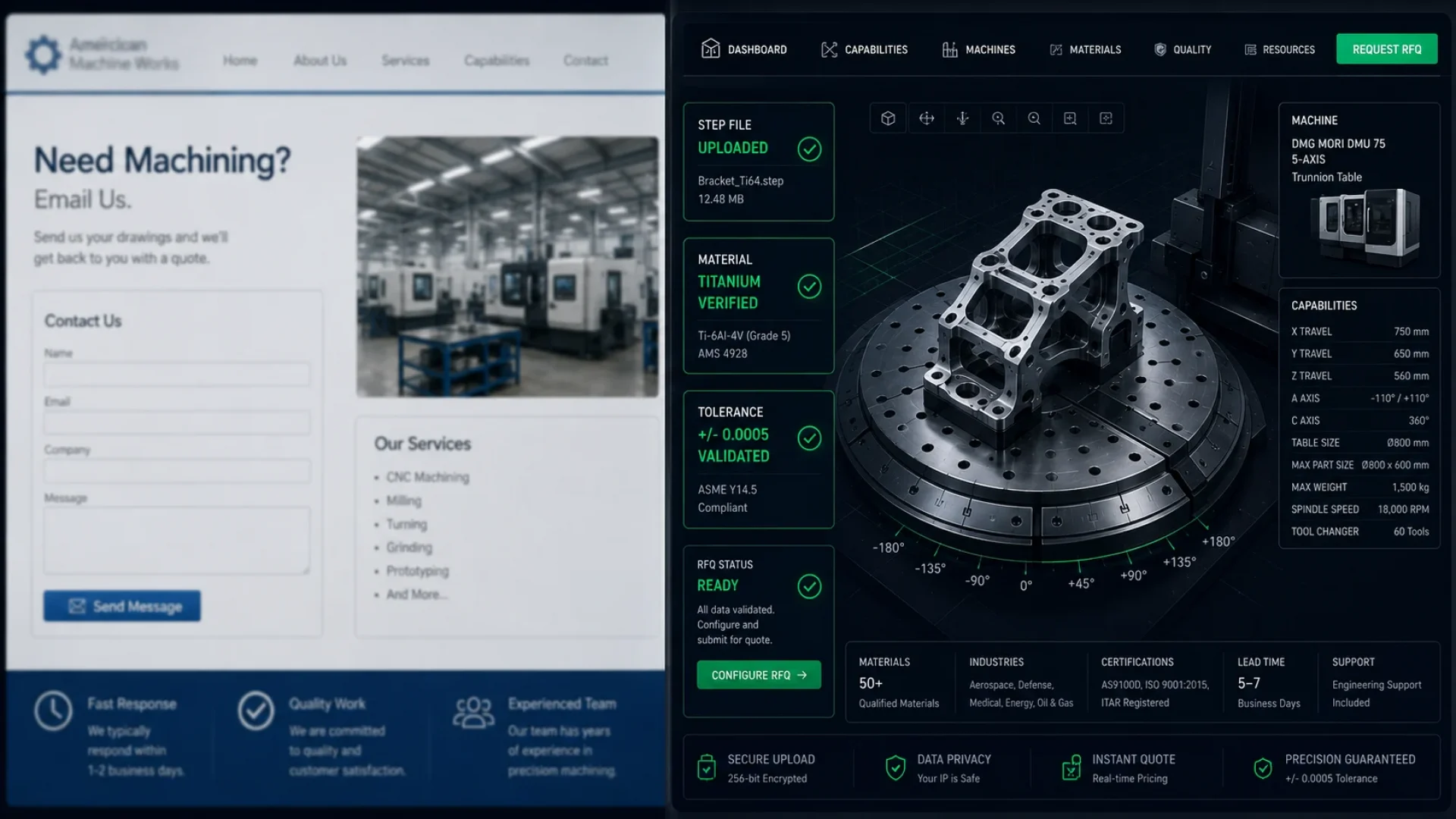
For precision machine shops, the difference between a $1,500 prototype order and a $150,000 aerospace contract often comes down to digital presentation. Highly capable facilities with advanced 5-Axis Milling centers and multi-axis CNC Lathes routinely lose lucrative bids to aggregator platforms because their digital infrastructure is obsolete.
In the specialized niche of industrial machinery, consumer marketing tactics fail. Methodical engineers do not care about flashy videos; they care about verifiable capacity, tight tolerances, and compliance. To capture high-ticket B2B contracts, a shop must invest in elite
CNC Web Design. This means transitioning from a static digital brochure to an agile Technical Source of Truth. By curing Digital Rust, deploying Answer Engine Optimization (AEO), and engineering a Zero Friction RFQ portal, machine shops can bypass the commodity pricing war and dominate the modern procurement landscape.
1. The Flaw in Traditional CNC Machining Marketing
The standard approach to CNC Machining Marketing is broken because it optimizes for traffic rather than validation. Generalist web agencies tell shop owners to cast a wide net by writing basic content to rank for “CNC machining services near me.”
This strategy generates massive Information Friction. It fills the sales pipeline with unqualified leads, hobbyists, and buyers seeking the cheapest hourly rate.
1.1 Validating the OEM Buyer
A procurement officer at an aerospace or medical device OEM focuses on risk mitigation. When seeking a partner to machine complex, High-Mix Low-Volume (HMLV) components from Inconel or Titanium, they conduct rigorous digital vetting. If your
CNC Web Design relies on vague claims like
“We provide high-quality parts with tight tolerances,” the buyer will immediately bounce.
To win high-margin work, your CNC Web Design must clearly validate your capabilities. It must speak the engineer’s language, offering absolute parameters, explicitly defined geometric dimensioning and tolerancing (GD&T), and machine-readable compliance data.
2. Structuring CNC Web Design for 5-Axis Milling
Simultaneous
5-Axis Milling is the crown jewel of a modern machine shop. It shows the ability to handle complex geometries, reduce setup times, and maintain extreme precision on monolithic parts. However, simply listing
“5-Axis CNC” on a website is not enough.
2.1 Explicit Envelope and Capacity Data
An optimized CNC Web Design must detail the physical limits of your machinery. A procurement officer needs to know if their part fits on your trunnion table. Instead of a generic paragraph, use high-contrast HTML data tables to display:
- Machine Make/Model: (e.g., Matsuura MAM72-35V)
- X/Y/Z Travels: (e.g., 26.7″ x 15.7″ x 24.6″)
- Max Workpiece Size/Weight: (e.g., D13.7″ x H12.5″ / 132 lbs)
- Spindle RPM: (e.g., 20,000 RPM for high-speed aluminum clearing)
2.2 Highlighting Specialized Materials
5-Axis Milling is often reserved for exotic, hard-to-machine alloys. Your
CNC Machining Marketing strategy must state your proficiency with materials like Titanium Ti-6Al-4V, Hastelloy, and Stainless Steel 316L. This deters low-value plastic jobs and attracts high-margin aerospace and defense contracts requiring this expertise.
3. Showcasing CNC Lathes and Advanced Turning
While 5-axis mills get the spotlight, advanced CNC Lathes and turning centers are the workhorses of profitable production. Obsolete
CNC Web Design often buries turning capabilities at the bottom of the equipment list.
3.1 Live Tooling and Swiss Turning
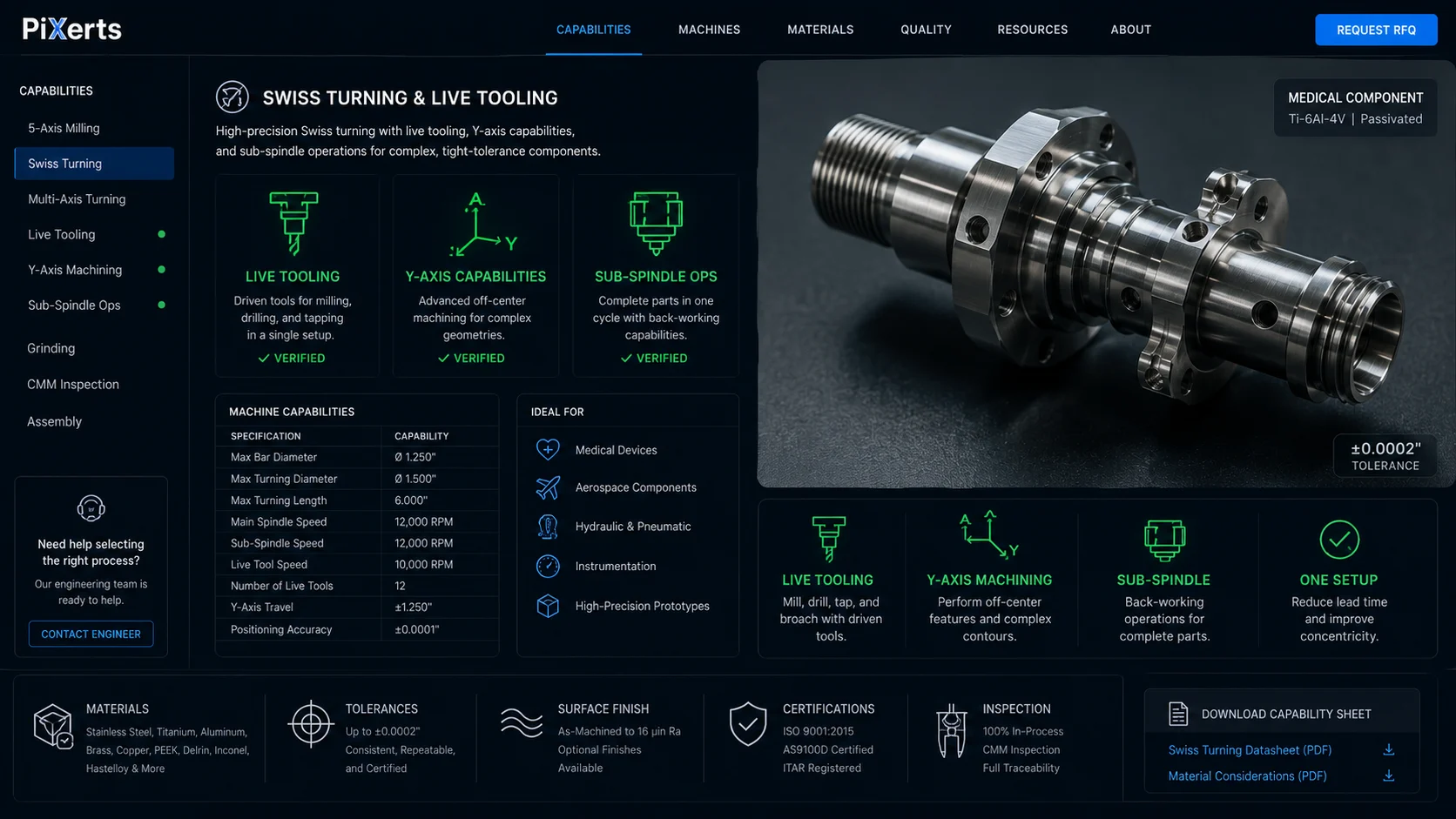
To capture complex, high-volume contracts, your interface must highlight advanced turning capabilities. If you use CNC Lathes with live tooling (Y-axis capabilities) or sub-spindles, this must be front and center. It signals to the buyer that you can deliver parts complete in a single operation, reducing handling errors and lead times.
If you operate Swiss-style lathes for micro-machining (critical for medical implants and electronics), you need a dedicated, structured page within your CNC Web Design that details maximum bar feeder diameters and micron-level tolerances.
4. The Zero Friction RFQ for CNC Shops
The biggest failure in obsolete CNC Web Design is the contact page. Forcing an engineer to request a quote for a complex 5-axis aerospace part using a generic name/email/message form is catastrophic.
4.1 Curing the Email Chain of Death
Generic forms start the “Email Chain of Death”—a multi-day delay where estimators try to extract native CAD files and material requirements from the buyer.
Elite CNC Web Design fixes this by deploying a Zero Friction RFQ engine. This engineering-grade digital intake portal captures absolute intent instantly. Integration: The portal features a secure, end-to-end encrypted drag-and-drop zone that forces uploads of native 3D files (STEP, IGES, DXF).
- Material and Compliance Dropdowns: Buyers select exact material grades and check off required certifications (e.g., AS9100D, ITAR) via dynamic dropdowns, eliminating ambiguity and pre-qualifying the lead for your estimating team.
5. Answer Engine Optimization (AEO) for Machine Shops
In 2026, human engineers are not the only ones evaluating your capabilities. Global procurement teams rely on
AI Answer Engines (like Google Gemini and Perplexity) to build instant supply chain shortlists.
5.1 The Death of the PDF Equipment List
The most common form of Digital Rust in machining is the flattened PDF equipment list. AI algorithms cannot reliably parse or extract data from a PDF. If your 5-Axis Milling capabilities are trapped in a PDF, your shop is invisible to AI.
5.2 Programming the AI with JSON-LD Schema
Modern CNC Machining Marketing relies on
Answer Engine Optimization (AEO). This means taking data from your HTML capacity tables and structuring it in the backend using JSON-LD technical schema. Your CNC Lathes and mills in explicit Schema.org microdata (e.g., @type: ManufacturingEquipment, capability: 5-axis), you program the AI. When a buyer prompts an Answer Engine to “find an ITAR-registered machine shop with 5-axis titanium capabilities,” the algorithm instantly reads your schema, verifies your Technical Source of Truth, and pushes your facility to Position Zero.
6. Agile Infrastructure for the Modern Shop Floor
A highly optimized CNC Web Design cannot be rigid. Your physical shop floor changes—you acquire a new CMM inspection machine, add a robotic pallet changer to your mill, or update your ISO certification. If it takes three weeks and a costly developer ticket to update your website, you are accumulating Digital Rust.
To maintain a frictionless
Technical Source of Truth, specialized agencies use agile frameworks. A robust approach leveraging high-performance page builders like Elementor Pro ensures your internal team can rapidly update dynamic data loops and technical schema. This platform-agnostic agility ensures that your digital twin matches your physical capabilities in real time, bypassing hard-coded bottlenecks.
7. Conclusion: Stop Competing on Price
If your CNC Machining Marketing strategy consists of a static brochure and a generic contact form, you will be trapped in a commodity pricing war. You will lose high-ticket contracts to aggregator platforms offering a superior digital User Experience.
To secure supply chain dominance, you must upgrade your digital infrastructure. Effective CNC Web Design is a rigorous exercise in risk mitigation and data transfer. By explicitly structuring your 5-Axis Milling and CNC Lathes capabilities, deploying a
Zero Friction RFQ, and optimizing for AI through AEO, you eliminate Information Friction.
Transform your machine shop’s website into a verifiable Technical Source of Truth today, and let your digital presence secure the high-margin contracts your shop floor deserves.
Frequently Asked Questions
1. What is the difference between traditional marketing and CNC Web Design?
Answer: Traditional marketing focuses on driving broad traffic using consumer tactics. Elite CNC Web Design is engineered specifically for B2B procurement; it focuses on risk mitigation, frictionless data transfer, and acting as a Technical Source of Truth for methodical engineers.
2. How should 5-Axis Milling capabilities be displayed on a website?
Answer: 5-Axis Milling capabilities should never be buried in paragraph text. They must be displayed in highly scannable HTML data tables detailing precise machine models, X/Y/Z envelope dimensions, maximum workpiece weights, and compatible exotic materials (like Titanium or Inconel).
3. Why do standard contact forms fail for CNC machine shops?
Answer: A standard contact form generates massive Information Friction. It forces engineers to manually type out complex GD&T tolerances and prevents the secure upload of native 3D CAD models, forcing the estimating team into a multi-day “Email Chain of Death.”
4. What is a Zero Friction RFQ in CNC Machining Marketing?
Answer: A Zero Friction RFQ is a highly structured digital intake portal that replaces the generic contact form. It utilizes secure drag-and-drop zones for STEP/IGES files and dynamic dropdowns for precise material grades, instantly capturing the absolute engineering intent required to quote a part accurately.
5. How does Answer Engine Optimization (AEO) help CNC machine shops?
Answer: AEO uses JSON-LD technical schema to translate a machine shop’s physical capabilities into machine-readable code. When procurement officers use AI (like Perplexity or Gemini) to search for specific capabilities—like live-tooling CNC Lathes with ITAR registration—the AI reads the schema and instantly cites the shop.
6. Why are PDF equipment lists bad for CNC Web Design?
Answer: PDF equipment lists are a form of Digital Rust. AI search algorithms and Answer Engines cannot reliably parse or extract structured data from a flattened PDF. To capture AI search traffic, machinery lists must be built in dynamic HTML and wrapped in schema.