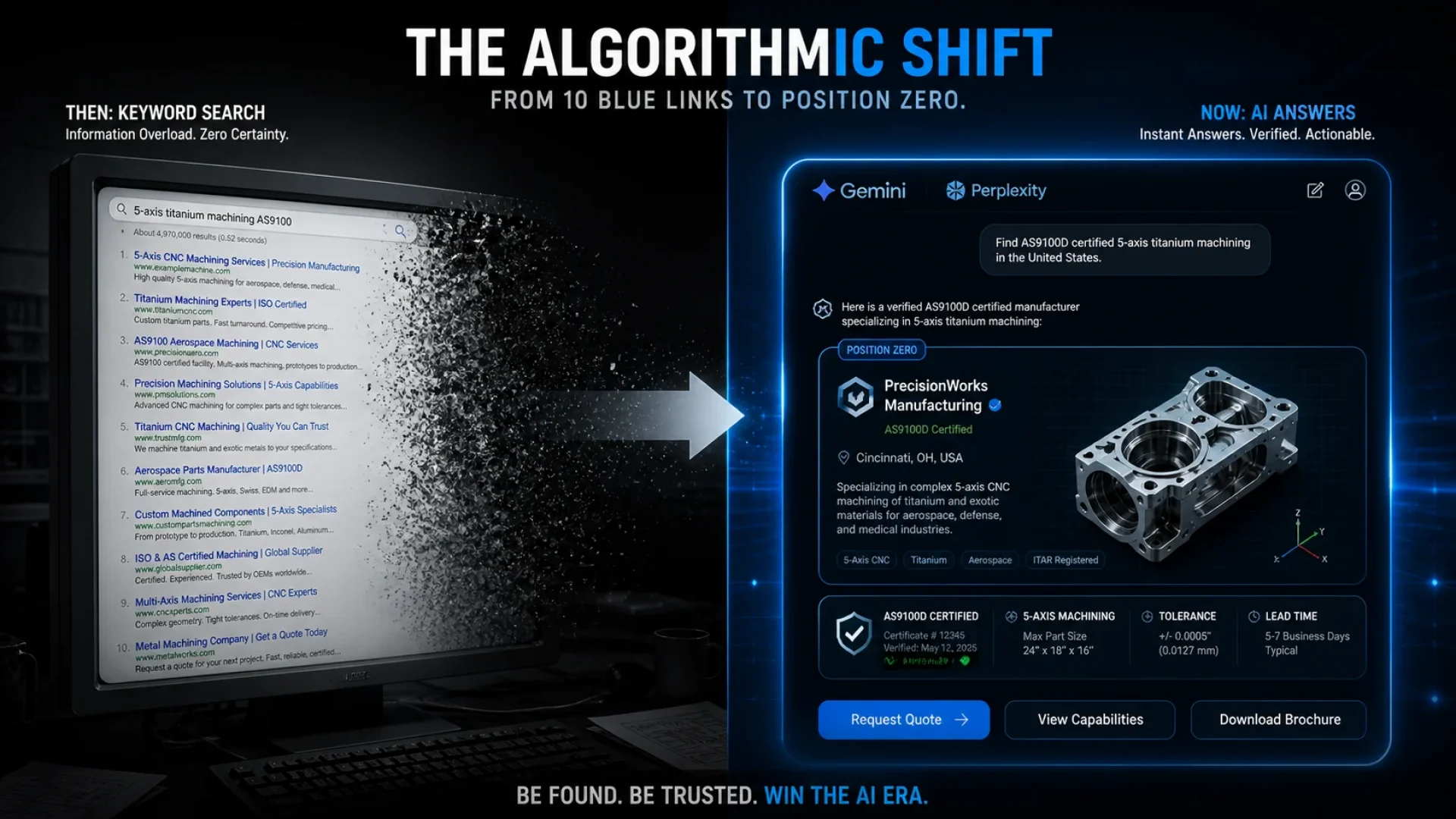
The era of typing “CNC machine shops near me” into a search bar and scrolling through ten blue links is officially over. In 2026, global procurement officers and engineering buyers are utilizing artificial intelligence—specifically Answer Engines like Google Gemini and Perplexity—to source vendors, verify compliance, and build supply chain shortlists instantly. This algorithmic shift has rendered traditional Industrial SEO obsolete.
To survive this transition, independent machine shops and industrial fabricators must adopt AEO for Manufacturers (Answer Engine Optimization). AEO is the science of translating your physical shop-floor capabilities into structured, machine-readable data. By eradicating Digital Rust and structuring your tolerances, equipment lists, and certifications using JSON-LD technical schema, your facility evolves into a verifiable Technical Source of Truth. This is the complete guide to mastering AEO for Manufacturers, securing “Position Zero,” and capturing high-ticket contracts in the age of AI search.
1. The Death of Traditional Industrial SEO
For the past decade, industrial marketing agencies sold a standardized playbook: identify a keyword, write a 500-word blog post about it, build some backlinks, and wait to appear on Page 1 of Google.
In 2026, this approach is a recipe for irrelevance. Procurement officers sourcing a $250,000 robotic assembly do not have the time to read a generic blog post titled “Top 5 Benefits of Aluminum.” They are experiencing severe Information Friction. To bypass this, they have turned to AI.
1.1 The Rise of the Answer Engine
Instead of using traditional search, a modern buyer inputs highly specific, complex prompts into Answer Engines: “Find me an AS9100D certified machine shop in the Midwest with 5-axis titanium milling capacity and a standard lead time under 14 days.”
An Answer Engine does not return a list of links; it synthesizes data from across the web to generate a definitive, single answer (often referred to as Position Zero or an AI Overview). If your website relies on outdated Industrial SEO tactics—hiding your capabilities in flattened PDFs or vague paragraph text—the AI will simply skip your facility. To be cited by the AI, you must practice AEO for Manufacturers.
2. Defining AEO for Manufacturers
AEO for Manufacturers (Answer Engine Optimization) is the highly specialized process of structuring a heavy industry website so that artificial intelligence can instantly comprehend, verify, and extract its technical data.
While traditional SEO focuses on human readability and keyword density, AEO for Manufacturers focuses on algorithmic fluency and entity relationships. It requires stripping away subjective marketing fluff (“We are the best shop in Texas”) and replacing it with objective, absolute parameters (“Tolerance: +/- 0.0005 inches”).
When you successfully execute AEO for Manufacturers, you transform your digital brochure into a Technical Source of Truth. The AI recognizes your website as a definitive database, granting you priority placement when procurement officers prompt the algorithm for specialized manufacturing partners.
3. The Architecture of Answer Engine Optimization
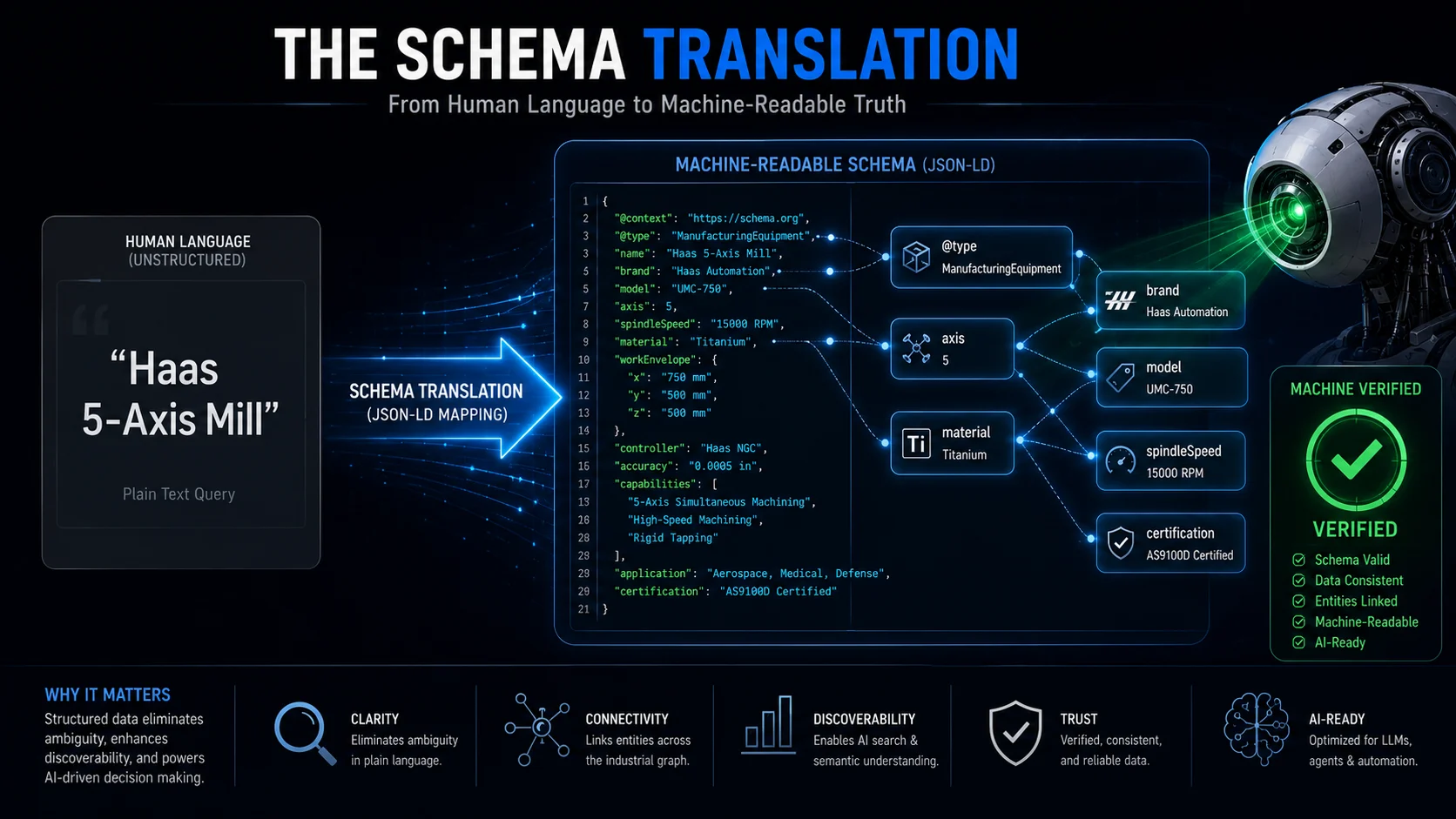
To capture Position Zero in AI search results, you must speak the language of the algorithms. That language is not English; it is JSON-LD (JavaScript Object Notation for Linked Data).
3.1 Technical Schema: The Engine of AEO
The backbone of AEO for Manufacturers is Schema.org microdata. Schema is backend code that explicitly defines the elements on your website.
Without schema, an AI crawler looks at the text “Haas UMC-750” and has to guess contextually if it is a product you sell, a machine you own, or a random string of text. With AEO for Manufacturers, you wrap that text in technical schema. The code explicitly tells the AI: "@type": "ManufacturingEquipment", "name": "Haas UMC-750", "capability": "5-axis milling".
3.2 Structuring the Industrial Portfolio
To dominate AEO for Manufacturers, your B2B Industrial UX must categorize and structure every asset on your shop floor:
-
Material Capabilities: Do not just list “Steel.” Use schema to define explicit grades, such as 316L Stainless Steel with Material Test Reports (MTRs).
-
Compliance & Certifications: Wrap your ISO 9001:2015, ITAR, or AS9100D credentials in verifiable schema tags.
-
Dimensional Capacities: Define your maximum turning diameters and X/Y/Z milling envelopes so AI agents can match them against a buyer’s exact component dimensions.
4. Curing Digital Rust for AI Crawlers
You cannot practice AEO for Manufacturers if your digital infrastructure is corroding. Digital Rust—the accumulation of obsolete code, slow load times, and inaccessible data—is fatal to AI crawling.
4.1 The PDF Penalty
The most common form of Digital Rust in heavy industry is the flattened PDF equipment list. Many shops upload a PDF of their machinery and assume buyers will read it. However, Answer Engines cannot reliably parse the unstructured text trapped inside a PDF.
AEO for Manufacturers demands the eradication of the PDF. Equipment lists must be built into dynamic, HTML-based data tables. These tables must be encoded with the technical schema discussed above. By transitioning data from static files into a fluid, web-native format, you instantly eliminate algorithmic Information Friction.
4.2 High-Velocity Agile Frameworks
Answer Engines prioritize up-to-date, rapidly loading sites. If your B2B website design relies on hard-coded legacy systems that take 5 seconds to load, the AI will penalize you. Elite AEO for Manufacturers utilizes agile, high-performance frameworks (like Elementor Pro on WordPress) to ensure lightning-fast server responses and dynamic data looping.
5. AEO and the Zero Friction RFQ
Traffic generated by AI search is useless if it does not convert. AEO for Manufacturers is only half of the equation; the other half is lead capture.
When an Answer Engine recommends your facility to a procurement officer, that buyer expects the frictionless experience to continue onto your website. If they arrive at your site and are forced to use a generic “Contact Us” form, the seamless AI experience shatters.
This is why AEO for Manufacturers must be inextricably linked to a Zero Friction RFQ engine.
5.1 Closing the Loop
Once the AI algorithm guides the high-intent buyer to your Technical Source of Truth, the Zero Friction RFQ allows them to seamlessly upload their native 3D CAD files (STEP/IGES) and define their GD&T requirements in a structured portal.
Because the RFQ engine forces the user to input structured data, it perfectly mirrors the structured backend of your AEO for Manufacturers framework. The algorithms read your precise capabilities, the buyer validates them, and the RFQ engine captures the precise engineering intent without a single drop of Information Friction.
6. Dominating Niche Semantic Clusters
The true power of AEO for Manufacturers lies in capturing high-margin, niche contracts. Aggregator platforms (like Xometry) dominate broad keywords like “custom CNC machining.” Independent shops cannot win a head-to-head budget war for those terms.
However, independent shops can dominate niche semantic clusters using AEO. Because AI models thrive on specificity, you can program your site to answer highly complex queries.
If you focus your AEO for Manufacturers strategy on hyper-specific entities—such as “multi-cavity plastic injection molding for Class II medical devices”—the AI will recognize your deep topical authority. While the aggregator platforms offer broad generalization, your site offers definitive, machine-readable proof of specialized competence.
7. Conclusion: The AI Mandate for 2026
In 2026, relying on traditional Industrial SEO is a guaranteed path to obscurity. Procurement officers are bypassing directories and blue links in favor of direct, AI-generated answers.
To secure your place in the future of the global supply chain, you must embrace AEO for Manufacturers. You must stop treating your website as an emotional marketing brochure and start programming it as an operational database.
By curing Digital Rust, deploying rigorous JSON-LD technical schema, and backing your traffic with a Zero Friction RFQ, you build a digital moat around your business. You provide exact answers to the machines, and frictionless experiences to the engineers. Adopt AEO for Manufacturers today, capture Position Zero, and establish your facility as the definitive Technical Source of Truth in your industry.
Frequently Asked Questions
1. What is AEO for Manufacturers?
Answer: AEO for Manufacturers (Answer Engine Optimization) is the specialized process of structuring a heavy industry website so that artificial intelligence search algorithms (like Google Gemini or Perplexity) can instantly comprehend, verify, and extract its technical data to answer complex procurement queries.
2. How does AEO differ from traditional Industrial SEO?
Answer: Traditional Industrial SEO focuses on optimizing for specific keywords to appear in a list of search engine links. AEO for Manufacturers focuses on structuring exact entities (like machinery types, tolerances, and certifications) using backend code so that AI can generate a direct, zero-click answer for the user.
3. Why do Answer Engines ignore PDF equipment lists?
Answer: Answer Engines struggle to reliably parse, structure, and index data trapped inside flattened PDF files. This creates Digital Rust. To practice effective AEO for Manufacturers, equipment lists must be converted into HTML data tables wrapped in JSON-LD schema.
4. What is JSON-LD Technical Schema in manufacturing?
Answer: JSON-LD is a type of backend code (Schema.org microdata) that explicitly tells search engines what a piece of text means. In AEO for Manufacturers, schema is used to categorize a word like “Titanium” explicitly as an available material grade, or “ISO 9001” explicitly as a verified facility certification.
5. How does AEO help independent machine shops beat aggregator platforms?
Answer: Aggregator platforms dominate broad keyword searches in traditional SEO. However, AEO for Manufacturers allows independent shops to dominate highly specific, niche queries. By providing deep, structured data on specialized capabilities (e.g., aerospace 5-axis milling), AI agents will bypass general aggregators to cite the specialized independent shop.
6. How does a Zero Friction RFQ relate to AEO?
Answer: While AEO for Manufacturers drives highly qualified AI search traffic to your site, a Zero Friction RFQ is the conversion mechanism that captures that traffic. It ensures that the frictionless experience provided by the Answer Engine continues natively on your site, allowing buyers to upload secure CAD files instantly.