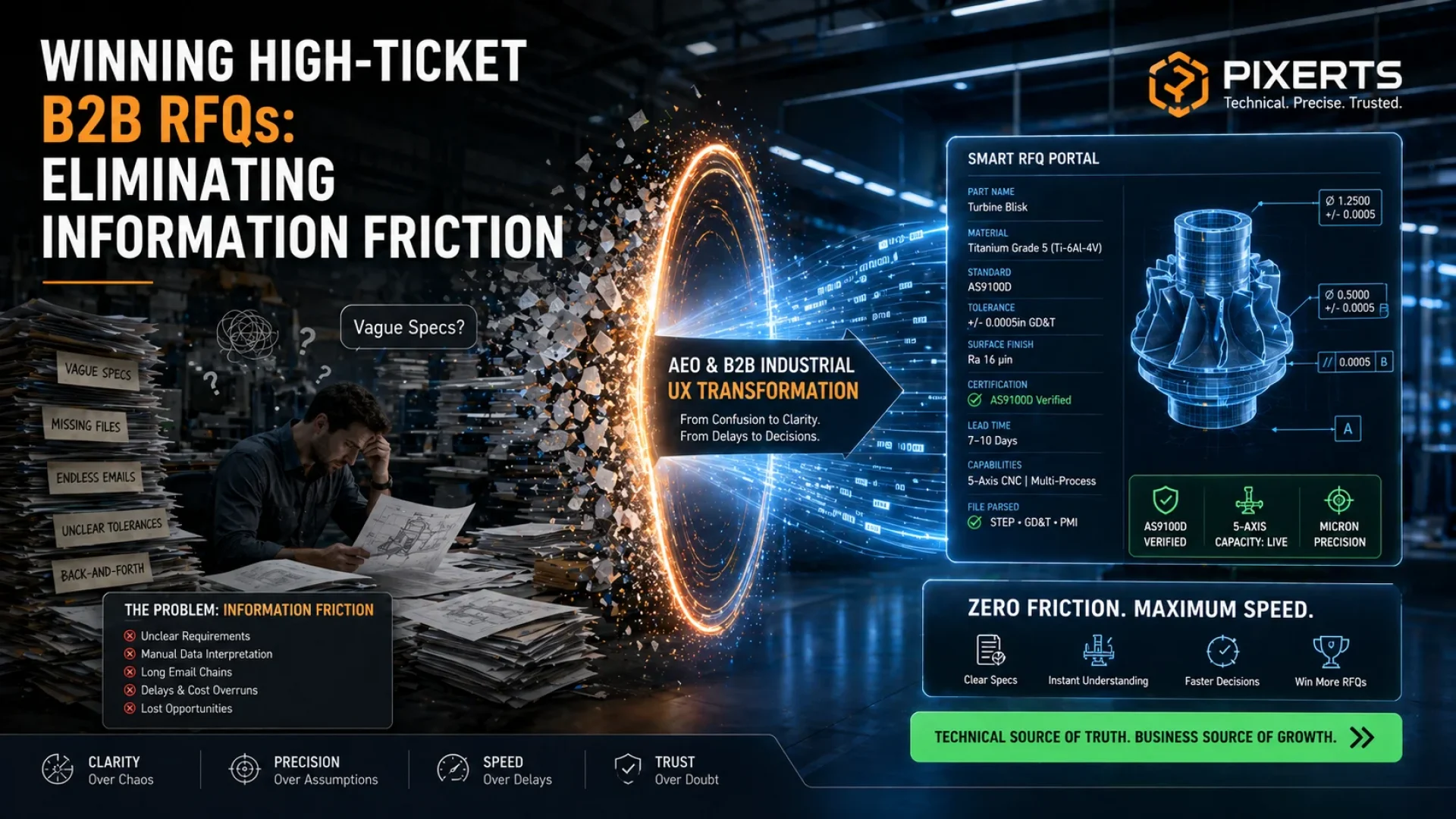
In B2B industrial procurement, Information Friction is the gap between a buyer’s technical intent and a manufacturer’s digital transparency. When procurement officers encounter vague material specifications, missing CAD integration, or outdated contact forms, they do not ask for clarification—they abandon the Request for Quote (RFQ).
To survive the shift toward Answer Engine Optimization (AEO) and AI-driven sourcing, manufacturers must eliminate “digital rust.” By transitioning from traditional B2B web design to specialized B2B Industrial UX, facilities can transform their digital presence into a verifiable Technical Source of Truth. This is the definitive guide to eradicating Information Friction and capturing high-ticket engineering contracts in 2026 and beyond.
1. Defining Information Friction in Heavy Industry
Information Friction is the cognitive and operational load placed on a technical buyer when attempting to extract exact specifications, capacities, or compliance data from a potential vendor.
In consumer eCommerce, friction is a slow-loading checkout button. In B2B industrial procurement, Information Friction is a missing AS9100D certification on an aerospace machining page. It is a material grade drop-down that says “Aluminum” instead of distinguishing between “6061-T6” and “7075.” It is the inability to verify if a shop’s 5-axis CNC mill has the spindle envelope required for a specific High-Mix Low-Volume (HMLV) run.
When an engineer or procurement officer experiences Information Friction, their internal risk assessment spikes. Procurement teams buy predictability and supply chain resilience. If your digital infrastructure forces them to guess about your capabilities, you are inadvertently signaling operational incompetence.
1.1 The Symptoms of Digital Rust
Information Friction is the direct byproduct of “digital rust.” Digital rust accumulates when a company treats its website as a static brochure rather than a dynamic engineering asset. Symptoms include:
- Flattened PDF equipment lists that cannot be crawled by search engines.
- “Contact Us” buttons that lead to generic email inboxes rather than structured routing.
- Lack of machine-readable specifications.
- Vague tolerance claims (e.g., “We hold tight tolerances”) instead of absolute geometric dimensioning and tolerancing (GD&T) data (e.g., “+/- 0.0005 inches”).
2. How Information Friction Kills $100k+ Contracts
To understand the devastating ROI impact of Information Friction, we must look at the modern buyer’s journey. Today’s procurement officers are digital-first. They conduct 70% to 80% of their vendor research before ever speaking to a sales representative.
2.1 The RFQ Abandonment Matrix
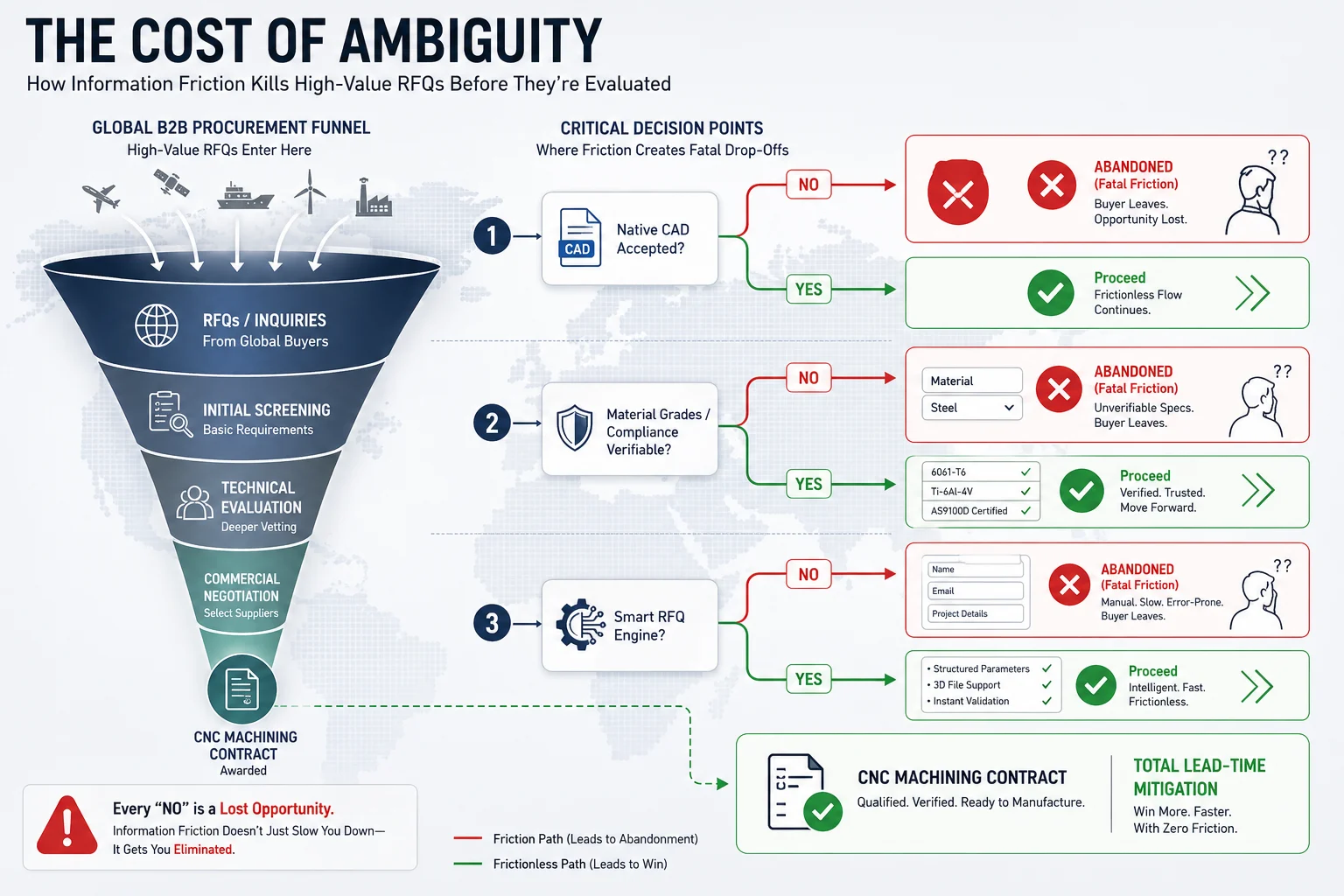
When a buyer holds a high-value Request for Quote (RFQ) for a complex assembly—such as a robotic palletizing cell or precision medical implants—they are actively looking for reasons to disqualify vendors and narrow their shortlist. Information Friction is the ultimate disqualifier.
If your facility requires the buyer to initiate an “Email Chain of Death” just to find out if you accept native STEP or IGES files, you have introduced massive Information Friction. The buyer will simply close your tab and award the contract to a facility with a zero-friction RFQ portal that accepts native CAD uploads and immediately parses their engineering intent.
2.2 The Risk of Ambiguity
In heavy industry, ambiguity is liability. If your B2B industrial web design fails to explicitly state your compliance protocols, material test report (MTR) availability, or First Article Inspection (FAI) processes, you are generating Information Friction. The buyer cannot assume you meet their regulatory standards; if the data isn’t instantly available, the answer is “no.”
3. Traditional B2B Web Design vs. B2B Industrial UX
A primary cause of Information Friction is the misapplication of consumer design trends to industrial applications. Many generalist agencies build websites focused on flashy aesthetics, aggressive animations, and emotional marketing copy.
3.1 Why Consumer Aesthetics Fail Procurement Officers
In the specialized world of CNC machining, robotics, and industrial manufacturing, “utility” is the highest form of beauty. A procurement officer does not want to watch a slow-loading parallax video of sparks flying; they want to see your live machine capacity, your ISO 9001:2015 certificate, and your exact material capabilities.
Traditional B2B industrial web design relies on telling a story. B2B Industrial UX (User Experience) relies on transferring data.
3.2 Designing for the Methodical Buyer
Eliminating Information Friction requires deep engineering empathy. B2B Industrial UX anticipates the exact questions a methodical buyer will ask and structures the interface to answer them instantly. This means designing high-contrast HTML data tables for spindle speeds, creating interactive capacity dashboards, and ensuring that complex technical workflows feel intuitive.
4. Answer Engine Optimization (AEO): The Antidote to Friction
The eradication of Information Friction is not just about human users; it is about the machines that those users rely on. In 2026, the search landscape has shifted drastically. Procurement officers are no longer sifting through ten pages of Google links. They are using AI search algorithms (like Google’s Gemini and Perplexity) to synthesize data and generate instant vendor shortlists.
This is where Answer Engine Optimization (AEO) becomes critical.
4.1 What is AEO for Manufacturers?
If Information Friction is the inability to find technical truths, AEO is the science of making those truths universally accessible. Answer Engine Optimization involves structuring your digital assets so that artificial intelligence can instantly comprehend, verify, and cite your capabilities.
When a buyer prompts an AI with, “Find a machine shop capable of 5-axis titanium milling with AS9100D certification for international export,” the AI scans the web for concrete data. If your website relies on vague marketing text, the AI experiences Information Friction and skips you.
4.2 The Power of Technical Schema
To eliminate AI-level Information Friction, you must deploy JSON-LD structured data. This translates your raw capabilities into machine-readable specifications. By wrapping your equipment lists, facility locations, and tolerance limits in Schema.org microdata, you remove all ambiguity.
This is particularly crucial for capturing international contracts. When bridging global supply chains—such as connecting Western procurement with Chinese manufacturing sectors—machine-readable data acts as a universal language. It bypasses translation errors and cultural marketing differences, providing pure, frictionless technical validation directly to the search algorithms.
5. Building Your Technical Source of Truth
To permanently cure Information Friction, your website must evolve. It can no longer act as a digital billboard; it must become a Technical Source of Truth.
A Technical Source of Truth is a centralized, highly structured digital environment that provides absolute clarity on your engineering capabilities, operational capacity, and regulatory compliance. It is the ultimate expression of zero-friction procurement.
5.1 Agile Infrastructure for Real-Time Accuracy
A Technical Source of Truth cannot be rigid. If you purchase a new CNC lathe or update an ISO certification, that data must be reflected online immediately to prevent Information Friction.
This requires agile digital infrastructure. Relying on sluggish, custom-coded websites creates an internal bottleneck. Instead, elite industrial platforms utilize high-performance page builders like Elementor Pro on WordPress. This allows internal teams to rapidly update specifications, deploy dynamic data loops, and inject fresh technical schema without waiting weeks for a developer. The result is a digital presence that perfectly mirrors the physical reality of the shop floor.
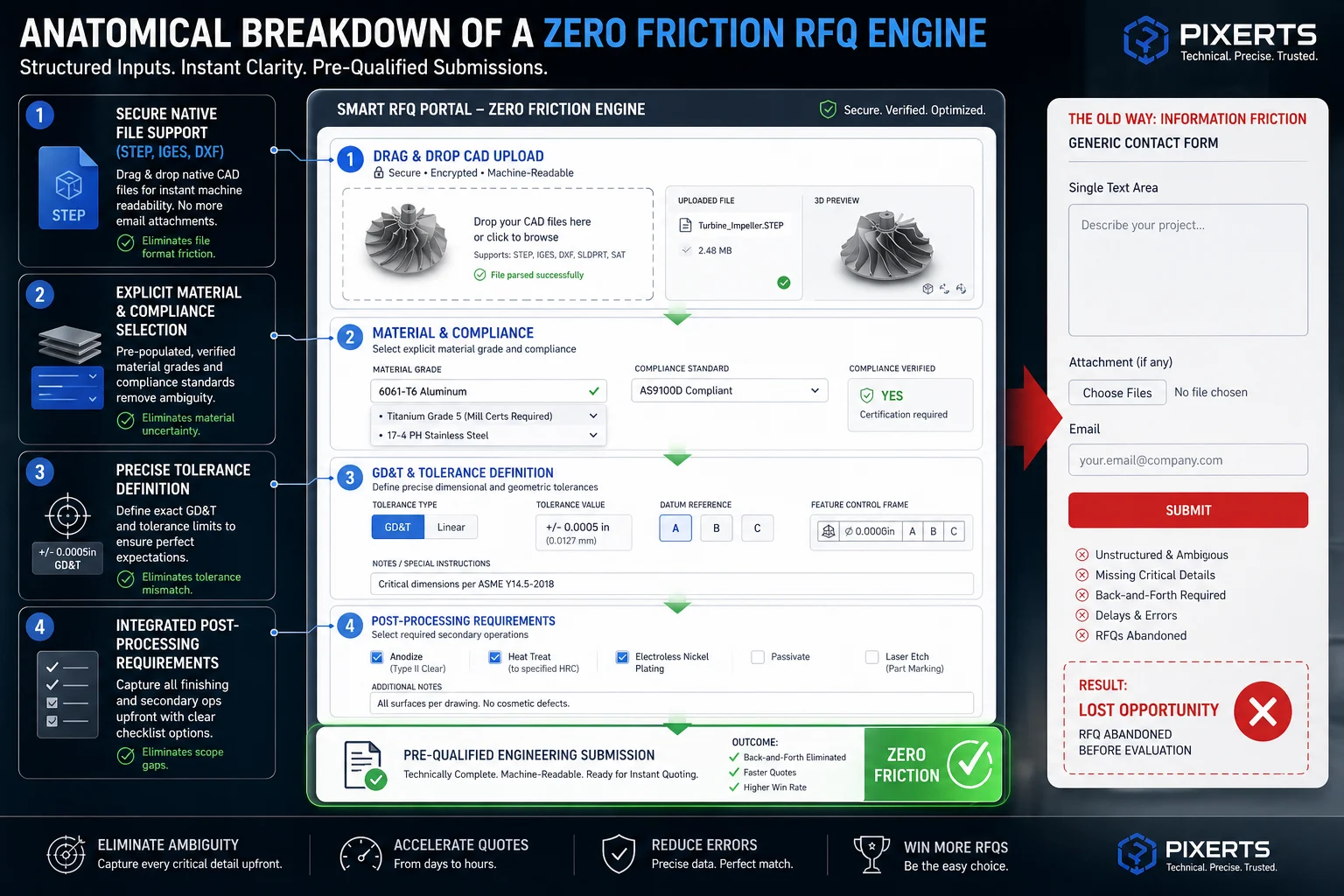
5.2 The Zero Friction RFQ Engine
The cornerstone of a Technical Source of Truth is the RFQ process. To eliminate Information Friction at the point of conversion, you must replace the standard “Contact Us” form with a Smart Request for Quote (RFQ) engine.
A Zero Friction RFQ engine allows an engineer to:
- Upload Native Files: Securely attach 3D STEP, IGES, and DXF files, bypassing the need to compress or convert highly detailed models.
- Define Absolute Parameters: Utilize dynamic dropdowns to select exact material grades (e.g., 316L Stainless Steel with Mill Certs) rather than typing into an ambiguous text box.
- Specify Post-Processing: Clearly indicate requirements for anodizing, heat treating, or specialized coatings.
By structuring the RFQ process, you eliminate the friction of back-and-forth emails, capture high-intent leads instantly, and feed structured data directly into your sales engineering pipeline.
6. The ROI of Eradicating Information Friction
The business case for eliminating Information Friction through advanced B2B industrial web design is undeniable. It directly impacts your bottom line by attacking inefficiencies in the sales cycle.
6.1 Lead-Time Mitigation and Faster Sales Cycles
Information Friction artificially inflates your lead times. Every day spent clarifying a poorly submitted RFQ or explaining your capabilities to an unqualified lead is a day lost. By acting as a Technical Source of Truth, you pre-qualify buyers. When they finally do contact your sales team, the conversation skips the introductory phase and moves directly to pricing and logistics.
6.2 Dominating the High-Ticket Market
Aggregator platforms (like Xometry) have captured massive market share simply because they built frictionless, user-friendly interfaces. To win back high-margin, complex engineering contracts, individual manufacturers must offer an even better, more specialized experience.
When you eliminate Information Friction, you project operational excellence. You signal to global procurement officers that you possess the sophistication to handle their most critical, high-risk components. You move out of the commodity pricing war and start competing on reliability, transparency, and technical validation.
7. Conclusion: The Zero Friction Mandate
In the modern landscape of B2B industrial procurement, friction is fatal. Your digital presence is no longer just a marketing tool; it is the first stage of your manufacturing process. If that stage is clogged with digital rust, missing data, and poor UX, the entire pipeline suffers.
The mandate for industrial growth is clear: You must eradicate Information Friction.
You do this by abandoning consumer aesthetics in favor of methodical B2B Industrial UX. You do this by optimizing for Answer Engines through rigorous technical schema. You do this by deploying agile frameworks that allow your website to act as a living, breathing Technical Source of Truth.
The manufacturers who embrace this zero-friction philosophy will secure the largest contracts, capture international market share, and dictate the future of global supply chain resilience. Those who ignore it will be quietly abandoned by the algorithms and the engineers who use them.
Frequently Asked Questions (FAQ)
- What is Information Friction in B2B industrial procurement?
Answer: Information Friction is the cognitive and operational load placed on a technical buyer when attempting to extract exact specifications, capacities, or compliance data from a potential vendor. It occurs when digital infrastructure forces an engineer to guess about manufacturing capabilities rather than providing instant verification.
- How does Information Friction impact RFQ abandonment?
Answer: Information Friction directly spikes RFQ abandonment rates. When a procurement officer holds a high-value contract and encounters ambiguous tolerances or cannot securely upload native CAD files (STEP/IGES), they will abandon the site rather than initiate a lengthy email chain to clarify capabilities.
- What is the difference between traditional B2B web design and B2B Industrial UX?
Answer: Traditional B2B web design often misapplies consumer trends, focusing on emotional marketing copy and flashy aesthetics. B2B Industrial UX focuses purely on frictionless data transfer. It anticipates the exact questions a methodical engineer will ask and structures the interface—using data tables and dynamic capacity dashboards—to answer them instantly.
- Why is Answer Engine Optimization (AEO) the antidote to Information Friction?
Answer: AEO is the science of making technical truths universally accessible to AI search algorithms. By structuring capabilities into machine-readable specifications via JSON-LD schema, AEO ensures that when procurement teams use AI to source vendors, your facility is cited instantly, eliminating AI-level Information Friction.
- What is a Technical Source of Truth in manufacturing?
Answer: A Technical Source of Truth is a centralized, agile digital environment that provides absolute clarity on a manufacturer’s engineering capabilities, operational capacity, and regulatory compliance (like ISO 9001). It replaces static PDF brochures with instantly verifiable, dynamic data.
- What defines a Zero Friction RFQ process?
Answer: A Zero Friction RFQ process replaces standard “Contact Us” forms with a smart engine that allows engineers to securely upload native 3D files, select exact material grades from dynamic dropdowns, and specify post-processing requirements, entirely eliminating the “email chain of death” regarding capabilities.
- Why do standard instant quoting widgets cause Information Friction in heavy industry?
Answer: Standard instant quoting widgets are built for simple, low-stakes parts. For complex, High-Mix Low-Volume (HMLV) components requiring rigorous Design for Manufacturability (DFM) reviews and First Article Inspection (FAI) reports, algorithmic quoting is often inaccurate, creating friction by setting false pricing and timeline expectations.