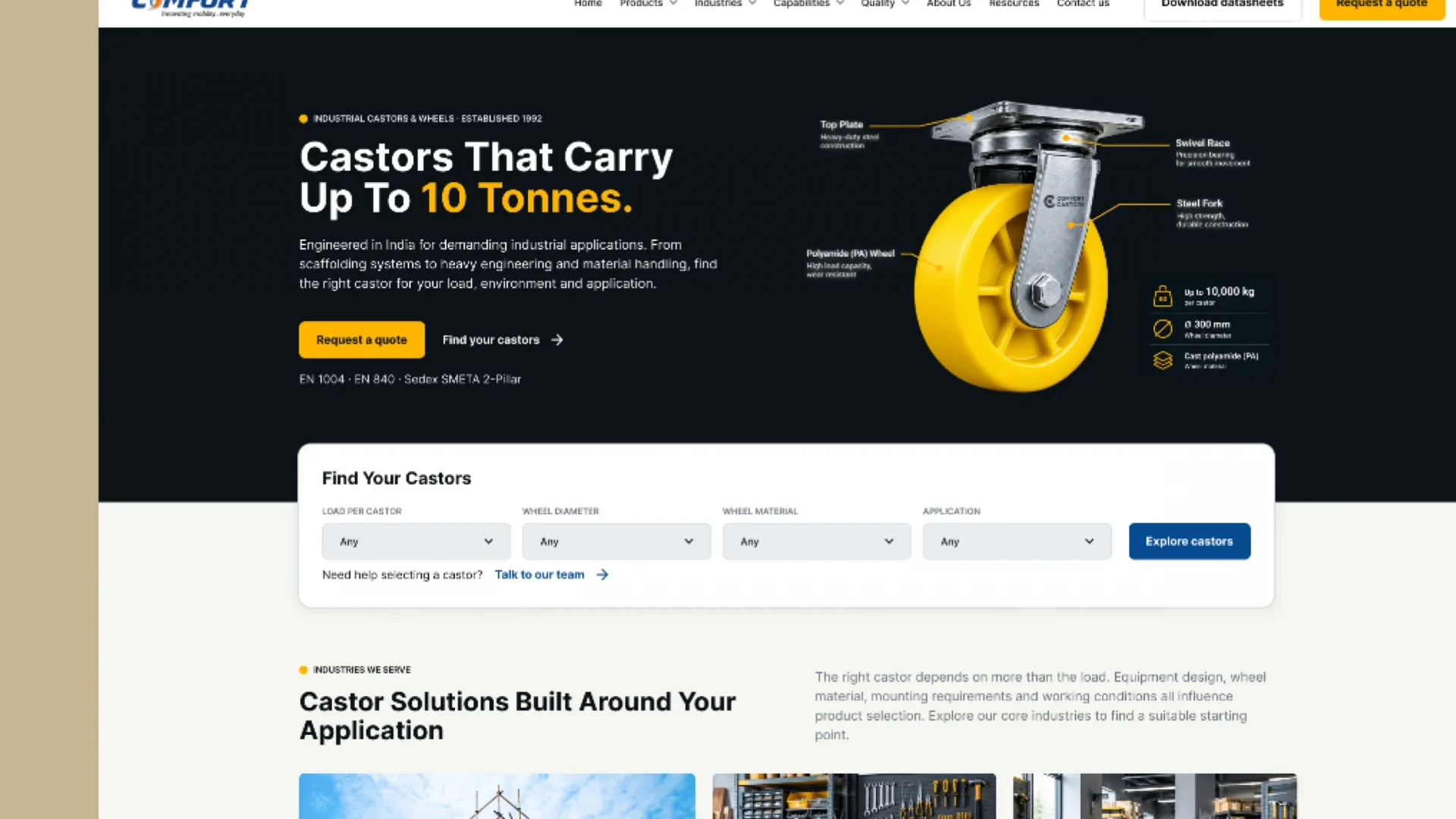

Choosing a marketing agency is an important decision for a manufacturing business. The right partner can help potential customers understand your capabilities, discover your products, evaluate your company, and take the next step toward working with you. The wrong partner can spend your budget on activities that look productive without addressing the reasons qualified buyers are not getting in touch.
Manufacturing marketing is not simply a matter of publishing more content, redesigning a website, or running advertising campaigns. Industrial companies often need to communicate complex products, specialized processes, technical specifications, certifications, and application-specific advantages to several people involved in a purchasing decision.
That makes the agency selection process particularly important.
The best partner is not necessarily the agency with the biggest portfolio, the longest service list, or the lowest price. It is the one that understands your commercial goals, can translate your technical capabilities into useful marketing, and can explain how its work will be delivered and evaluated.
This guide explains how to choose a manufacturing marketing agency, what to evaluate before signing a contract, which questions to ask, and how to recognize warning signs before committing your budget.
Quick answer: How do you choose a manufacturing marketing agency?
Start by defining your business goals and identifying the marketing problems you need to solve. Then evaluate agencies based on their understanding of manufacturing, relevant project experience, strategic thinking, technical capabilities, communication process, measurement approach, and proposed scope.
Before signing a contract, review relevant case studies, ask how results will be measured, clarify deliverables and ownership, and compare proposals on value rather than price alone.
A suitable agency should be able to explain not only what it will do, but why that work is appropriate for your business.
1. Understand what you need from a marketing agency
Before comparing agencies, clarify what is preventing your business from reaching its marketing goals.
A manufacturer with an outdated website may have a very different problem from one with a strong website that receives little organic traffic. A company receiving plenty of enquiries may need to improve lead quality rather than increase enquiry volume.
Start by examining your current situation.
Your website does not communicate your capabilities clearly
Potential customers may struggle to understand what you manufacture, which industries you serve, what equipment or processes you offer, or what differentiates your company from other suppliers.
In this situation, website strategy, information architecture, messaging, and UX/UI design may be more important than immediately investing in advertising.
Your website attracts visitors but produces few enquiries
The problem may be unclear calls to action, weak technical content, missing trust signals, difficult navigation, or an enquiry process that asks too much of the visitor.
A focused website audit and conversion review can help identify the obstacles before you invest in a larger redesign.
Your business struggles to appear in relevant searches
Your potential customers may search for particular manufacturing processes, component types, materials, applications, certifications, or supplier capabilities without finding your website.
This may call for technical SEO, keyword and page planning, useful content, and improvements to the way your products and services are organized online.
Your advertising attracts the wrong leads
Campaigns can generate clicks from people who do not match your target market. A manufacturer selling specialized components, for example, may need to filter out irrelevant searches and send visitors to pages that address specific industrial requirements.
Paid search management should therefore be connected to search intent, landing-page relevance, and meaningful conversion tracking.
You do not know which marketing activities deserve investment
Sometimes the problem is not one specific channel. It is a lack of clear priorities, reliable reporting, or a consistent connection between marketing activity and sales outcomes.
An agency should help you decide what to do first rather than automatically recommend every service it offers.
2. Look for genuine manufacturing and industrial B2B experience
A general marketing agency can have excellent creative skills and still struggle to communicate an industrial business effectively.
Manufacturing companies often sell products or services that require technical understanding. Their buyers may need to evaluate production capabilities, tolerances, materials, applications, quality processes, delivery requirements, and supplier reliability before requesting a quote.
Your agency does not necessarily need to manufacture products itself. However, it should demonstrate that it can learn your business, ask informed questions, and communicate technical information accurately.
What to look for
Ask whether the agency has worked with businesses such as:
- CNC machining and precision engineering companies.
- Metal fabrication and component manufacturers.
- Industrial machinery and equipment suppliers.
- Automation and engineering businesses.
- Injection molding, plastics, and materials manufacturers.
- Construction product and industrial equipment companies.
Relevant experience is useful because it may reveal familiarity with capability pages, technical specifications, manufacturing terminology, supplier evaluation, and industrial buyer journeys.
However, the industry label alone is not enough. A beautiful website for a manufacturing company does not automatically prove that the agency understands your specific audience or commercial problem.
Review the actual work. Look at how the company presents its capabilities, explains its processes, handles technical details, and helps visitors move toward an enquiry.
Ask the agency to explain one relevant project
Rather than asking only, “Have you worked with manufacturers?”, ask the agency to walk you through a project.
Useful questions include:
- What problem was the client trying to solve?
- What did you learn about the client’s buyers?
- How did that research influence the website or marketing strategy?
- What did you personally deliver?
- How did you evaluate the result?
- What would you approach differently today?
The answers should demonstrate thinking, not just visual presentation.
3. Evaluate strategic thinking before buying individual services
A manufacturing marketing agency should understand the business objective before recommending specific deliverables.
Suppose a precision machining company wants to generate more qualified RFQs. An agency might immediately recommend SEO, Google Ads, a website redesign, or more content.
Each could be appropriate, but none should be selected automatically.
The first questions should be about the company’s target applications, preferred customers, current enquiry sources, existing website, competitive position, and the quality of its incoming leads.
A useful strategy connects the business objective to the marketing work.
| Business challenge | Potential starting point |
|---|---|
| Buyers cannot understand the company’s capabilities | Positioning, messaging, and website UX/UI |
| Important capability pages receive little relevant traffic | Search-intent analysis, technical SEO, and content improvements |
| Advertising attracts unqualified enquiries | Campaign targeting, negative keywords, landing-page relevance, and qualification |
| Visitors struggle to request a quote | Conversion-path review, form improvements, and clearer calls to action |
| Technical products are difficult to explain | Better product content, diagrams, photography, or 3D visuals |
| Several channels operate without clear priorities | A joined-up strategy and measurement framework |
This is a starting framework, not a universal prescription. The right recommendation depends on the evidence available for your business.
A useful test: ask the agency to explain why it recommends a particular service, what it expects that work to improve, and how you will know whether the work is helping.
4. Assess the agency’s core capabilities
Manufacturing marketing can involve several disciplines, and not every company needs all of them at once.
Evaluate the services relevant to your goals rather than judging agencies solely by the length of their service lists.
Website strategy and UX/UI design
Your website should help different buying roles find relevant information without forcing everyone through the same journey.
Look for expertise in information architecture, navigation, capability pages, industry pages, technical content structure, and enquiry paths.
A strong manufacturing website should make it straightforward to understand what the business offers, which applications it supports, and how to start a conversation.
Website development
Design is only one part of a successful website. The implementation should also support performance, accessibility, maintainability, analytics, and the functionality your business needs.
Ask how the agency handles content management, integrations, forms, testing, redirects, backups, and website handover.
Clarify who owns the website, its code, design files, licences, and accounts after the project is complete.
Search engine optimization and answer-focused content
Manufacturing SEO should begin with the language and questions potential customers use when researching suppliers.
Relevant topics may include products, applications, materials, manufacturing processes, equipment, standards, and industry-specific requirements.
The agency should explain how it will prioritize pages, assess technical SEO, improve internal linking, and create useful content. Ask how it will report meaningful progress without promising guaranteed rankings.
Answer-focused content can help make technical information easier to understand for both people and search systems. It should be based on accurate information and genuine expertise rather than generic text created simply to target keywords.
Paid search and Google Ads
Paid campaigns can be useful when your company wants to appear for relevant, high-intent searches.
Ask the agency how it will structure campaigns, select keywords, exclude irrelevant searches, control geographic targeting, align ads with landing pages, and measure conversions.
You should also clarify whether the agency fee includes media spend. In many engagements, management fees and advertising spend are separate costs.
Technical content and industrial visuals
Some products and manufacturing processes are difficult to explain through text alone.
Product photography, diagrams, technical illustrations, process videos, and 3D animations may help potential customers understand how a component works or why a particular capability matters.
The right agency will recommend visual assets based on the communication problem, audience, and intended use—not because every project needs animation.
5. Examine case studies, not just portfolio screenshots
A portfolio shows what an agency can create. A useful case study explains why the work was done and what happened afterward.
When evaluating manufacturing marketing agencies, look for case studies that cover the business context, the challenge, the agency’s contribution, and the outcomes.
For a website project, relevant evidence might include clearer information architecture, improved capability-page coverage, a more useful RFQ journey, or verified improvements in relevant conversion activity.
For an SEO engagement, the evidence might include better visibility for relevant searches, more qualified organic traffic, or increased enquiries from the intended market.
For paid search, it could include conversion tracking quality, lead relevance, and the relationship between campaign spend and meaningful enquiries.
Ask how results were measured
A statement such as “traffic increased” is not enough to understand whether the project succeeded.
Useful follow-up questions include:
- What was the starting point?
- What time period was measured?
- Did the metric describe all traffic or a relevant segment?
- Were enquiries qualified by the sales team?
- Did the measurement method change during the project?
- Which results were directly influenced by the work, and which had other contributing factors?
Not every project will have a perfect set of before-and-after metrics. A new website may have limited historical data, and some outcomes take time to materialize.
A trustworthy agency will distinguish verified results from expectations, estimates, and strategic goals.
6. Understand the agency’s measurement and reporting approach
Manufacturing marketing often involves a longer sales cycle than a simple online purchase. A visitor might research suppliers, revisit the website, request specifications, consult colleagues, and submit an RFQ much later.
That means marketing performance should not be judged exclusively by immediate sales or website traffic.
Ask the agency to define the metrics that matter at each stage.
| Stage | Useful measurements |
|---|---|
| Discovery | Relevant organic impressions, qualified traffic, relevant search visibility |
| Evaluation | Capability-page engagement, technical-content use, return visits where measurable |
| Enquiry | RFQs, contact submissions, calls, and relevant conversion actions |
| Qualification | Sales-accepted leads, fit with target applications, or fit with target accounts |
| Commercial progression | Quotes issued, opportunities created, and eventual sales where the CRM supports attribution |
Not every business needs every metric. Select indicators that align with your sales process and can be measured consistently.
Ask how website analytics, ad platforms, CRM records, and sales feedback will be used together. Also clarify what the agency can measure directly and what requires cooperation from your sales or operations team.
An agency should be honest about attribution limits. It should not claim that every sale can be attributed precisely to a single marketing activity.
7. Compare proposals by scope and value—not price alone
Once you have shortlisted agencies, review proposals side by side.
One agency may quote a lower amount but exclude research, content migration, technical SEO, analytics setup, or ongoing support. Another may charge more because it includes strategy, user experience work, detailed content planning, development, testing, and handover.
Neither price is meaningful without understanding what is included.
Compare proposals using the following criteria:
| Evaluation area | What to confirm |
|---|---|
| Objectives | Are the business goals and priorities clear? |
| Scope | Are deliverables specific and measurable? |
| Responsibilities | Who supplies technical content, approvals, images, and access? |
| Schedule | Are milestones, review rounds, and dependencies documented? |
| Measurement | Are tracking, reporting, and success criteria defined? |
| Ownership | Who owns designs, code, accounts, and content? |
| Exclusions | What is not included in the quoted investment? |
| Support | What happens after launch or during ongoing work? |
For ongoing marketing, also ask about minimum commitment periods, notice terms, media spend, production costs, and how priorities can change when the data suggests a different approach.
A useful proposal should help you make a decision. It should not leave you guessing about what the quoted price actually buys.
8. Evaluate communication and technical collaboration
Manufacturing marketing often requires input from people who understand different parts of the business.
The marketing contact may understand the business objectives, an engineer may need to verify technical claims, and sales staff may know why some RFQs qualify while others do not.
Your agency needs a practical way to collaborate with these people without turning every decision into a lengthy process.
Ask who your main contact will be, how often you will meet, how feedback will be collected, and who is responsible for approvals.
Clarify how the agency handles incomplete information and technical uncertainty. It should know when to ask your team for confirmation instead of guessing about a process, specification, or certification.
Communication quality is especially important when a project includes website development, technical copy, advertising, and several review stages.
9. Watch for these red flags
Not every warning sign means an agency is unsuitable, but several should prompt further questions.
Guaranteed rankings or lead volumes
Search rankings, enquiries, and sales depend on factors beyond an agency’s direct control. Be cautious of guarantees that are not supported by clear assumptions and a credible measurement plan.
Generic strategies for every client
Manufacturers in different sectors can have different buyers, sales cycles, markets, and technical requirements. A strategy should reflect those differences.
Impressive claims with no evidence
Ask for context behind claimed results. Be wary of anonymous statistics that cannot be explained or verified.
Reporting focused only on vanity metrics
Impressions, clicks, followers, and raw traffic can be useful diagnostic signals, but they are not sufficient on their own. Ask how the agency connects activity to relevant enquiries and sales opportunities.
Unclear ownership or access
Your business should understand who controls its website, hosting, domain, analytics, advertising accounts, and design assets. Avoid arrangements that make you unnecessarily dependent on one provider for access to your own business assets.
No clear exclusions or responsibilities
If the proposal doesn’t explain what your team must supply, how revisions work, or what happens when requirements change, clarify those points before signing.
Pressure to buy everything immediately
A credible agency should be able to discuss priorities. It may recommend several connected services, but it should explain which are essential now and which can wait.
10. Questions to ask before hiring a manufacturing marketing agency
Use this checklist during your discovery calls.
Industry understanding
- How would you learn about our products, applications, and target buyers?
- Which similar industrial or manufacturing projects have you completed?
- How would you account for our technical content and sales process?
Strategy and execution
- What would you investigate before recommending services?
- Which activities would you prioritize first, and why?
- How would our website, SEO, advertising, and content support each other?
Measurement
- What would you measure during the first 90 days?
- How would you distinguish relevant enquiries from unqualified submissions?
- What access or information would you need from our sales team?
Commercial terms
- What exactly is included in the proposal?
- What additional costs might arise?
- Who owns the website, creative assets, accounts, and content?
- What happens if we need to change direction?
Communication
- Who will manage the engagement?
- What will the approval and feedback process look like?
- How often will we review work and results?
The quality of the answers matters more than whether the agency uses all the right terminology.
11. A practical scorecard for comparing agencies
After speaking with several providers, use a simple scorecard to reduce the influence of personal preference.
Rate each agency from 1 to 5 against the following criteria:
| Criterion | Suggested weight |
|---|---|
| Understanding of manufacturing and industrial B2B | 20% |
| Strategy and clarity of recommendations | 20% |
| Relevant case studies and evidence | 15% |
| Quality of proposed scope and deliverables | 15% |
| Measurement and reporting approach | 10% |
| Communication and collaboration | 10% |
| Pricing transparency and commercial terms | 10% |
Multiply each rating by its weight and compare the resulting scores.
The score is not an objective verdict on agency quality. It is a decision aid. If one agency scores highly but has a major weakness in ownership terms or technical understanding, investigate that weakness before proceeding.
You should also consider whether the proposed partner is suited to your company’s current stage. A small manufacturer that needs a focused website improvement may not need the same engagement model as an established supplier preparing for international expansion.
12. What should happen after you choose an agency?
Once you have selected an agency, the first stage should align everyone around the business problem and what success means.
Provide the agency with information about your products, target markets, best-fit customers, sales process, competitors, current website, and known marketing challenges.
Where possible, share examples of good and poor enquiries, common customer questions, important technical documents, and the capabilities you most want to promote.
Agree on the scope, responsibilities, schedule, review process, tracking requirements, and reporting method before execution begins.
For an ongoing engagement, establish a review rhythm so the team can use new information to improve priorities. For a fixed-scope project, agree on acceptance criteria and handover requirements.
The goal is not simply to finish a marketing deliverable. It is to ensure that the work has a clear role in helping the business communicate, attract, and convert relevant buyers.
Frequently asked questions
Q: What does a manufacturing marketing agency do?
A: A manufacturing marketing agency helps industrial and manufacturing businesses communicate their capabilities, reach relevant audiences, and improve how potential customers move from discovery to enquiry. Services may include website design and development, search optimization, technical content, paid advertising, and industrial visuals.
Q: How much does a manufacturing marketing agency cost?
A: Pricing depends on the scope, complexity, required expertise, number of channels, content requirements, and duration of the engagement. Website projects are commonly priced separately from ongoing marketing retainers. Compare deliverables, exclusions, and ownership terms rather than selecting a provider on price alone.
Q: Should a manufacturer choose a specialist agency or a general marketing agency?
A: A specialist may already understand industrial buyer journeys and technical website requirements. A generalist may still be a good fit if it demonstrates strong research, sector learning, relevant experience, and a credible plan for your particular business. Evaluate the actual team and approach rather than relying solely on the agency’s label.
Q: How long does it take to see marketing results?
A: It depends on the work. Website improvements can make information and enquiry paths clearer after launch, while organic search visibility generally requires ongoing work. Paid advertising can produce early campaign data, but lead quality and commercial outcomes still need evaluation. No single timeline applies to every manufacturer.
Q: Should we hire an agency for all marketing services?
A: Not necessarily. Some manufacturers need a stronger website foundation before investing heavily in traffic acquisition. Others may already have a capable website and need more relevant search visibility or better advertising performance. Choose services based on evidence and priorities.
Q: What should a manufacturing marketing proposal include?
A: It should define the business objectives, recommended approach, deliverables, responsibilities, timeline, investment, exclusions, reporting, ownership, and support arrangements. For ongoing work, it should also describe how priorities will be reviewed and adjusted.
Final thoughts
Choosing a manufacturing marketing agency is less about finding the provider with the most services and more about identifying a partner that can understand your business and help solve the right problem.
Look for industrial understanding, useful strategic thinking, transparent scope, relevant proof, sound measurement, and a practical working relationship. Ask difficult questions before you commit, and make sure you know what you are buying.
The strongest partnership is one where the agency can explain why a particular activity matters, how it supports your commercial goals, and what evidence will help determine the next step.
Looking for a more connected approach to manufacturing marketing?
Explore Pixerts’ manufacturing marketing services to see how website strategy, UX/UI, development, industrial SEO/AEO, Google Ads, and technical visuals can work together around your business goals.