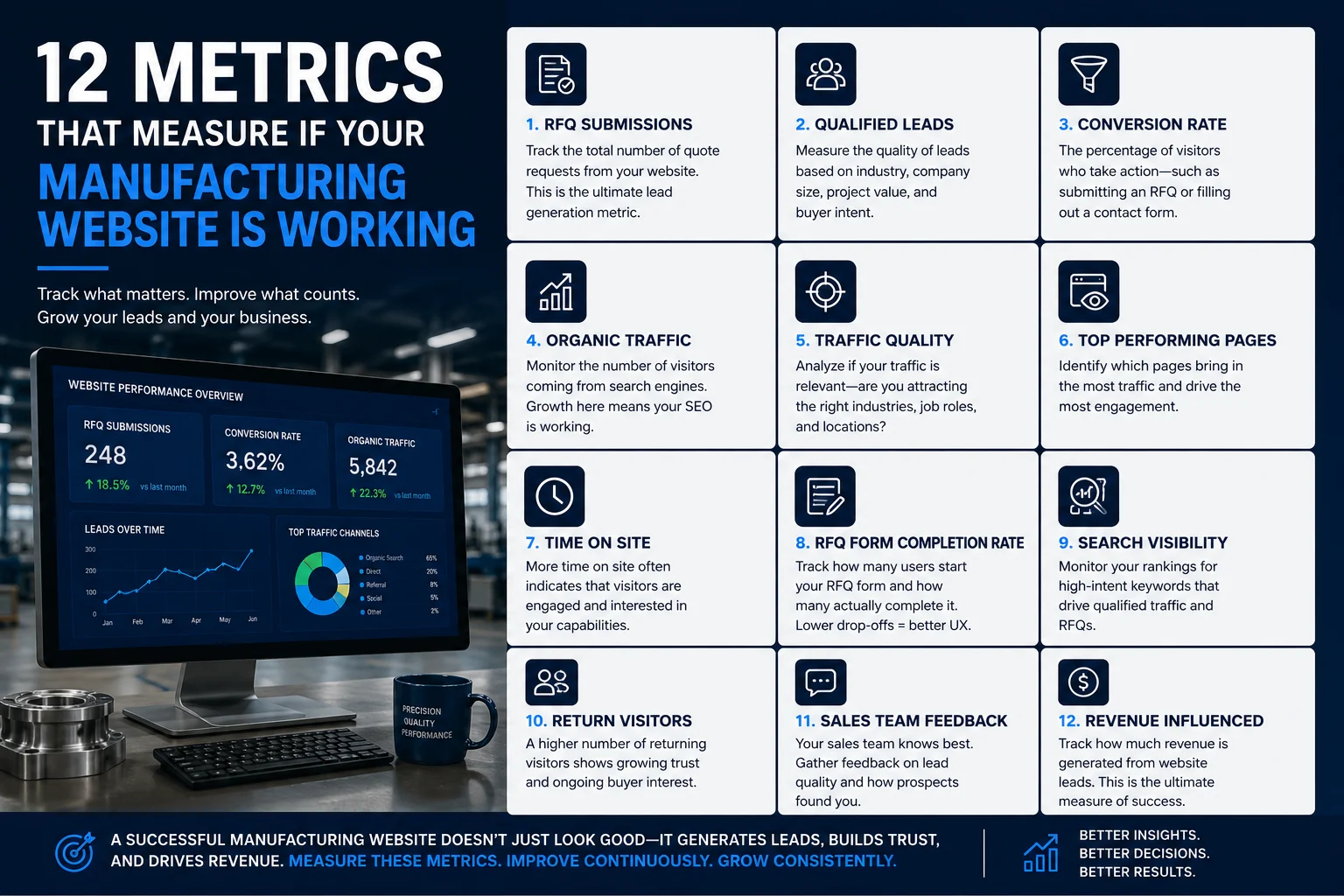
How Do I Measure If My Manufacturing Website Is Working?
Many manufacturing companies invest thousands of dollars into a website redesign and then ask the same question months later:
“How do we know if it’s actually working?”
The answer is simple:
A manufacturing website should be measured by business outcomes, not just aesthetics.
A website may look modern and professional, but if it isn’t generating RFQs, attracting qualified buyers, or supporting sales growth, it may not be delivering value.
In this guide, we’ll explore the key metrics manufacturers should track to determine whether their website is contributing to business growth.
The Biggest Mistake Manufacturers Make
Many companies evaluate their website based on:
- Design preferences
- Internal opinions
- Number of pages
- Visual appearance
While these factors matter, they don’t tell you whether the website is producing results.
A successful manufacturing website should help buyers:
- Find your company
- Understand your capabilities
- Trust your expertise
- Request a quote
- Contact your sales team
The metrics below reveal whether that’s happening.
1. RFQ Submissions
For most manufacturers, RFQs are the most important source of website conversions.
Track:
- Total RFQ submissions
- Monthly RFQ growth
- RFQ source channels
- Qualified vs unqualified RFQs
If your website isn’t generating quote requests, it may have issues with messaging, UX, or visibility.
Healthy Benchmark
A growing manufacturing website should show a consistent increase in RFQs over time.
2. Qualified Leads
Not every lead is valuable.
A better question is:
Are the right companies contacting you?
Track:
- Company size
- Industry relevance
- Project value
- Buyer intent
Ten qualified RFQs are often more valuable than one hundred low-quality inquiries.
3. Website Conversion Rate
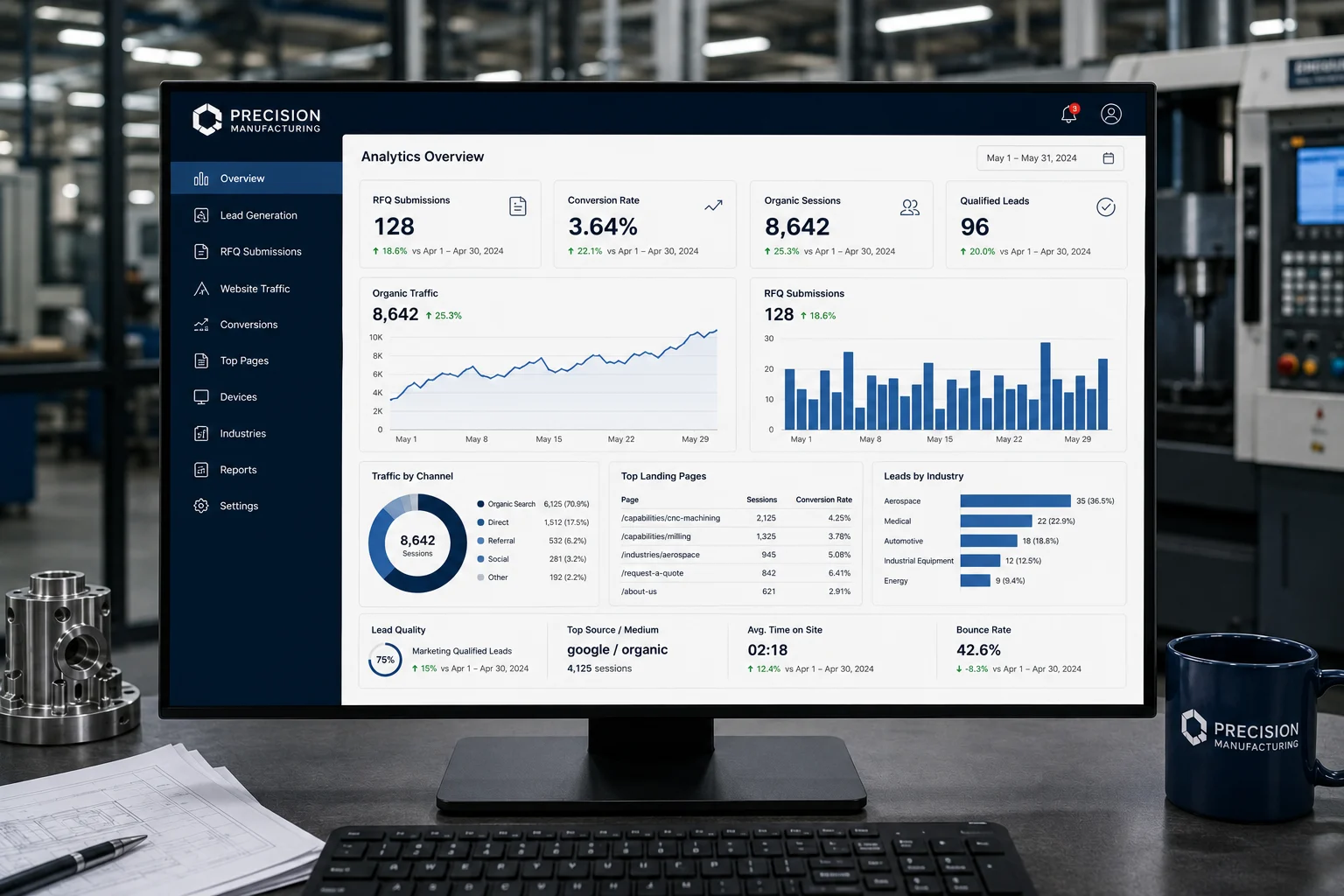
Conversion rate measures how many visitors take a desired action.
Formula:
Conversions ÷ Visitors × 100Examples of conversions:
- RFQ submissions
- Contact forms
- Consultation requests
- Capability statement downloads
Typical Manufacturing Website Conversion Rate
Many industrial websites convert between 1% and 5%.
Well-optimized websites often perform significantly better.
4. Organic Search Traffic
Organic traffic refers to the number of visitors who arrive through search engines.
If your SEO strategy is working, you should see growth in:
- Organic sessions
- Keyword rankings
- Search visibility
- New visitors
Increasing traffic indicates more buyers are discovering your company online.
5. Traffic Quality
Traffic alone doesn’t guarantee success.
A manufacturing website that receives thousands of irrelevant visitors may generate fewer leads than a website that attracts highly targeted buyers.
Analyze:
- Industry-specific traffic
- Geographic relevance
- Visitor intent
- [rank_math _ related_posts]Engagement levels
Quality always beats quantity.
6. Top Performing Pages
Review which pages attract the most visitors.
Common high-performing pages include:
- Capability pages
- Industry pages
- Equipment pages
- Case studies
- RFQ pages
Understanding popular content helps identify what buyers value most.
7. Time on Site
When buyers spend time exploring your content, it often signals interest.
Higher engagement typically suggests visitors are:
- Researching capabilities
- Comparing suppliers
- Evaluating expertise
Although time on site isn’t a direct ranking factor, it can indicate content quality.
8. RFQ Form Completion Rate
Many manufacturers focus only on form submissions.
However, it’s equally important to understand how many users abandon the process.
Track:
- Form starts
- Form completions
- Drop-off points
If abandonment rates are high, your RFQ form may be too complicated.
9. Search Visibility for High-Intent Keywords
Manufacturers should monitor rankings for keywords such as:
- CNC machining services
- precision manufacturing
- sheet metal fabrication
- injection molding services
- industrial automation solutions
Higher visibility often leads to increased lead opportunities.
10. Return Visitors
B2B manufacturing purchases often involve long decision cycles.
Buyers may visit multiple times before contacting you.
An increase in returning visitors can indicate:
- Growing brand awareness
- Ongoing buyer research
- Increased trust
Many industrial buyers compare several suppliers before submitting an RFQ.
11. Sales Team Feedback
One of the most overlooked metrics is direct feedback from sales.
Ask:
- Are leads becoming more qualified?
- Are prospects mentioning the website?
- Are buyers better informed before calls?
Sales teams often identify improvements before analytics reveal them.
12. Revenue Influenced by the Website
Ultimately, this is the metric that matters most.
Track:
- Revenue from website-generated leads
- Closed deals from organic traffic
- Revenue from RFQs
- Customer acquisition cost
A website should contribute to measurable business growth.
Key Metrics Dashboard for Manufacturers
A simple dashboard should include:
| Metric | Why It Matters |
|---|---|
| RFQ Submissions | Lead generation |
| Qualified Leads | Lead quality |
| Conversion Rate | Website effectiveness |
| Organic Traffic | SEO performance |
| Keyword Rankings | Search visibility |
| Form Completion Rate | UX performance |
| Returning Visitors | Buyer engagement |
| Revenue Generated | Business impact |
This provides a complete picture of website performance.
Warning Signs Your Website Isn’t Working
Common indicators include:
- Low RFQ volume
- High bounce rates
- Poor keyword rankings
- Low engagement
- Few returning visitors
- Minimal organic traffic
- Low lead quality
These signals often point to UX, content, SEO, or messaging problems.
Tools Manufacturers Should Use
Google Analytics 4
Track:
- Visitors
- Traffic sources
- Conversions
- Engagement
Google Search Console
Track:
- Keyword rankings
- Search impressions
- Click-through rates
Heat Mapping Tools
Track:
- User behavior
- Click patterns
- Scroll depth
These tools help uncover opportunities for improving website performance.
Final Thoughts
The success of a manufacturing website should never be measured by appearance alone.
A website is working when it helps buyers:
- Discover your company
- Understand your capabilities
- Trust your expertise
- Request a quote
- Become customers
By tracking RFQs, conversion rates, qualified leads, organic traffic, and revenue, manufacturers can evaluate whether their website is supporting long-term growth and delivering a return on investment.
If your website isn’t generating measurable business outcomes, it may be time to review its UX, content strategy, SEO, and conversion pathways.
FAQ Section
What is the most important metric for a manufacturing website?
Answer: For most manufacturers, RFQ submissions and qualified leads are the most important metrics because they directly support revenue growth.
How many leads should a manufacturing website generate?
Answer: The ideal number depends on industry, traffic levels, and business goals. Focus on lead quality rather than lead volume alone.
How often should website performance be reviewed?
Answer: Manufacturers should review website analytics monthly and conduct deeper performance evaluations quarterly.