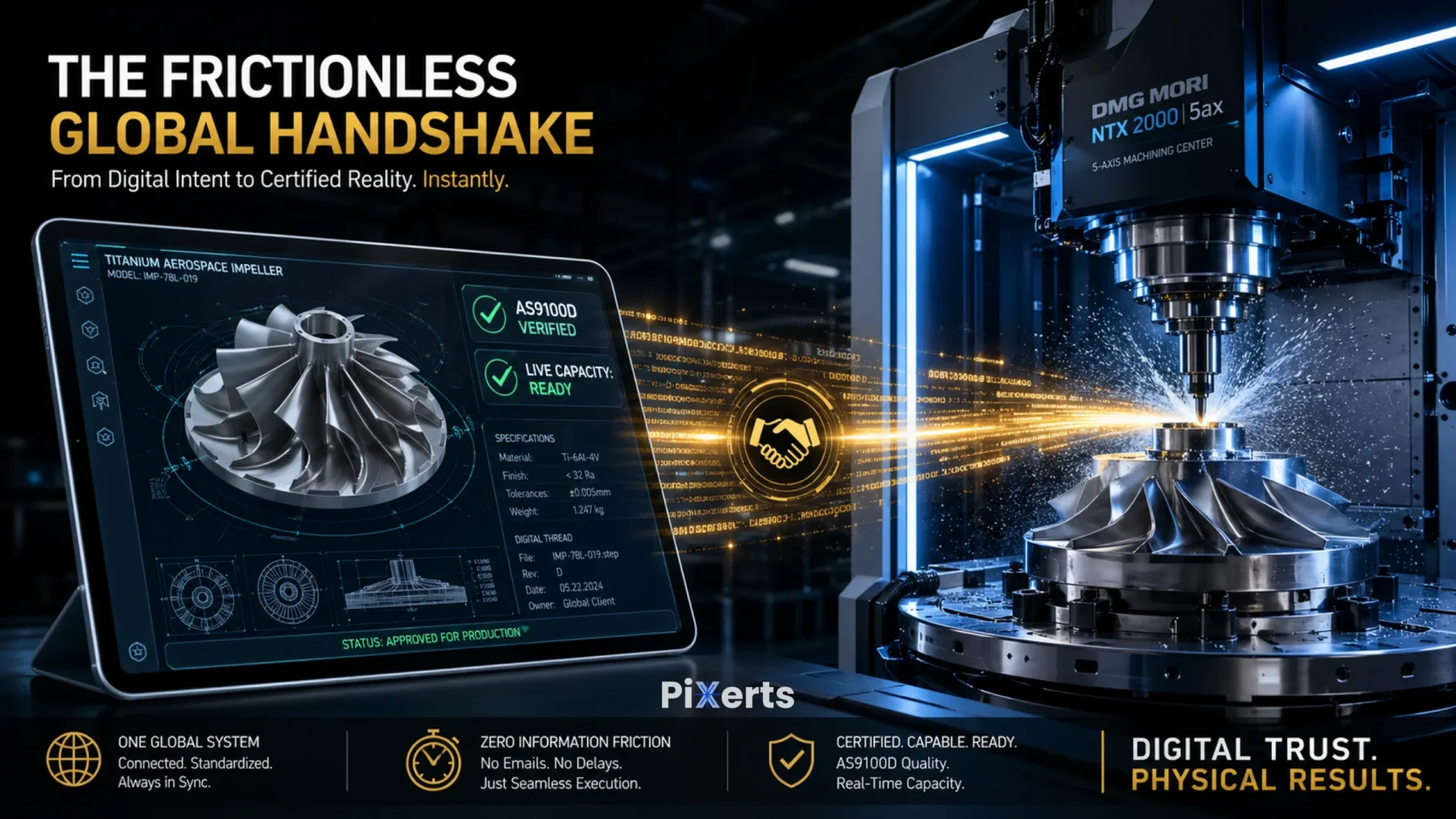
By transforming an industrial digital presence from a static brochure into a machine-readable Technical Source of Truth, manufacturers can eliminate the hidden costs associated with vague specifications and secure a dominant position on the global Technical Buyer Journey shortlist. Mastering Answer Engine Optimization (AEO) is the ultimate lever for outranking broad aggregator platforms. It will reduce the Information Friction.
1. The Anatomy of Global B2B Industrial Procurements
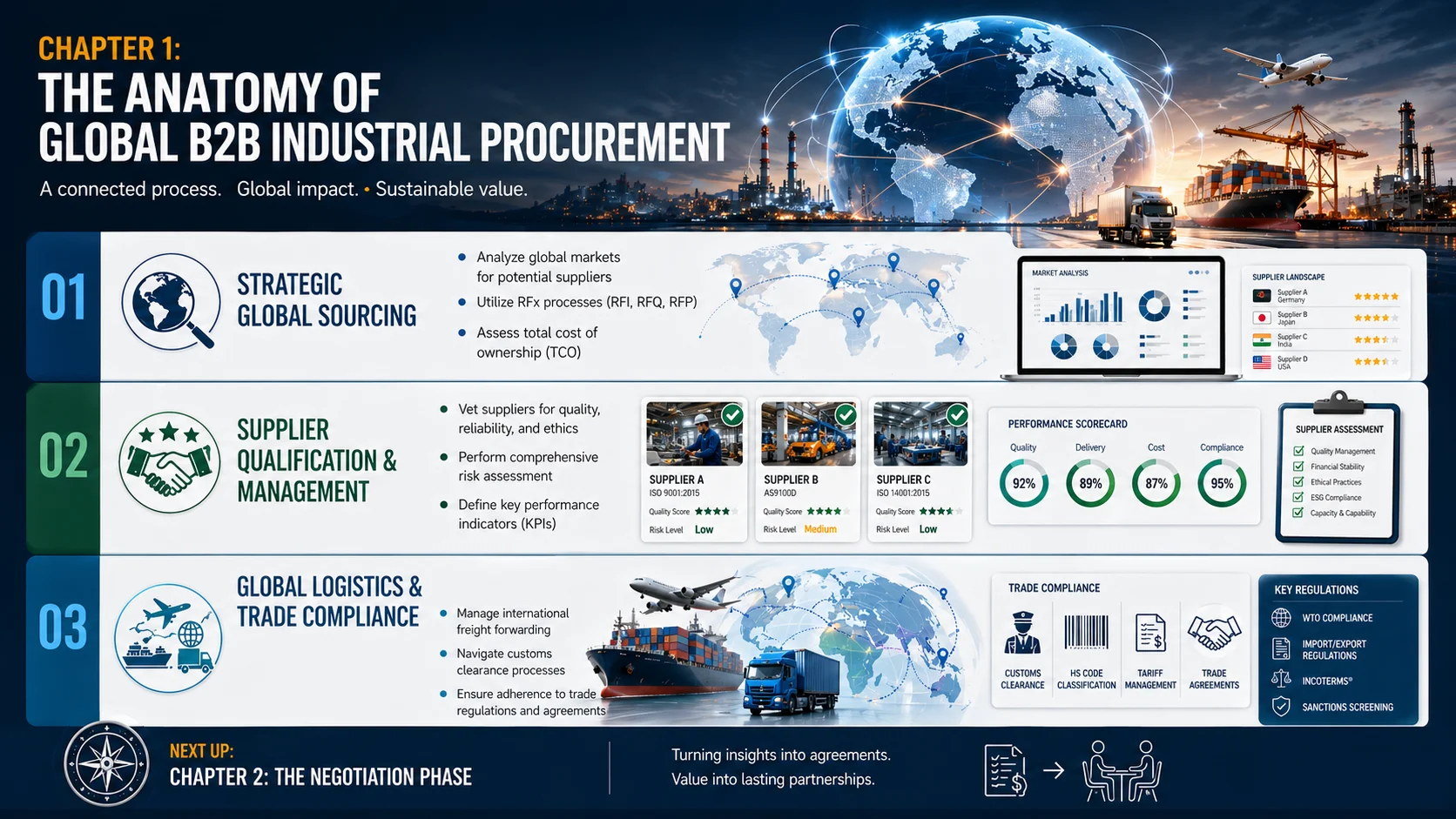
The landscape of B2B Industrial Procurement has fundamentally shifted from relationship-based sales to data-driven technical vetting. When a global procurement officer (PO) or lead engineer sits down to source a partner for a massive, multi-year CNC Machining Contract, their primary enemy is not price—it is Information Friction.
1.1 Defining Information Friction in High-Stakes Manufacturing
Information Friction is the operational drag, cognitive load, and systemic delay caused by fragmented technical data. It occurs when a potential buyer cannot seamlessly access the precise engineering parameters required to authorize a purchase. In the realm of Advanced Machining SEO, friction is the dangerous gap between a buyer’s urgent intent and your website’s ability to instantly verify your shop floor’s capabilities.
When an aerospace contractor in Germany or a robotics firm in Japan searches for a global manufacturing partner, they are evaluating Supply-Chain Resilience. If your digital footprint is vague, lacks immediate Traceability and Documentation, or forces them to wait 48 hours just to confirm your machine envelope sizes, they perceive extreme risk. In $100k+ manufacturing agreements, risk equals a disqualified vendor.
1.2 The Economic Impact of the Vague RFQ
Industry data indicates that a staggering percentage of industrial buyers will silently disqualify a vendor during the early Technical Buyer Journey if critical Technical Specifications are missing.
-
The Hidden Cost: For every day a Request for Quotation (RFQ) sits in limbo due to unclear Material Grade capabilities or missing Geometric Dimensioning and Tolerancing (GD&T) standards, the project’s Total Cost of Ownership (TCO) inflates.
-
The Global Penalty: Information Friction costs the global Precision CNC Machining sector billions in lost efficiency, misallocated engineering hours, and delayed speed-to-market.
1.3 The Psychology of the Methodical Buyer
The modern industrial buyer is highly methodical. They do not want to “hop on a quick discovery call.” They want to download your ISO 9001 Compliance certificate, verify your 5-Axis Milling spindle speeds, review your CMM Inspection Reports, and submit a STEP file through a secure portal. If your website forces them into a generic sales funnel, you introduce Information Friction, driving them directly to competitors who offer a frictionless Technical Source of Truth.
2: Mapping the Competitor Strategy
To dominate the global stage, you must understand how the apex predators of the manufacturing world operate. Giant aggregator networks and digital manufacturing platforms like Thomasnet, Worcon, Xometry, and Fictiv have captured market share by systematically reducing Information Friction for low-to-mid-tier parts.
2.1 Competitive Keyword & Operational Mapping
Here is how the giants position themselves, and the strategic wedge required to beat them in the high-ticket space:
| Competitor Archetype | Primary SEO Targets & Keywords | The High-Ticket “Silent Operator” Edge |
| Broad Aggregators (e.g., Thomasnet) | CNC Machining Services, Find Suppliers, Online CNC Quote. | Deep Niche Authority: Aggregators are generalists. Your strategy must target “Complex 5-Axis Aerospace Components” and “Titanium Precision Turning”—highly specific niches where broad platforms fail to convey engineering depth. |
| Instant Quoting OEMs (e.g., Xometry) | Automated Quoting, Rapid Tooling, Digital Manufacturing. | The Technical Partnership: Instant quotes cannot accurately price complex, multi-stage $100k+ assemblies. Your site must emphasize Design for Manufacturability (DFM) collaboration and human engineering oversight. |
| Traditional Machine Shops | Custom Metal Parts, Precision Machining, Local Machine Shop. | AEO Leadership: Most traditional shops have terrible websites. By deploying Answer Engine Optimization (AEO) and structured data, you make your traditional expertise machine-readable for global AI search engines. |
2.2 The Trap of “Instant Quoting” for High-Value Contracts
While instant Request for Quotation (RFQ) plugins look impressive, they often create more Information Friction for complex contracts. A $100k+ Aerospace Precision Machining job cannot be algorithmically quoted accurately without accounting for strict AS9100D Certification compliance, First Article Inspection (FAI) reports, and specialized heat treatments. By positioning your agency as a partner for complex High-Mix Low-Volume (HMLV) production, you capture the high-margin contracts that automated platforms are forced to reject.
3: Vertical Powerhouse
To build a globally recognized Technical Source of Truth, your digital architecture must speak the distinct dialects of the world’s most lucrative industrial sectors.
3.1 Aerospace & Defense: The Peak of Precision
In the global aerospace and defense supply chain, friction is a massive liability. A single documentation error on a jet engine manifold can ground a multi-million dollar project.
-
The UX Strategy: You must build dedicated Validation Hubs. These are secure, front-facing environments where global engineers can instantly verify your capacity for Micron-Level Precision and download sample Material Test Reports (MTRs). This proves your shop operates under rigorous Quality Management Systems (QMS).
3.2 Bio-Pharma & Medical Device Manufacturing
Medical device OEMs require an interface that reflects their own sterile, highly regulated environments. A chaotic website implies a chaotic cleanroom.
-
The UX Strategy: The emphasis must be on Process Control. Your digital presence should highlight ISO 13485 Compliance, cleanroom assembly standards, and strict Traceability and Documentation workflows.
3.3 Robotics & Industrial Automation
The companies building the next generation of collaborative robots (Cobots) and autonomous guided vehicles (AGVs) demand highly agile manufacturing partners.
-
The UX Strategy: Feature interactive CAD viewers and Digital Twin visualizers. Show that you understand the nuances of Design for Manufacturability (DFM) for lightweight, high-strength robotic chassis and end-of-arm tooling.
3.4 Heavy Equipment & Mining Machinery
For mining, construction, and oil & gas, parts must withstand extreme environments. The procurement focus is on durability, scale, and material strength.
-
The UX Strategy: Highlight your ability to handle massive raw materials. Showcase your large-envelope gantry mills, horizontal boring capabilities, and expertise in machining work-hardening alloys like Inconel and Hardox.
4: The Technical Cost Of Information Friction
To truly understand why Information Friction destroys high-value contracts, we must dissect the engineering data gaps that plague standard B2B websites.
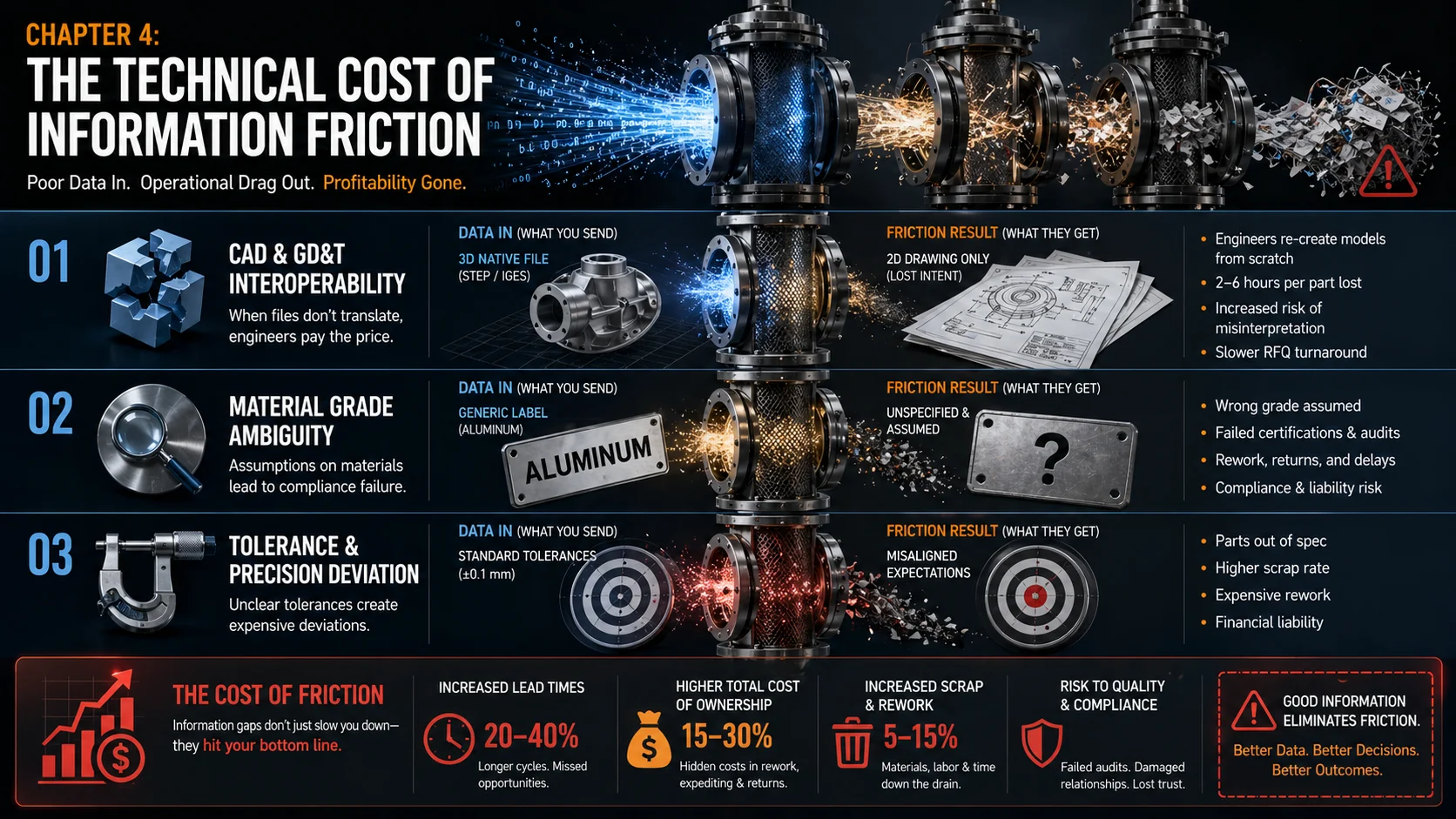
4.1 GD&T and CAD Interoperability
When an engineer uploads a native SolidWorks or STEP file, they need to know if you can interpret their Geometric Dimensioning and Tolerancing (GD&T) callouts. If your website only asks for a “PDF drawing,” you are instantly introducing friction. Modern B2B Industrial Procurement requires secure portals that explicitly state which CAD formats you support (STEP, IGES, Parasolid) and how your CAM software integrates with them.
4.2 The Material Grade Confusion
Not all metals are created equal. A procurement officer looking for “Aluminum” isn’t looking for just any aluminum; they are looking for “6061-T6” or “7075-T6” with specific mill certs. If your website simply lists “We machine steel and aluminum,” you fail the test. A Technical Source of Truth lists exacting specifications:
-
Titanium: Grade 2, Grade 5 (Ti-6Al-4V).
-
Stainless Steel: 304, 316L, 17-4 PH.
-
High-Performance Plastics: PEEK, Ultem, Delrin.
4.3 Tolerance Mismatches
Standard commercial tolerances won’t win $100k+ contracts. You must explicitly broadcast your ability to hold +/- 0.0005″ Precision Tolerances across complex geometries. Failing to boldly display your true capabilities creates doubt, and doubt creates Information Friction.
5: Legal & Financial Liability in High-ticket Machining
A $100k+ CNC Machining Contract is not merely an exchange of CAD files for metal parts; it is a legally binding commitment fraught with financial risk. Supply-Chain Resilience is deeply tied to how well a manufacturer preemptively mitigates this liability before the contract is even drafted. Information Friction at this stage doesn’t just lose the sale—it introduces legal exposure.
5.1 Total Cost of Ownership (TCO) and the Fear of Non-Conformance
Global procurement teams calculate the Total Cost of Ownership (TCO) long before they issue a purchase order. TCO goes far beyond the quoted unit price. It includes the cost of international shipping, potential scrap rates, machine downtime due to late deliveries, and the devastating risk of non-conformance.
If your website forces a buyer to guess about your quality control measures, you trigger immediate Information Friction. Your digital presence must aggressively address these fears by explicitly outlining your Quality Management Systems (QMS), your statistical process control (SPC) data, and your CMM Inspection Reports procedures. A true Technical Source of Truth proves financial stability and operational maturity, assuring the buyer that you can absorb the liability of a high-ticket global contract.
5.2 Compliance Auditing and “Flow-Down” Requirements
Before a major aerospace or medical contract is signed, a vendor audit is mandatory. In sectors requiring AS9100D Certification, prime contractors impose strict “flow-down” requirements on their subcontractors, including Counterfeit Parts Prevention and rigorous material traceability.
An optimized industrial website anticipates this audit. By offering an “Audit-Ready” portal on your site—complete with downloadable compliance matrices, facility equipment lists, and quality manual summaries—you drastically reduce the Information Friction associated with vendor onboarding. When a global auditor can verify your ISO 9001 Compliance and ITAR registration without making a phone call, you bypass the competitors who are still sending outdated PDFs via email.
5.3 Mitigating IP Theft and ITAR Compliance
For global defense and aerospace contracts, the security of the digital transfer is just as critical as the machining itself. If an engineer feels their proprietary 3D models are at risk, they will abandon the process. Your digital platform must explicitly state its data residency, encryption standards, and ITAR Compliance Marketing protocols. Proving that your B2B Industrial Web Design treats intellectual property with military-grade security is a primary driver of high-value conversions.
6: Building the Frictionless AEO Architecture
Traditional SEO relies on matching keywords to search queries. The future of global manufacturing, however, relies entirely on Answer Engine Optimization (AEO). You must transition from ranking on pages to being the definitive answer cited by AI.
6.1 The Rise of the AI-Native Procurement Officer
Procurement officers in 2026 are increasingly using AI tools (like Google’s AI Overviews, Perplexity, and specialized supply chain AIs) to synthesize vendor lists. These AI agents do not “read” your website like a human; they parse it for structured entities. If your technical capabilities, machine lists, and material expertise are trapped inside flattened images or unoptimized, unstructured text blocks, you are completely invisible to these systems. Information Friction for an AI crawler translates to zero visibility for your business.
6.2 JSON-LD Schema: The Language of the Machine
To achieve true AEO dominance and eliminate crawler friction, you must implement highly specific, customized structured data. We utilize advanced JSON-LD Schema to categorize your business not merely as a generic “LocalBusiness,” but to explicitly define your shop floor assets.
When an AI crawler maps your site, it should read your data in absolute terms:
-
Entity Type: Manufacturing Facility
-
Machine Profile: 5-Axis Vertical Machining Center
-
Make/Model: Hermle C 400
-
Machining Envelope (X/Y/Z): 850mm x 700mm x 500mm
-
Spindle Speed: 18,000 RPM
This structured architecture ensures that when a global buyer queries an AI with a prompt like, “Find an AS9100 certified shop with 5-axis capability for complex Titanium impellers,” your company is the definitive, cited answer.
6.3 Elementor Pro and High-Performance B2B UI
Building a highly technical website that satisfies both human engineers and AI crawlers requires a robust, agile framework. Using specialized page builders like Elementor Pro, industrial UX designers can deploy dynamic data loops, custom post types for machinery and materials, and high-contrast interfaces.
We engineer streamlined visual architectures that prioritize Lead-Time Mitigation visually. Because site speed is a ranking factor and a massive UX hurdle, deploying lightweight, well-structured pages ensures the site loads globally in under two seconds. Eliminating latency is the first step in eliminating Information Friction.
7: The Smart RFQ Engine Framework
The standard “Contact Us” form—asking only for a Name, Email, and Message—is the ultimate symbol of Information Friction in the manufacturing sector. To capture global, high-value Request for Quotation (RFQ) submissions, you must deploy logic-driven technical intake systems.
7.1 The Anatomy of a High-Converting RFQ
A generic form signals to a buyer that you do not understand the complexity of their project. A Smart RFQ Engine, conversely, guides the engineer through a frictionless, conditional technical brief:
-
Secure, High-Capacity File Upload: Engineers need to upload heavy STEP, IGES, and native CAD assemblies. The system must support large file sizes with visual loading confirmation and explicit security guarantees (e.g., end-to-end encryption).
-
Dynamic Material & Finishing Dropdowns: Conditional logic should drive the form. If a user selects “Stainless Steel,” the next dropdown should offer specific grades (304, 316L, 17-4 PH). This must be followed by post-processing requirements such as Hard Anodizing Type III, Passivation, or specialized Heat Treating.
-
Volume & Target Dates: Clear input fields separating prototype volumes from high-production runs map directly to your Capacity Planning. This allows your quoting team to prioritize high-value CNC Machining Contracts instantly.
-
Compliance & Certification Checkboxes: Instant requirements gathering for ISO 9001 Compliance, Material Test Reports (MTRs), and specific hardware certifications (like RoHS or REACH compliance for European markets).
7.2 Eliminating the Email Chain of Death
By gathering this exacting data cleanly on the first interaction, you eliminate days of back-and-forth email chains requesting clarification on tolerances or missing 2D drawings. This positions your machine shop not just as a vendor, but as a highly efficient, technically sophisticated global operator. You eradicate Information Friction at the exact moment the buyer is ready to transact.
8: Global Logistics & Lead-time Mitigation
In the wake of ongoing global supply chain disruptions, the primary driver of Supply-Chain Resilience is predictability. Global buyers will frequently pay a premium for a guaranteed delivery date over a cheaper, uncertain alternative.
8.1 Capacity Planning UX and Radical Transparency
The most advanced Precision CNC Machining websites in the world do not hide their lead times; they broadcast them as a competitive advantage. By integrating a “Live Capacity” dashboard or a Lead-Time Mitigation indicator on your site, you instantly build trust.
If an engineer in London knows your facility has open spindle time next Tuesday for 5-Axis Milling, you win the contract over a local shop that takes three days just to reply to the initial email. Transparency destroys Information Friction.
8.2 Navigating Tariffs, Incoterms, and Global Shipping
Global B2B Industrial Procurement involves navigating complex customs, international tariffs, and freight logistics. A frictionless website preemptively answers these questions. By providing clear documentation on your accepted Incoterms (e.g., FOB, EXW, DDP), your international shipping partners, and your packaging standards (such as vacuum sealing for rust prevention on overseas maritime shipments), you prove you are equipped to handle high-stakes global logistics.
A buyer looking to award a $100k+ contract must know that the parts will not only be machined perfectly but will arrive at their assembly line without being held up in customs due to improper paperwork. Your website must communicate this global logistical competence clearly.
9: Why Specialized Industrial UX is the Only Solution
To eliminate Information Friction and secure global $100k+ CNC Machining Contracts, you cannot rely on generic marketing templates or consumer-grade web design. Industrial procurement is a high-stakes engineering discipline; your digital infrastructure must reflect that exact same rigor.
9.1 The Generalist Agency Trap vs. The 0-to-1 Approach
A marketing agency that builds websites for e-commerce brands and local dentists cannot build a Technical Source of Truth for a precision engineering firm. They do not know the difference between a Swiss-style lathe and a 5-axis mill. They do not understand the critical nature of Geometric Dimensioning and Tolerancing (GD&T) or the nuances of AS9100D Certification. Hiring a generalist guarantees Information Friction because the agency itself does not speak the language of the buyer.
Furthermore, generalist agencies often rely on “redesigning” broken templates. In the high-stakes industrial sector, you cannot simply paint over a rusty foundation. True digital transformation requires a “0-to-1” design philosophy—building the digital architecture from scratch specifically for the B2B Industrial Procurement cycle.
9.2 The Industrial Exclusive Ethos (The Pixerts Advantage)
As a specialized industrial UX/UI agency, we operate with a singular focus: the industrial machinery sector is our one and only niche. We merge complex Mechanical Engineering reality with elite Digital UX.
By exclusively utilizing high-performance page builders like Elementor Pro—configured for maximum speed and global stability—alongside advanced Answer Engine Optimization (AEO) strategies, we ensure that every pixel, schema tag, and RFQ form serves one purpose. We do not do coded websites that trap you in proprietary development cycles; we build universally accessible, scalable systems that your internal team can manage while dominating global search. We close global manufacturing contracts by entirely removing friction from the Technical Buyer Journey.
10: The ROI of Eradicating Information Friction
For decision-makers authorizing the digital retooling of their manufacturing firm, the investment in Industrial UX must yield a measurable return. The ROI of eliminating Information Friction is felt across three distinct operational pillars.
10.1 Shortening the Sales Cycle
When a global buyer can independently verify your ISO 9001 Compliance, view your live Capacity Planning data, and submit a Smart RFQ with native CAD files attached, the sales cycle compresses dramatically. You bypass the “exploratory phase” entirely. Your sales engineering team stops answering basic capability questions and starts negotiating the final terms of the CNC Machining Contract.
10.2 Increasing the Win Rate on High-Ticket Bids
Procurement officers evaluate risk just as heavily as they evaluate price. By providing absolute Technical Transparency and seamless Traceability and Documentation, you project an image of extreme operational competence. A frictionless website acts as a massive trust anchor, increasing your win rate on $100k+ bids because buyers trust that your shop floor is as organized and precise as your digital front-end.
10.3 Lowering the Cost of Customer Acquisition (CAC)
Traditional industrial marketing relies on expensive trade shows and outbound sales forces. By deploying a robust AEO strategy, your website becomes an inbound lead engine. When AI agents and global engineers cite your facility as the definitive Technical Source of Truth for Precision CNC Machining, your inbound organic traffic scales without a corresponding increase in advertising spend.
Conclusion: Securing the Future of Your Machine Shop
The global manufacturing landscape is unforgiving. The companies that thrive in the coming decade will not necessarily be the ones with the newest spindles, but the ones that make their operational excellence the easiest to access. Information Friction is a silent killer, bleeding revenue from your pipeline by turning highly qualified global buyers away before you even know they were looking.
By investing in specialized B2B Industrial Web Design and transitioning your digital presence into a true Technical Source of Truth, you are doing more than updating a website. You are building the digital infrastructure required to secure $100k+ CNC Machining Contracts, anchor global Supply-Chain Resilience, and dominate the AI-driven future of industrial procurement.
Frequently Asked Questions
1. What is the main cause of Information Friction in CNC procurement?
Answer: The primary cause of Information Friction is the lack of immediate, machine-readable technical data. When a global procurement officer cannot instantly find your +/- 0.0005″ Precision Tolerances, supported CAD formats, or Material Test Reports (MTRs), they experience operational drag and will often abandon the Request for Quotation (RFQ).
2. Why do instant quoting widgets fail for $100k+ aerospace contracts?
Answer: Instant quoting algorithms are built for simple, low-complexity parts. They fail in high-stakes Aerospace Precision Machining because they cannot accurately calculate the costs associated with AS9100D Certification flow-down requirements, complex Design for Manufacturability (DFM) reviews, and rigorous First Article Inspection (FAI) protocols required for High-Mix Low-Volume (HMLV) contracts.
3. What is the difference between traditional SEO and AEO for machine shops?
Answer: Traditional SEO focuses on ranking a webpage for broad keywords like “CNC machining.” Answer Engine Optimization (AEO) focuses on structuring your technical data (like spindle speeds, ISO 9001 Compliance, and machine envelope sizes) so that AI agents like Gemini and ChatGPT cite your facility as the direct answer to complex engineering queries.
4. How does a “Technical Source of Truth” improve supply-chain resilience?
Answer: A Technical Source of Truth centralizes all compliance, capacity, and engineering data. By providing transparent Traceability and Documentation and real-time Capacity Planning dashboards, it removes uncertainty. This allows global buyers to trust your facility, inherently boosting their Supply-Chain Resilience.
5. How can my CNC website actively reduce lead-time risk for buyers?
Answer: By integrating Lead-Time Mitigation features directly into your UX. This includes broadcasting live machine availability, offering clear insights into your raw material sourcing network, and utilizing a Smart RFQ Engine that captures exact material grades (e.g., Titanium Ti-6Al-4V) and CAD files instantly to prevent days of delayed email communication.
6. What features must a Smart RFQ engine have for high-value contracts?
Answer: A high-converting Smart RFQ Engine must include secure drag-and-drop CAD uploads (STEP, IGES), dynamic dropdowns for specific Material Grades, precision tolerance toggles, and mandatory checkboxes for compliance standards (ITAR, GMP, ISO).
7. How does JSON-LD schema help manufacturing websites rank globally?
Answer: JSON-LD Schema translates your website’s human-readable text into “Machine-Readable” code. It allows you to explicitly tag your business assets—identifying specific 5-axis mills, CMM inspection tools, and regional certifications—ensuring global search engines categorize you as a highly specialized engineering facility rather than a generic local business.