
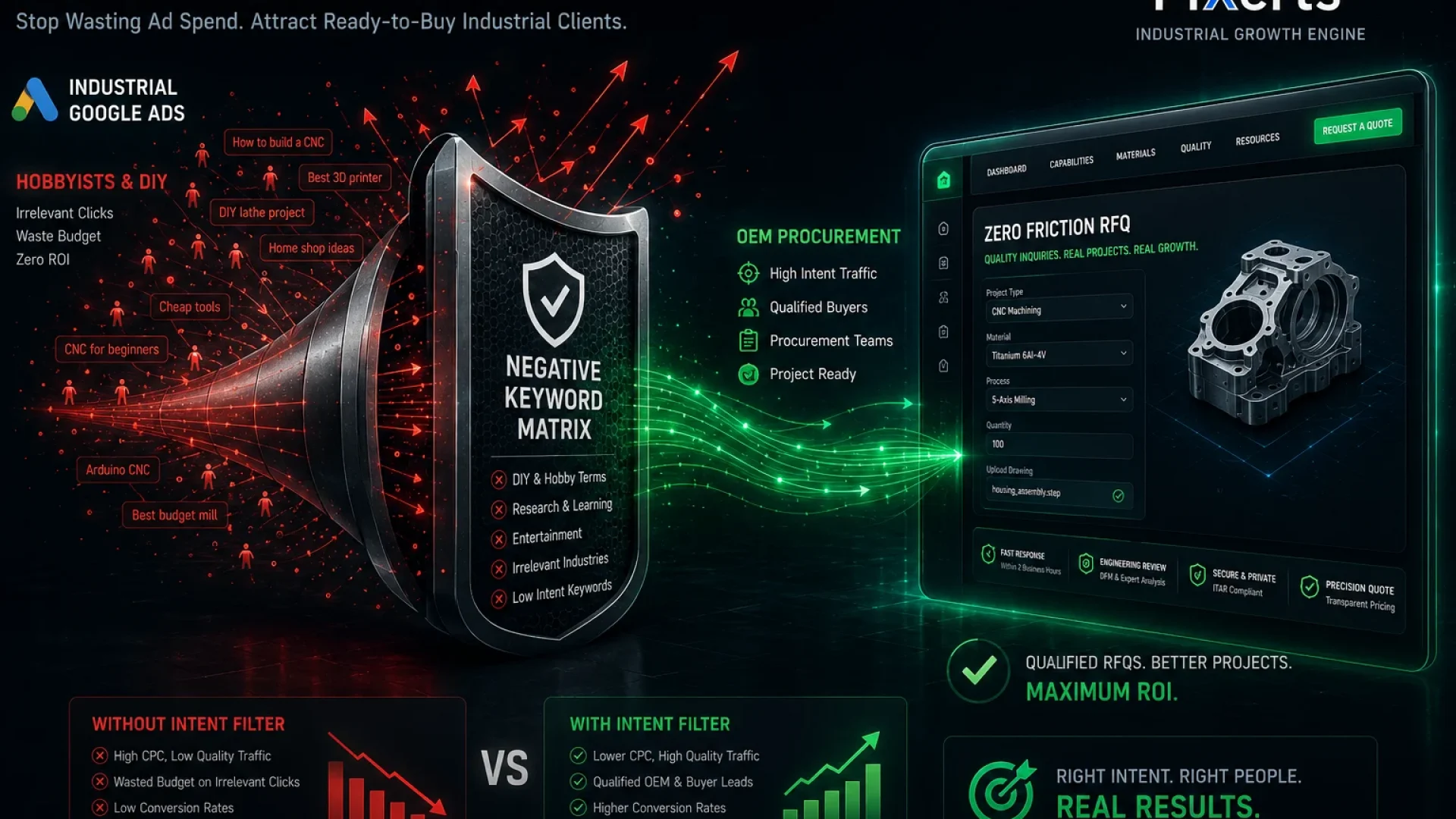

For the industrial machinery sector, Industrial Google Ads is a double-edged sword. When executed correctly, it is the fastest way to place your facility directly in front of OEM procurement officers actively searching for supply chain partners. When executed poorly, it is a rapid incinerator of marketing budgets. The difference between capturing high-ticket B2B RFQs and paying for useless traffic comes down to intent filtering and landing page architecture.
Generalist agencies run Industrial Google Ads like consumer retail campaigns, prioritizing click volume over engineering empathy. They send expensive traffic to obsolete B2B distributor websites suffering from Digital Rust. This guide breaks down the specialized PPC architecture required for the industrial machinery sector. Learn how to deploy aggressive negative keyword lists, target exact engineering parameters, and construct a Zero Friction RFQ landing page that maximizes your Return on Ad Spend (ROAS).
The Broad Match Disaster in Heavy Industry
The most common failure point in Industrial Google Ads is relying on Google’s automated “Broad Match” settings. Google’s algorithm is designed to maximize ad spend by showing your ad to anyone remotely related to your keywords.
If you bid on “Metal Fabrication,” Google will show your ad to consumers looking for “custom metal signs for home” or “cheap metal welding repair.” If you are a facility that specializes in AS9100D aerospace components, every click from these consumers is pure waste.
The Power of Intent Filtering
To capture high-ticket B2B RFQs, your campaign must act as a filter, not a net. You must transition entirely to Exact Match and Phrase Match targeting. Instead of bidding on “CNC Machining,” you bid on explicit, machine-readable capabilities:
- “5-axis titanium milling services”
- “ISO 13485 medical device contract manufacturing”
- “Heavy industrial machinery distributor near me”
By targeting absolute parameters, you drastically lower your click volume but exponentially increase your conversion rate.
The Industrial Shield: Negative Keyword Lists
In Industrial Google Ads, what you exclude is far more important than what you target. A robust Negative Keyword List is your shield against consumer traffic and hobbyists. Before launching any campaign for the industrial machinery niche, you must upload a massive list of negative modifiers to prevent your ads from triggering on low-value searches.
- Hobbyist Exclusions:
-DIY,-hobby,-home,-cheap,-used,-desktop. - Student/Job Exclusions:
-jobs,-salary,-resume,-what is,-tutorial,-how to. - Material Exclusions: If you only machine metal, exclude
-wood,-plastic,-acrylic.
By rigorously defending your ad spend, you ensure that every dollar goes toward capturing the attention of methodical engineers and plant managers with real procurement budgets.
The B2B Informational & Distributor Campaign
The B2B buying cycle is long. A procurement officer does not wake up and immediately issue a $250,000 purchase order. They begin with deep technical research.
Targeting the Research Phase
Elite Industrial Google Ads strategies deploy specific campaigns to target B2B informational and distributor websites. These campaigns bid on highly technical specification queries, such as “Matsuura MAM72-35V capacity limits” or “Inconel 718 feed and speed parameters.”
By intercepting the engineer during their research phase, you establish your facility as a Technical Source of Truth. You answer their technical questions, demonstrate your engineering empathy, and build brand awareness weeks before the official RFQ is issued.
The Landing Page: Eradicating Information Friction
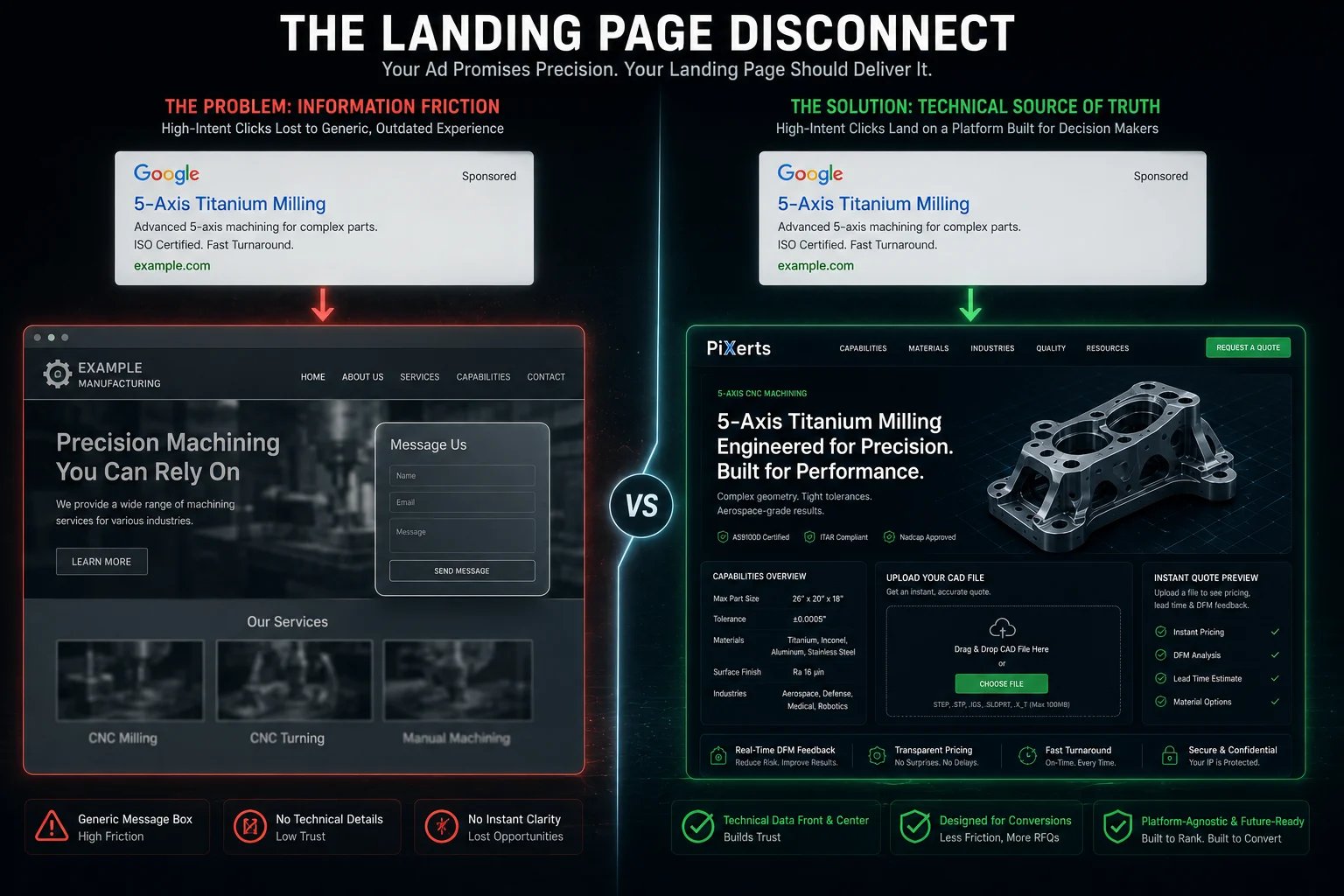
The most flawless Industrial Google Ads campaign will fail if the landing page generates Information Friction. If you pay $15 for a click and send that engineer to your generic homepage or a standard “Contact Us” form, they will bounce.
The “Email Chain of Death”
Generalist landing pages force buyers to type complex geometric dimensioning and tolerancing (GD&T) requirements into a blank message box. This initiates the “Email Chain of Death,” causing frustrating delays as estimators chase down missing CAD files. The buyer loses trust and abandons the deal.
Engineering the Zero Friction RFQ
Your paid traffic must land on a dedicated, high-performance portal. At Pixerts, we champion a platform-agnostic approach—prototyping in Figma and deploying agile, lightning-fast infrastructure using tools like Elementor Pro. This ensures your landing pages never suffer from Digital Rust.
The landing page must feature a Zero Friction RFQ:
- Native CAD Uploads: A secure, drag-and-drop zone explicitly accepting STEP, IGES, and DXF files.
- High Data Density: High-contrast HTML tables detailing exact spindle capacities, material proficiencies, and ISO certifications.
- Machine-Readable Trust: Answer Engine Optimization (AEO) schema embedded in the backend to ensure AI algorithms and browser extensions validate your page instantly.
When the landing page mirrors the ad copy’s precise technical intent, the buyer’s cognitive load drops and your conversion rate skyrockets.
Conclusion: Stop Buying Clicks, Start Buying Contracts
In the industrial machinery sector, Industrial Google Ads should never be treated as a generic branding exercise. It is a highly tactical procurement weapon.
If your current agency is celebrating high click-through rates while your estimating team starves for qualified leads, your strategy is broken. To capture high-ticket B2B RFQs, you must implement aggressive intent filtering, deploy impenetrable negative keyword lists, and refuse to send expensive traffic to obsolete websites.
By engineering platform-agnostic landing pages equipped with Zero Friction RFQs, you transform your ad spend from a risky expense into a calculated investment, securing the high-margin OEM contracts your shop floor deserves.
Frequently Asked Questions
What makes Industrial Google Ads different from regular PPC?
Answer: Industrial Google Ads prioritize extreme intent filtering over click volume. Because industrial machinery and CNC contracts are high-value, the strategy relies on exact match keywords, massive negative keyword lists, and highly technical landing pages to capture OEM buyers rather than general consumers.
Why am I getting unqualified leads from my manufacturing Google Ads?
Answer: You are likely experiencing Information Friction due to “Broad Match” settings. Google’s algorithm shows your ads to consumers searching for DIY projects or cheap repairs. You must deploy negative keyword lists to shield your budget.
What is a Zero Friction RFQ in PPC marketing?
Answer: A Zero Friction RFQ is a specialized digital intake portal used as a landing page for Industrial Google Ads. Instead of a generic contact form, it securely accepts native 3D CAD files (STEP/IGES) and explicitly captures GD&T parameters, eliminating the “Email Chain of Death.”
Should I run ads to my manufacturing homepage?
Answer: No. Sending paid traffic to a homepage forces the engineer to navigate your site to find specific machine capabilities, creating cognitive load. Ads should always direct traffic to highly targeted, platform-agnostic landing pages that exactly match the search query.
How do B2B informational and distributor campaigns work?
Answer: These campaigns target procurement officers during their research phase. By bidding on highly technical specs or distributor part numbers, you intercept the buyer early, establishing your facility as a Technical Source of Truth before the official RFQ is issued.
How does landing page speed affect Industrial Google Ads?
Answer: Search engines penalize slow landing pages, increasing your Cost-Per-Click (CPC). Obsolete sites suffering from Digital Rust will drain your budget. Elite agencies use agile frameworks (like Elementor Pro) to ensure instant load times and perfect Core Web Vitals.