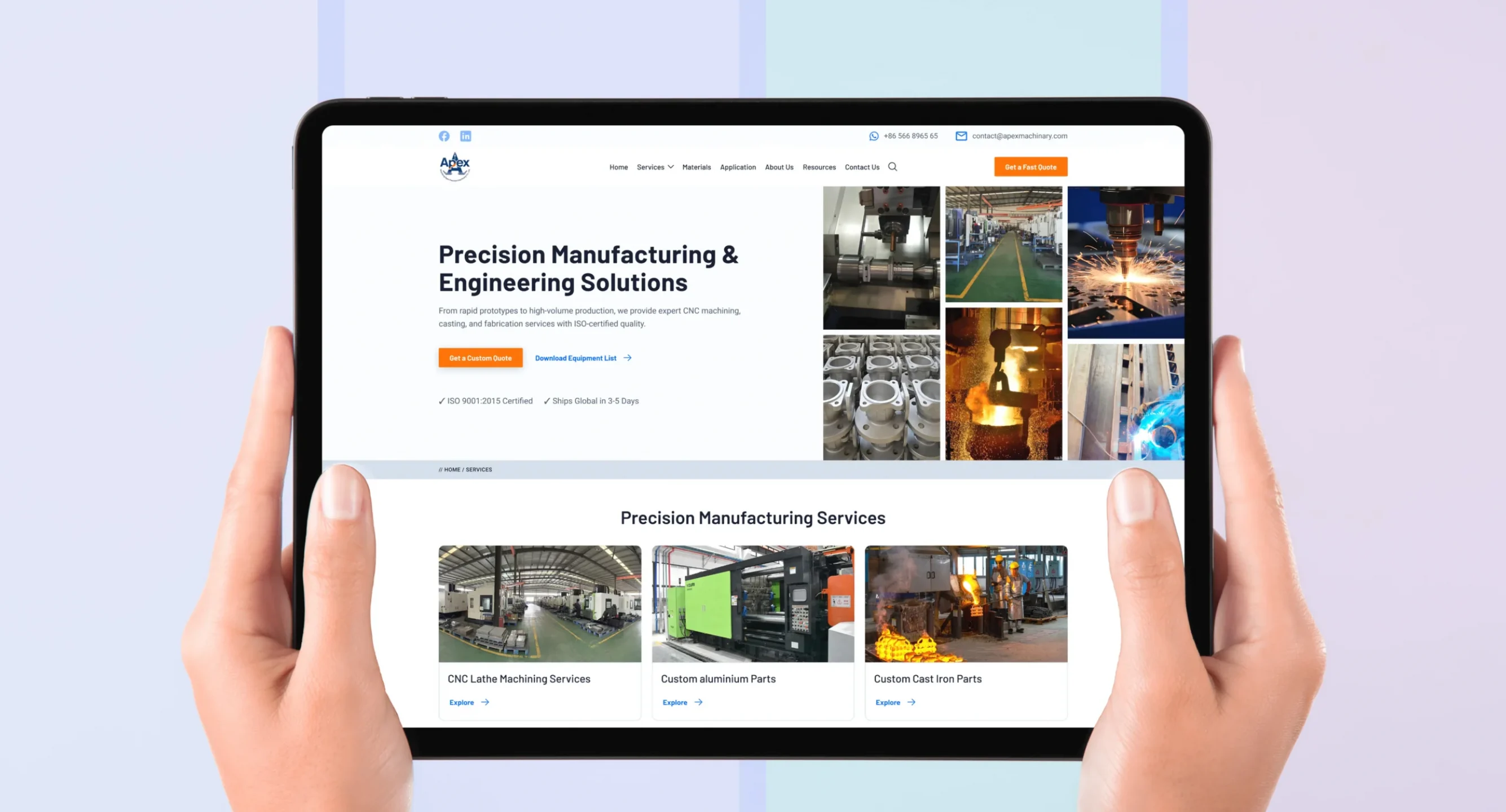
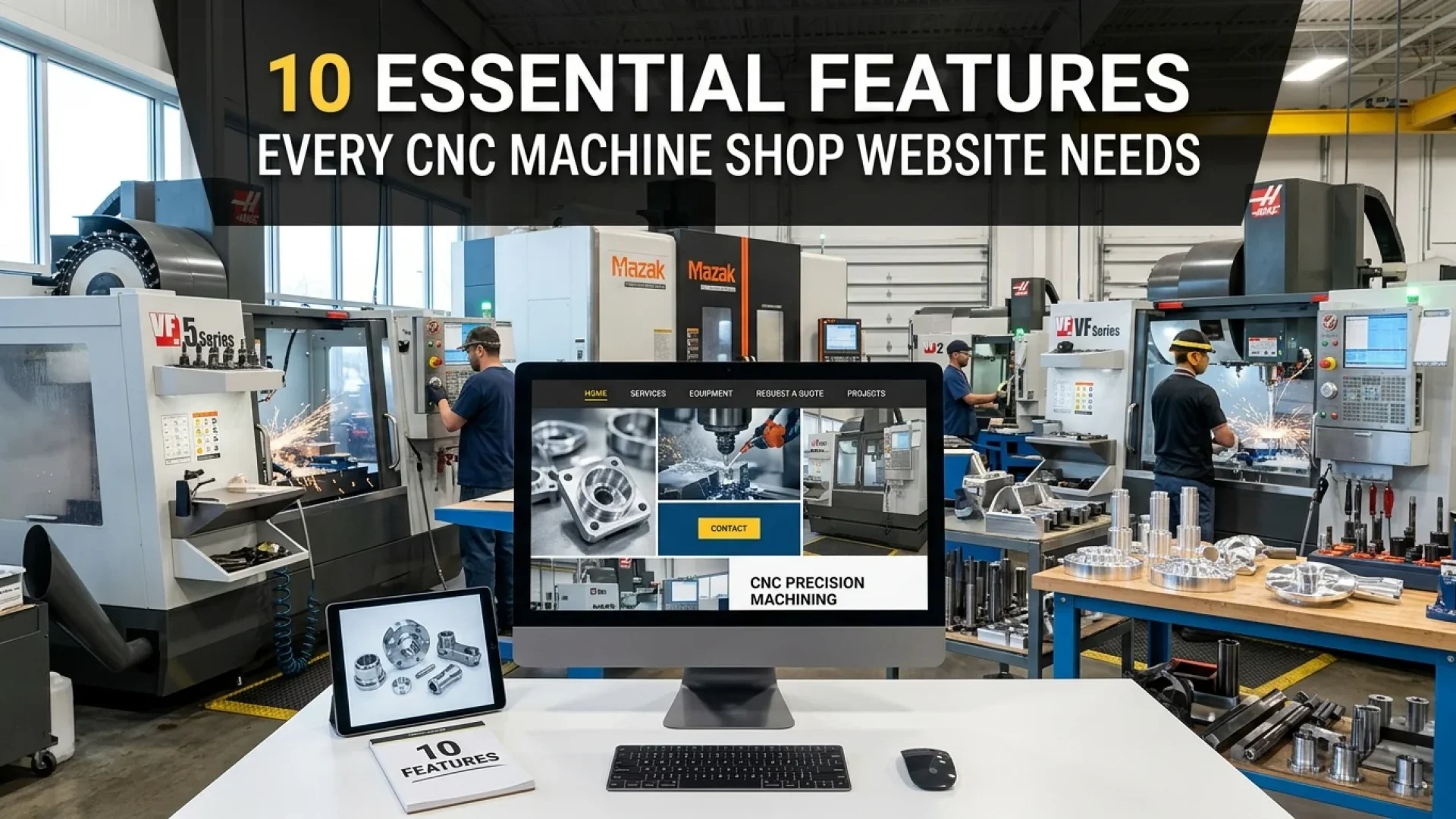
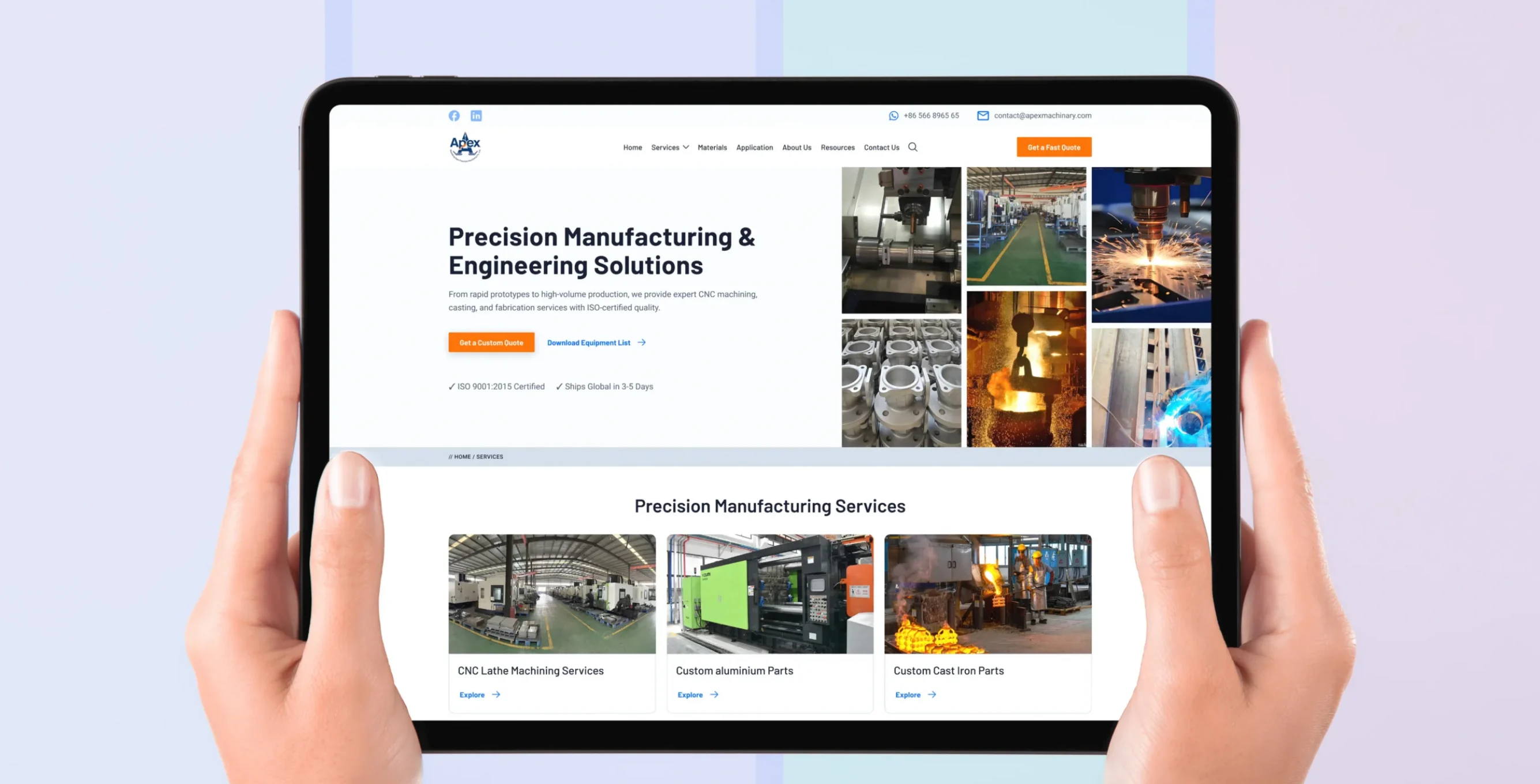
Introduction: 10 Essential Features Every CNC Machine Shop Website Needs
In the high-stakes precision manufacturing industry, a website is far more than a digital business card—it is the front door to your digital factory floor. When a supply chain director, mechanical engineer, or B2B procurement officer searches for a subcontractor for complex 5-axis milling or high-volume Swiss turning, they conduct a rigorous technical evaluation within seconds of landing on your domain.
Unfortunately, many CNC machine shops rely on outdated web layouts that fail to communicate technical authority. If a prospective buyer cannot verify your shop’s ISO certifications, material tolerances, or CAD file compatibility immediately, they will bounce to a competitor.
Integrating 10 essential features specifically tailored for precision component manufacturing transforms your site into an automated lead-generation engine. At Pixerts, we engineer specialized web architectures that bridge the gap between complex engineering capabilities and intuitive buyer enablement.
The 10 Essential Features for CNC Machine Shop Websites
1. Detailed Equipment Fleet & Machine Specifications
Procurement teams judge your shop’s capacity by your hardware. Listing specific machine models—such as Mazak, Haas, DMG Mori, or Citizen Swiss lathes—along with axis travel limits and spindle speeds builds instant technical credibility.
2. Clear Tolerance & Process Capability Matrix
Engineers search for exact precision metrics. Explicitly state your achievable tolerances (e.g., 0.0001inches or 0.0025mm) alongside core processes like Wire EDM, Surface Grinding, and 5-Axis CNC Milling.
3. Prominent ISO, AS9100, and ITAR Compliance Badges
Trust badges must be visible in the site header and footer. Displaying ISO 9001:2015, AS9100D (Aerospace), ISO 13485 (Medical), and ITAR registration badges immediately validates your shop for regulated industries.
4. High-Resolution Inspection & Sample Part Gallery
Showcase your machining craftsmanship with crisp, high-resolution photography of finished parts. Include macro shots of complex geometries, surface finishes (Ra values), and tight-tolerance threads.
5. Encrypted RFQ Portal with CAD File Upload
Remove friction from the inquiry process. Your Request for Quote (RFQ) form must handle heavy 3D CAD file formats including .STEP, .IGES, .SLDPRT, and .DWG files securely over encrypted protocols.
6. Embedded Non-Disclosure Agreement (NDA) Assurance
Defense and medical clients will not upload proprietary designs without security guarantees. Place explicit NDA check-boxes and data encryption protocols directly alongside your CAD file upload form.
7. Material Expertise & Finishing Breakdown
Technical buyers need to know if you work with exotic metals. Create clear sections highlighting your experience with Titanium, Inconel, Stainless Steel 316, Hastelloy, PEEK, and specialized anodizing or heat treatments.
8. Interactive 3D CAD/Component Viewer
Allowing engineers to inspect sample 3D CAD renders directly in the browser using WebGL or Three.js demonstrates high-tech authority and engages visitors far longer than static images.
9. Lean WordPress & Elementor Pro Core Architecture
Avoid rigid, hard-coded setups that lock out your team. A lean WordPress infrastructure built on Elementor Pro delivers lightning-fast load times under 2 seconds while letting your internal staff easily update machine lists.
10. Structured Schema for Answer Engine Optimization (AEO)
Modern procurement uses AI tools to source suppliers. Implementing JSON-LD structured data ensures engines like ChatGPT, Perplexity, and Google Gemini accurately read and cite your machine capabilities.
Engineering the Digital Factory Floor: The Pixerts Process
Generalist marketing agencies often waste months trying to understand the difference between a 3-axis mill and a 5-axis machining center. At Pixerts, we work exclusively within the industrial machinery and manufacturing space, eliminating the agency learning curve from day one.
We map out the precise buyer journey required to turn high-intent traffic into qualified RFQs:
- Validation Phase: The visitor verifies your ISO compliance, ITAR registration, and equipment capabilities within 5 seconds.
- Evaluation Phase: They review your material tolerance matrix and inspect past work in the high-resolution component gallery.
- Conversion Phase: The engineer uploads complex CAD drawings through an encrypted RFQ form backed by automated NDA safeguards.
Our structured 8-week design sprint moves your shop seamlessly from Figma wireframes to a fully deployed Elementor Pro web engine.
Tech Stack: Why We Champion WordPress & Elementor Pro
A common misconception in B2B web development is that high-performance manufacturing sites require custom-coded React or Vue frameworks. In reality, these setups often create long-term maintenance bottlenecks for client teams.
Pixerts leverages a customized, bloat-free WordPress architecture powered by Elementor Pro for several key reasons:
- Internal Team Autonomy: Your marketing staff can update machinery lists, add new certifications, or post project case studies without paying developer fees.
- Core Web Vitals Compliance: We write custom CSS/JS scripts to strip out unnecessary plugin bloat, maintaining green PageSpeed scores across mobile and desktop.
- Scalable B2B Features: Easily integrate third-party CRM platforms, custom RFQ calculators, and secure client portals as your manufacturing business grows.
Answer Engine Optimization (AEO): AI-Proofing Your Machine Shop
Search behavior is evolving rapidly. B2B buyers and supply chain managers increasingly prompt AI assistants with technical queries like:
“Which ITAR-registered CNC machine shops in North America offer 5-axis milling for Inconel aerospace components with tolerances under 0.0002inches?”
Without structured Answer Engine Optimization (AEO), your machine shop will remain invisible to these AI platforms.
Pixerts embeds precise JSON-LD schema markup directly into your site’s code, indexing your equipment list, quality certifications, and material capabilities so AI search engines can instantly parse, recognize, and cite your shop.
Conclusion: Upgrade Your Web Infrastructure to Drive High-Value RFQs
If your current website functions as a static online brochure, you are actively losing contracts to competitors with modern digital presences. Implementing these 10 essential features transforms your digital presence into a 24/7 RFQ generation machine.
Stop relying on generalist agencies that don’t understand precision manufacturing. Partner with Pixerts to build a fast, scalable, AEO-ready web system designed specifically for the CNC machining industry.
Frequently Asked Questions
Q: Why is a dedicated CAD file upload form essential for a CNC website?
A: Technical buyers rarely order standard off-the-shelf items; they require custom parts built to precise engineering drawings. Providing a secure, encrypted RFQ form that supports heavy CAD files like .STEP, .IGES, and .SLDPRT eliminates friction, allowing procurement teams to submit RFQs in minutes.
Q: How do you protect client IP when they submit drawing files online?
A: We build secure, SSL-encrypted upload portals equipped with explicit Non-Disclosure Agreement (NDA) assurances and automated privacy protocols. This ensures your clients’ proprietary designs and CAD files remain protected throughout the quoting process.
Q: Why build a CNC website on WordPress with Elementor Pro instead of custom code?
A: WordPress paired with Elementor Pro offers the perfect balance of bespoke design and user independence. It allows us to deliver high-performance, custom-designed layouts while empowering your internal staff to easily update machine lists, add new equipment specs, or publish case studies without developer assistance.
Q: What is Answer Engine Optimization (AEO) and how does it help CNC shops?
A: AEO structures your website’s technical data—such as machine models, tolerances, and ISO certifications—using JSON-LD schema so AI platforms like ChatGPT, Google Gemini, and Perplexity can read, understand, and cite your machine shop in response to technical sourcing queries.
Q: How long does it take to implement these 10 features on a new website?
A: Our standard project timeline follows a predictable 8-week sprint. This includes sitemap architecture, technical UX wireframing, high-fidelity Figma design, Elementor Pro custom development, CAD upload integration, and full AEO/SEO setup.
Q: Will adding a detailed machine list give away proprietary secrets to competitors?
A: No. Displaying your machinery fleet (e.g., 5-axis CNC mills, Swiss lathes) and maximum work envelopes gives procurement officers the exact data they need to verify your capacity. It signals that you are a well-equipped, capable shop without exposing internal operational secrets.