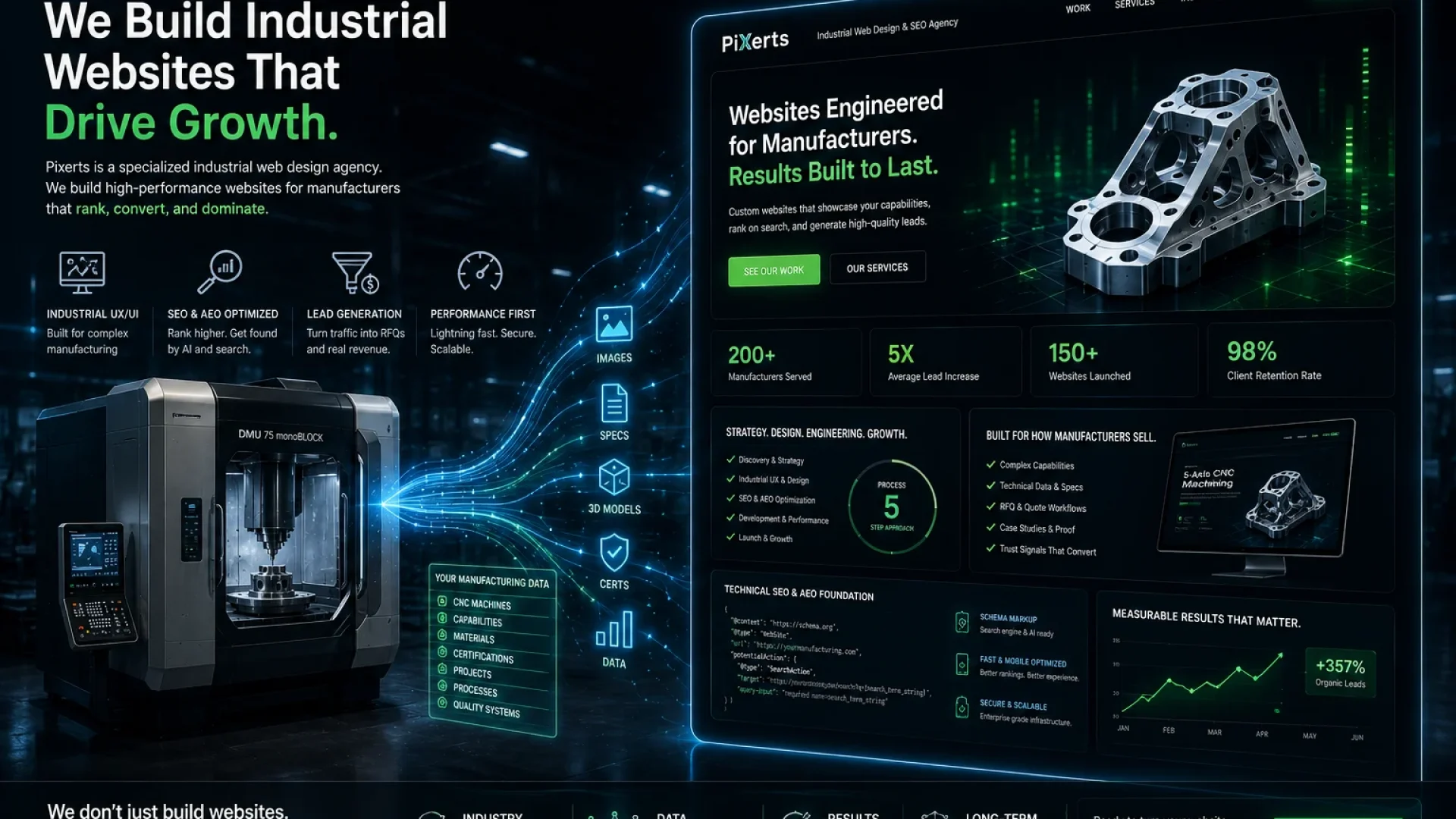
In the hyper-competitive 2026 industrial landscape, your website is no longer a static digital brochure; it is a vital piece of supply chain infrastructure. For many facilities, the cost of a manufacturing website design is viewed as an arbitrary marketing expense rather than an engineering investment. This guide exposes the systemic failures of traditional agency pricing—which often ranges from $35,000 to over $100,000—and introduces the Pixerts model: specialized, high-performance, and custom industrial ecosystems delivered at a budget that respects the margins of independent machine shops.
By focusing exclusively on the industrial machinery niche, Pixerts eliminates the “Agency Overhead Tax,” cures Digital Rust, and eradicates Information Friction, ensuring your facility serves as a verifiable Technical Source of Truth for both human procurement officers and AI Answer Engines.
The Industrial Landscape: Why Web Design is an Obsolete Term
When a CEO or Plant Manager at a precision engineering or industrial machinery firm begins researching the cost of a manufacturing website design, they are often approaching the problem with a 2015 mindset. In 2026, “design” is secondary to “data transfer.”
The High Cost of Information Friction
Most websites in the industrial machinery sector suffer from Information Friction—the gap between what buyers need to know and what the websites actually communicate. If a procurement officer from a Tier 1 aerospace firm cannot immediately verify your 5-axis milling capacity, see your AS9100D certifications, or upload a native 3D CAD file, they will abandon your site within 15 seconds.
The “cost” of a cheap or generalist website isn’t just the invoice; it is the $250,000 lost contract that goes to an aggregator platform like Xometry or ThomasNet because your interface was too difficult to navigate.
Curing Digital Rust
Digital Rust is the accumulation of obsolete code, slow load times, and unreadable technical data. When you pay a legacy agency $60,000 for a custom-coded site, you are often buying into a framework that will “rust” the moment you add a new piece of equipment to your shop floor. Because these sites are hard-coded, you must pay the agency a retainer for every minor update. Pixerts cures this by utilizing platform-agnostic, agile frameworks (like Elementor Pro) that allow your internal team to update machinery lists and capacities in real-time.
Why Legacy Agencies Overcharge for B2B Industrial Web Design
To understand why Pixerts can deliver specialized results on a lower budget, we must analyze where the money goes at a traditional, “full-service” B2B agency.
The Account Management Bloat
Traditional agencies are top-heavy. When you receive a $50,000 quote for seo for manufacturing marketing, you are typically paying for:
- Layers of Middlemen: Account managers and project coordinators who act as filters between you and the actual designer.
- Long “Discovery” Phases: Weeks spent on brand workshops and “emotional storytelling” that often have zero impact on an engineer’s decision-making process.
- Real Estate & Soft Costs: You are subsidizing their high-rise office space and their pursuit of creative awards.
The Custom Code Trap
Agencies often push proprietary, “from-scratch” builds to justify high pricing. For an industrial lead generation agency, this is a strategic play to create vendor lock-in. These custom frameworks are expensive to build and host, and a nightmare for your Technical SEO for Manufacturers. Pixerts rejects this. By using a platform-agnostic approach, we focus 100% of your budget on Answer Engine Optimization (AEO) and UX Engineering rather than reinventing the wheel with redundant code.
The Hidden Financial Dangers of “Cheap” Web Design
At the opposite end of the spectrum, many shops hire generalist freelancers or “cheap” agencies that charge $2,000 to $5,000. This is often more expensive in the long run than a $50,000 build.
Lack of Engineering Empathy
A designer who builds websites for retail shops or medical clinics does not understand High-Mix Low-Volume (HMLV) production or GD&T (Geometric Dimensioning and Tolerancing). They will hide your equipment list in a flattened PDF—an algorithmic black hole that AI Answer Engines cannot read.
The Email Chain of Death
Cheap sites rely on generic contact forms. This initiates the Email Chain of Death:
- Buyer submits a vague message: “Need a quote for 100 parts.”
- Estimator replies: “Please send CAD files and material specs.”
- Buyer replies (2 days later): “Here is a zipped folder.”
- The estimator discovers that the file is a proprietary format that they can’t open.
Cost: Hundreds of hours per year in administrative drag. Pixerts eliminates this by including a Zero Friction RFQ engine in every build, allowing for secure, native CAD uploads from Day 1.
The Pixerts Disruptive Pricing Model: High Spec, Lean Budget
Pixerts, founded by Ferdaus, is built specifically to bridge the gap between “overpriced” and “under-engineered”. As a specialized B2B manufacturing marketing partner, we have streamlined our operations to deliver elite seo services in the machinery industries without the agency bloat.
We Don’t Need Discovery
Because we focus exclusively on industrial machinery, we already understand your business. We know what a Haas UMC-750 is. We understand ITAR compliance. We know why a Material Test Report (MTR) is critical. This specialized knowledge allows us to move 3x faster than a generalist agency, drastically reducing the labor hours you are billed for.
Platform-Agnostic Advantage
We are not locked into one tool, but we prioritize agility. Whether we use Elementor Pro or another high-performance builder, we ensure your site is a Technical Source of Truth, serving as a digital twin of your physical shop floor. This approach allows us to deliver a $40,000-tier website for a fraction of the cost.
Answer Engine Optimization (AEO) Included
In 2026, search is changing. If your website isn’t machine-readable, it doesn’t exist. Pixerts wraps your technical data in JSON-LD Schema. This ensures that when a procurement officer asks an AI, “Find me a machine shop in the Midwest with 5-axis titanium capacity,” the algorithm cites your facility directly.
Comparative Pricing Matrix: 2026 Market Analysis
| Feature | Legacy B2B Agency | Generalist Freelancer | Pixerts |
| Typical Cost | $35,000 – $75,000+ | $2,000 – $8,000 | $8,000 – $18,000 |
| Specialization | General B2B | None | Exclusive Industrial Machinery |
| Architecture | Custom/Proprietary | Templated | Agile/Platform-Agnostic |
| RFQ Portal | Basic Form | Standard Plugin | Zero Friction (CAD Ready) |
| AEO Strategy | Minimal/Add-on | None | Full Technical Schema |
| Risk of Digital Rust | High | Medium | Zero |
| Lead Generation | Passive | Low | Aggressive/Validated |
The 2026 Technical Checklist: What Your Budget Must Cover
When you review a proposal for seo for manufacturing companies or a website redesign, ensure it covers these seven non-negotiable pillars. If it doesn’t, the site will rust within 12 months.
- Native CAD Integration: Standard “file upload” buttons are not enough. Your budget must include a secure, encrypted portal that handles native STEP, IGES, and DXF files. This is the core of the Zero Friction RFQ.
- Machine-Readable Equipment Lists: Flattened PDF equipment lists are the #1 cause of poor seo for manufacturing. Your machinery must be listed in high-contrast HTML tables that are wrapped in Schema.org microdata.
- Micron-Level Tolerance Broadcasting: In precision engineering SEO, specificity is king. Your site must explicitly state your GD&T limits (e.g., +/- 0.0005″). Vague claims of “tight tolerances” will be ignored by both AI and engineers.
- AS9100D and ISO Certification Visibility: Compliance is the ultimate trust signal. Your site must feature a centralized compliance vault where buyers can download your latest certificates and Material Test Reports (MTRs) with a single click.
- Mobile Shop-Floor Adaptability: Engineers and plant managers are increasingly using tablets and smartphones on the floor. Your site must load in under 2 seconds and be fully navigable on a mobile device without losing technical data density.
- Answer Engine Optimization (AEO): AEO is the “overnight” indexer. By coding your machine envelopes and material proficiencies in JSON-LD, you ensure you are cited when buyers use voice search or AI agents to find vendors.
- Platform-Agnostic Agile Framework: Avoid “locked” systems. Use a framework like Elementor Pro to let your internal sales engineering team bypass IT bottlenecks and update your digital twin instantly.
Conclusion: Don’t Buy a Website, Engineer a Digital Asset
The cost of a manufacturing website design should never be a mystery. At Pixerts, we have demystified the process by stripping away agency bloat and focusing entirely on friction eradication.
Whether you are looking for seo for the CNC companies or a complete digital overhaul for a global industrial machinery brand, the goal remains the same: create a Technical Source of Truth that eliminates Information Friction.
Cure your Digital Rust. Stop paying for the “magic” of generalist agencies and start investing in specialized industrial engineering. Partner with Pixerts today and secure the high-margin, high-ticket contracts your shop floor deserves.
Frequently Asked Questions
What is the average manufacturing website design cost in 2026?
Answer: The cost of a manufacturing website design ranges from $5,000 for basic generalist builds to $75,000+ for legacy agencies. Specialized firms like Pixerts provide high-performance, AEO-ready digital infrastructure between $8,000 and $18,000.
Why do manufacturing websites cost more than standard websites?
Answer: Manufacturing websites require deep engineering empathy and technical integration. The cost includes building Zero Friction RFQs, structuring machine-readable equipment lists, and implementing JSON-LD schema for AI search verification.
What is the ROI of a high-performance industrial website?
Answer: A high-performance site pays for itself by reducing Information Friction. By implementing a Zero Friction RFQ, a shop can save 20+ hours of estimating time per week and increase RFQ conversion rates by up to 40%.
How does Answer Engine Optimization (AEO) impact manufacturing SEO?
Answer: AEO ensures that your machinery capacities and certifications (ISO, AS9100D) are wrapped in machine-readable code. This allows AI algorithms like Gemini to instantly verify your facility as a Technical Source of Truth and cite you in AI Overviews.
What is “Digital Rust” on a factory website?
Answer: Digital Rust occurs when a website is built on rigid, custom-coded frameworks that are difficult to update. This causes the digital presence to lag behind the physical shop floor’s capabilities, leading to lost leads and search engine penalties.
Why should manufacturers avoid custom-coded proprietary websites?
Answer: Custom-coded sites create vendor lock-in and lead to Digital Rust. Manufacturers should insist on a platform-agnostic approach using agile tools like Elementor Pro, ensuring their internal teams can update machine lists in real-time.
How can a Zero Friction RFQ eliminate the “Email Chain of Death”?
Answer: A Zero Friction RFQ allows buyers to upload native 3D CAD files (STEP/IGES) and select material grades directly. This ensures the shop floor receives all required engineering data on day one, bypassing days of back-and-forth communication.
What are the best SEO strategies for manufacturers in 2026?
The most effective seo strategies for manufacturers involve moving away from generic keywords and focusing on Technical SEO and AEO. This involves building data-dense HTML tables for capacities and wrapping every asset in JSON-LD schema.
Can a low-budget website be high quality for a machine shop?
Answer: Yes, if the agency is specialized. Pixerts achieves lower pricing by focusing exclusively on industrial machinery, which removes the need for expensive discovery phases and bloated account management teams.
What is a Technical Source of Truth in manufacturing marketing?
Answer: A Technical Source of Truth is a digital environment that perfectly mirrors a facility’s physical capabilities. It provides instantly verifiable data on tolerances, materials, and compliance, making it the primary vetting tool for risk-averse procurement officers.