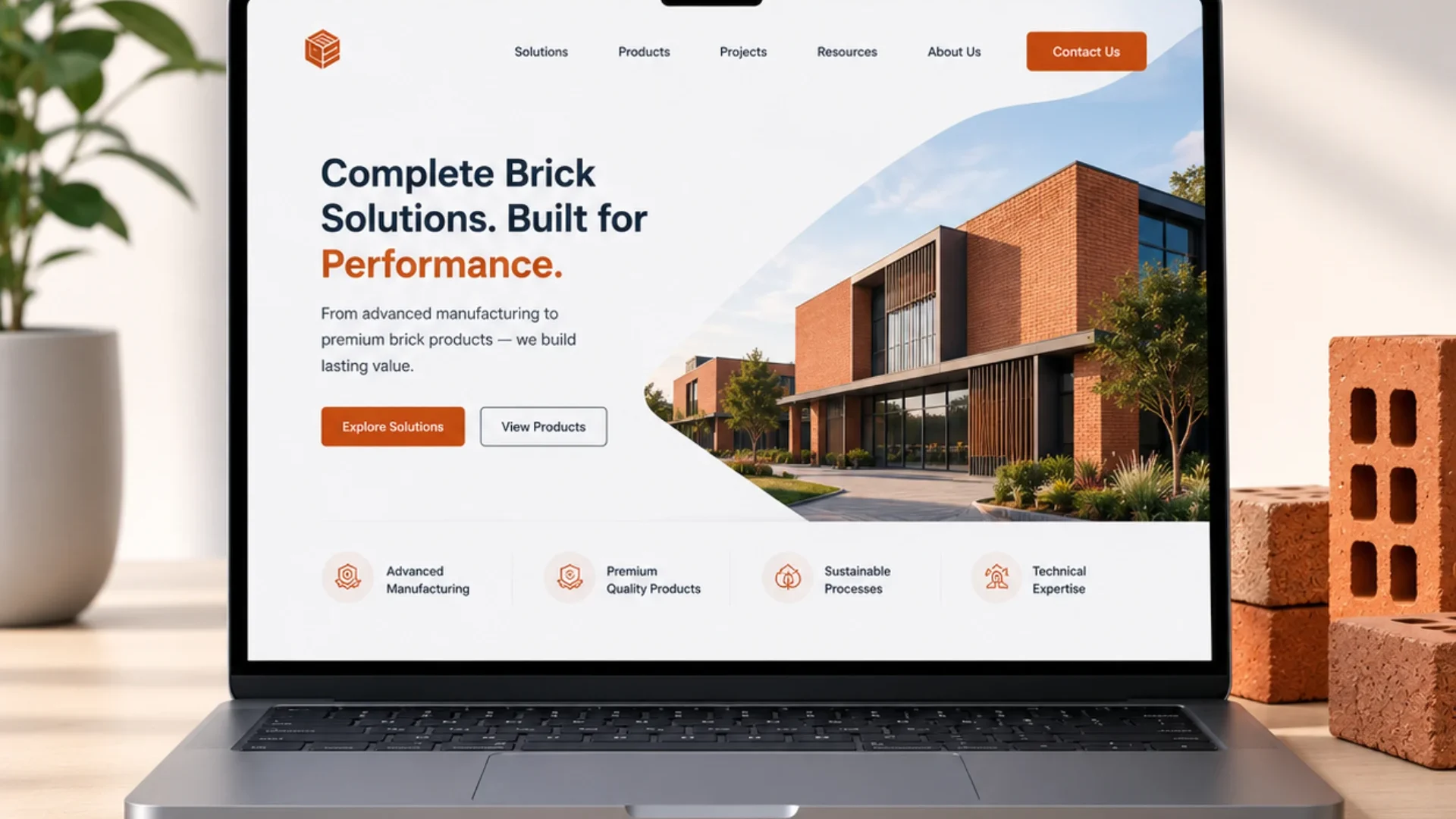
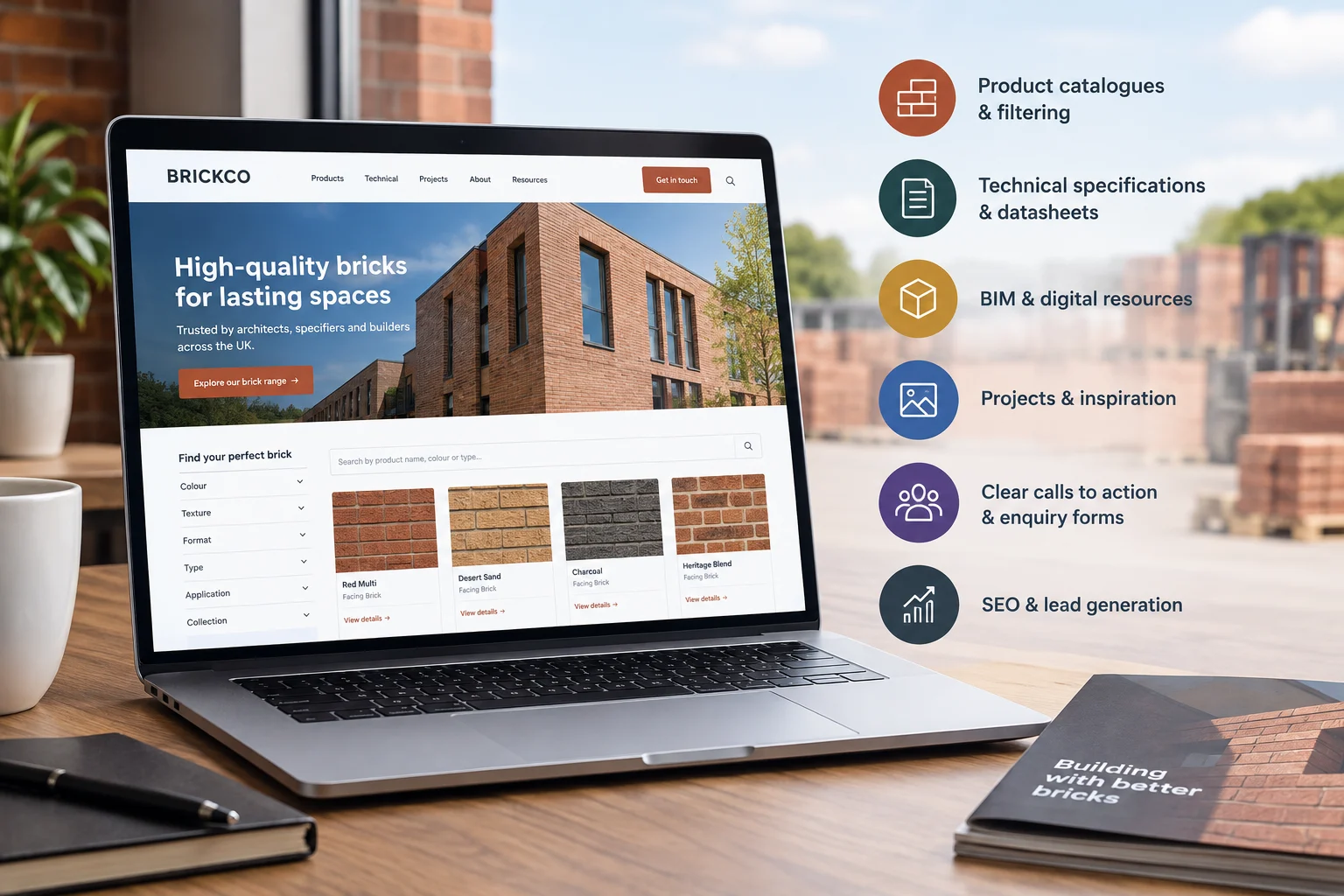
A modern brick manufacturing website should do more than display products and company information. It should help architects, specifiers, housebuilders, developers, contractors, merchants and other B2B buyers find the right brick, understand the product, access technical information and take the next step towards an enquiry.
For UK brick manufacturers, this makes web design a commercial issue as well as a branding issue. A well-structured website can support product discovery, specification, search visibility and lead generation at the same time.
This is also reflected in how established UK brick manufacturers structure their digital experiences. Major manufacturers provide product selectors, technical documentation, BIM resources, project information and other tools designed around professional users rather than treating the website as a simple online brochure.
So, what should a modern brick manufacturing website include?
1. A clear and easy-to-use product catalogue
For most brick manufacturing companies, the product catalogue is one of the most important sections of the website.
Brick ranges can contain large numbers of products with differences in colour, texture, size, format, application, collection and technical characteristics. A visitor should not have to browse through long pages to find a suitable product.
A strong web design for brick manufacturing companies should make product discovery simple through:
- Product categories
- Search functionality
- Filters
- Product attributes
- Related products
- Application-based navigation
- Clear product photography
- Easy access to technical information
For example, Ibstock provides a brick selector with filtering options that help users narrow products by characteristics such as factory, colour, type and texture. This type of functionality is particularly useful for large product ranges.
The objective is not simply to make the website look better. It is to reduce the time between “I am looking for a brick” and “I have found the right product.”
2. Dedicated, information-rich product pages
Every major product should have a page that gives the visitor enough information to evaluate it.
A useful product page can include:
- Product name and reference
- High-quality product images
- Colour and texture information
- Dimensions and format
- Technical characteristics
- Applications
- Certifications
- Technical datasheets
- BIM resources
- Sustainability information
- Related products
- Project examples
- Sample requests
- Sales or technical enquiries
This approach is already common among leading UK building-product manufacturers. Wienerberger, for example, provides product information alongside technical documentation, BIM resources and other downloadable materials.
For a brick manufacturer, the product page should become the central information point for that product, not just a page with a photograph and a short description.
3. Product search and filtering
Search and filtering become increasingly important as a manufacturer adds more products.
An architect may know the colour they want.
A specifier may need a particular technical characteristic.
A housebuilder may be looking for a product suitable for a particular development.
A contractor may need to identify a specific product quickly.
Your website should support these different ways of searching.
Depending on the range, useful filters may include:
Colour → Texture → Format → Type → Application → Collection → Factory → Technical characteristics
The exact filtering structure should reflect how your customers actually choose products.
This is where web design for the brick manufacturing industry needs to go beyond visual design and consider information architecture, user experience and product data.
4. Technical specifications that are easy to find
Architects and specifiers often need more than product imagery.
They may need technical datasheets, declarations, certifications, performance information, installation guidance, CAD files, BIM objects and sustainability documentation before they can make a specification decision.
The important point is accessibility.
Technical information should be connected to the relevant product and easy to locate.
For example, Forterra provides technical information, datasheets, certification resources, BIM resources and technical tools as part of its online product support.
A better structure is:
Product → Technical Information → Download → Specification
Rather than:
Product → Generic Downloads → Search through unrelated documents
That small difference can have a major effect on usability.
5. BIM and digital specification resources
Professional construction audiences increasingly expect digital product information to be available online.
Where appropriate, brick manufacturers can make BIM objects, CAD files and other specification resources accessible directly from product pages or a dedicated resource centre.
The important part is not simply having the files. Users should be able to find them quickly and understand what each resource is for.
A strong website can make this journey straightforward:
Find product → View resources → Select BIM/CAD/document → Download
Wienerberger, for example, provides digital product resources including BIM objects and CAD-related information within its online technical ecosystem.
For manufacturers targeting architects and specifiers, this can also strengthen the wider role of the website in the specification process.
6. Project case studies and architectural inspiration
Brick is a highly visual product, so a modern brick manufacturing website should show how products are used in real projects.
Project content can demonstrate:
- How a brick looks in a completed building
- Different laying patterns
- Colour combinations
- Building types
- Architectural applications
- Product performance in context
- The relationship between product and design
This content is useful for users, but it can also support search visibility and content marketing by creating dedicated pages around products, projects, applications and building types.
A well-designed project section can therefore support both branding and lead generation for brick manufacturing companies.
7. Clear calls to action
One of the biggest mistakes in B2B manufacturing website design is assuming that a visitor will automatically know what to do next.
A generic Contact Us button is useful, but it should not be the only conversion option.
Depending on your business model, visitors may want to:
- Request a sample
- Request a quotation
- Ask a technical question
- Find a stockist
- Discuss a project
- Request product information
- Speak to sales
The call to action should match the user’s stage in the buying journey.
For example, someone looking at a specific brick may be more likely to click Request a Sample than a generic Contact Us button.
This is where lead generation for the brick manufacturing industry becomes part of web design rather than a separate activity.
8. A structure based on different B2B buyer journeys
A brick manufacturer may have several audiences visiting the same website.
- Architects may want inspiration, product details and BIM resources.
- Specifiers may prioritise technical documents and certifications.
- Housebuilders and developers may want product suitability, availability and project support.
- Contractors may need straightforward product information and purchasing routes.
- Distributors may have different commercial requirements altogether.
A modern website should accommodate these journeys without creating confusing navigation.
A useful principle is:
Discover → Explore → Evaluate → Specify → Enquire
Every major page should help move the visitor naturally towards the next stage.
This is one reason why B2B marketing for brick manufacturing companies should be considered when planning website architecture.
9. Search-engine-friendly website architecture
A modern brick manufacturing industry web design service should also consider how search engines understand the website.
Each important product, category, application, project and resource should have a clear purpose.
For example, a manufacturer could potentially create useful, indexable content around:
- Brick products
- Brick colours
- Brick textures
- Brick types
- Brick applications
- Product specifications
- BIM resources
- Project case studies
- Technical information
- Sustainability resources
The aim is not to create pages simply because a keyword exists.
Google’s current guidance specifically recommends creating content primarily for people and warns against producing large quantities of pages mainly to capture search variations. Google’s systems are designed to understand relevance even when a page does not contain an exact-match version of every possible query.
For that reason, SEO and web design for brick manufacturing companies should work together, rather than being treated as completely separate projects.
10. Mobile-friendly and fast performance
Professional buyers may access a manufacturer’s website from an office, project site, showroom, home or mobile device.
The website should therefore provide a reliable experience across desktop, tablet and mobile.
Important considerations include:
- Fast-loading pages
- Responsive design
- Easy navigation
- Readable technical information
- Simple enquiry forms
- Optimised product imagery
- Accessible downloads
- Clear calls to action
Google also emphasises page experience and making it easy for visitors to find the information they came for.
A visually impressive website is not enough if users struggle to find a product, open a technical document or submit an enquiry.
11. A scalable content management system
Brick manufacturers often need to manage large amounts of changing information.
- New products may be introduced.
- Old products may be discontinued.
- Technical documents may be updated.
- New projects may be completed.
- Additional BIM files may become available.
The website platform should make these changes manageable without requiring developers to rebuild pages every time something changes.
A scalable website should make it straightforward to manage:
Products → Categories → Technical documents → Projects → Resources → Content → Enquiries
This is particularly important for growing brick manufacturing companies because the website should remain useful several years after launch.
12. Website analytics and conversion tracking
A website should not simply generate traffic. You should be able to understand what visitors do after arriving.
Useful measurements can include:
- Product page visits
- Product searches
- Downloads
- Sample requests
- Quote requests
- Technical enquiries
- Contact form submissions
- Calls
- Traffic sources
- Organic search conversions
This helps marketing managers understand which pages are contributing to enquiries and which areas of the site need improvement.
It also creates a stronger foundation for wider brick manufacturing industry digital marketing services, including SEO, content marketing, PPC and future conversion optimization.
What makes a brick manufacturing website generate more enquiries?
The key is to connect product discovery with commercial action.
A potential buyer should be able to move through a logical journey:
Find the product → Understand the product → Check technical information → See relevant projects → Take the next step
When this journey is difficult, users may leave the website and look elsewhere.
When it is simple, the website becomes more than a company brochure. It becomes a useful B2B sales and specification platform.
How web design, SEO and lead generation work together
For brick manufacturers, web design should not be developed in isolation.
A strong digital strategy connects:
Web Design
Creates a clear and useful experience.
Development
Makes product catalogues, filters, resources and enquiry functionality work reliably.
SEO
Helps relevant audiences discover products, applications and information through search.
Content Marketing
Provides useful technical, project and educational information.
Lead Generation
Turns relevant website visitors into enquiries.
This integrated approach is particularly valuable because the same website may support several stages of the B2B buying journey.
Final thoughts
The best website for a brick manufacturing company is not necessarily the one with the most visual effects or the largest number of pages.
It is the one that makes it easy for the right person to find the right product, access the right information and take the right next step.
For UK brick manufacturers, that means combining product catalogues, intuitive filtering, technical specifications, BIM resources, project content, SEO-friendly architecture, clear calls to action and measurable conversion paths.
That is the real purpose of web design for the brick manufacturing industry: creating a digital platform that supports product discovery, specification, marketing and B2B lead generation.
At Pixerts, we approach web design for brick manufacturing companies with those commercial goals in mind, combining UX, development, SEO and B2B conversion strategy to create websites that do more than look professional.
Learn more about our Web Design Services for Brick Manufacturing Companies.
Related Questions & Answers
Q: What should a modern brick manufacturing website include?
A: A modern brick manufacturing website should include an easy-to-use product catalogue, search and filtering, detailed product pages, technical specifications, BIM resources, project case studies, clear calls to action and enquiry functionality.
Q: How can a brick manufacturing website generate more B2B enquiries?
A: It can generate more enquiries by making products easy to find, providing the technical information buyers need, showing relevant project examples and using clear conversion paths such as sample requests, quotation requests and technical enquiries.
Q: Why is SEO important for brick manufacturing websites?
A: SEO helps architects, specifiers, developers, housebuilders and other relevant audiences discover products, technical information, applications and project content when they are actively searching online.