What Should a Manufacturing Website Include
A manufacturing website is often the first place buyers evaluate your company.
Before contacting your sales team, engineers, procurement managers, and sourcing professionals want answers to critical questions:
- Can this company meet our requirements?
- Do they have relevant experience?
- What certifications do they hold?
- What industries do they serve?
- How can I request a quote?
If your website doesn’t answer these questions quickly, potential customers may move on to competitors.
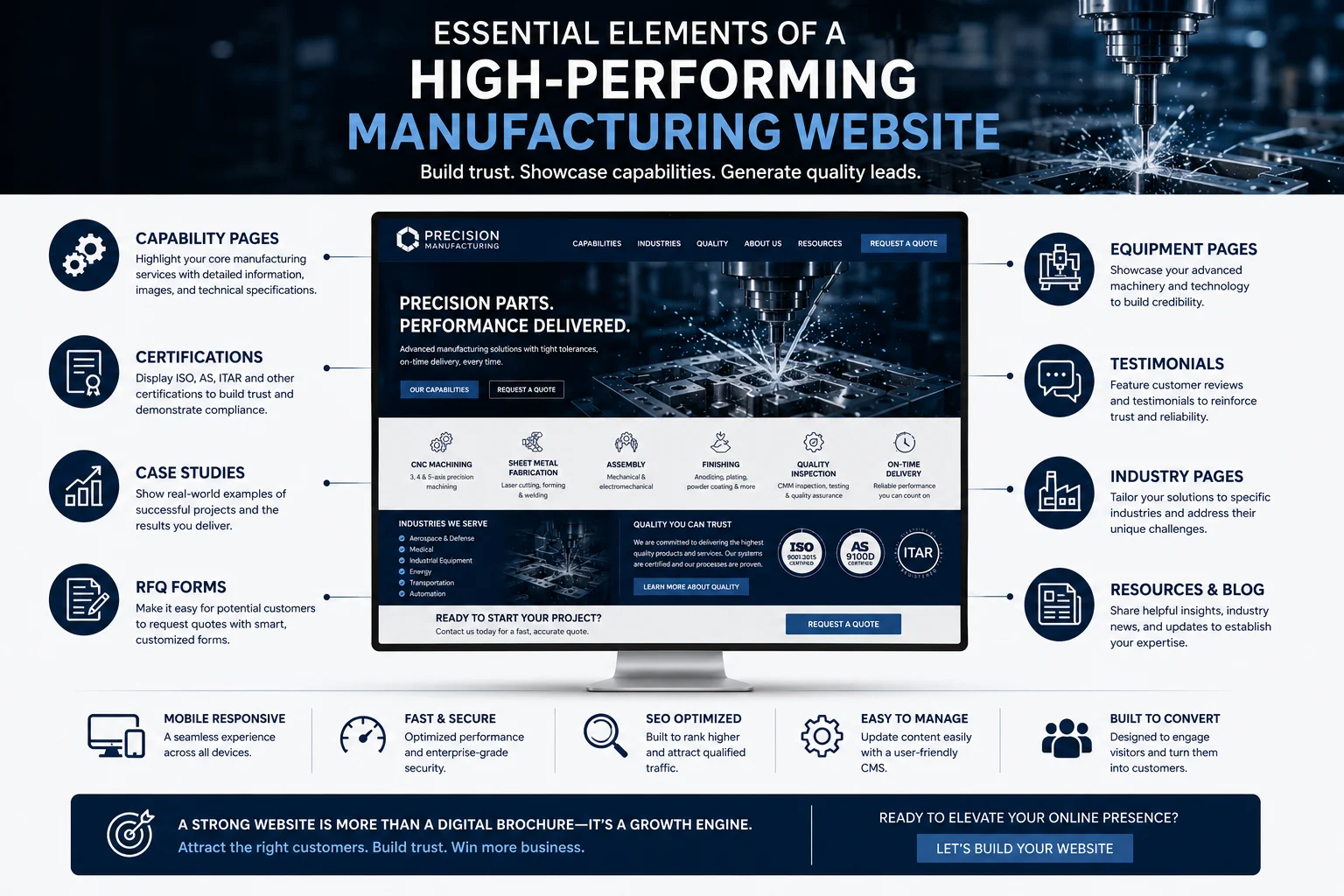
In this guide, we’ll cover the essential elements every manufacturing website should include to improve credibility, generate more RFQs, and support business growth.
Why Manufacturing Websites Matter
Today’s manufacturing buyers complete a significant portion of their research before speaking with a supplier. Your website serves as:
- A credibility builder
- A lead generation tool
- A technical resource
- A sales support platform
A well-structured website can help buyers move from research to quote request much faster.
1. A Clear Value Proposition
Visitors should understand within seconds:
- What you manufacture
- Who you serve
- What makes you different
Avoid vague statements like:
“Providing quality solutions since 1995.”
Instead, use specific messaging:
“Precision CNC machining services for aerospace, medical, and industrial manufacturers.” Clarity builds trust immediately.
2. Detailed Capability Pages
Capability pages are often the most visited pages on manufacturing websites. Examples include:
- CNC Machining
- Injection Molding
- Sheet Metal Fabrication
- Welding Services
- Assembly Services
- Precision Manufacturing
Each capability should explain:
- Process details
- Materials supported
- Tolerances Equipment used
- Industries served
The more specific the information, the more confident buyers become.
3. Industry-Specific Pages
Many manufacturers serve multiple industries. Create dedicated pages for:
- Aerospace
- Automotive
- Medical Devices
- Electronics
- Defense
- Industrial Equipment
Industry pages help buyers see relevant expertise and improve SEO visibility.
4. An Easy-to-Use RFQ Form
The RFQ form is one of the most important conversion points on your website. Include fields such as:
- Name
- Company
- Project requirements
- Material specifications
- File uploads
Make the process simple and intuitive. Complicated forms often reduce conversion rates.
5. Certifications and Compliance Information
Buyers want evidence of quality standards. Display certifications prominently:
- ISO 9001
- ISO 13485
- AS9100
- ITAR Compliance
- FDA Registration
Certification badges can significantly increase trust.
6. Equipment and Technology Pages
Many buyers want to know:
- What machines do you use
- Production capabilities
- Capacity information
- Technical specifications
Equipment pages help establish credibility and technical competence.
7. Case Studies and Success Stories
Case studies provide proof that you can deliver results. Include:
- Customer challenges
- Your solution
- Outcomes achieved
- Project highlights
Case studies help buyers imagine working with your company.
8. High-Quality Manufacturing Photography
Avoid generic stock photos whenever possible. Show:
- Your facility
- Production equipment
- Team members
- Quality control processes
- Finished products
Authentic visuals increase trust and engagement.
9. Customer Testimonials
Social proof helps reduce buyer uncertainty. Strong testimonials should include:
- Company name
- Industry
- Specific results
- Real customer feedback
Specific testimonials are more persuasive than generic praise.
10. About Us Page
Your About page should explain:
- Company history
- Team expertise
- Mission
- Manufacturing philosophy
- Core values
Buyers often review the About page before making contact.
11. Contact Information on Every Page
Never make visitors search for contact details. Include:
- Phone number
- Email address
- Location
- Contact form
Easy access improves conversion opportunities.
12. Mobile-Friendly Design
Many B2B buyers conduct research from mobile devices. Your website should:
- Load quickly
- Be easy to navigate
- Display properly on all screen sizes
A poor mobile experience can drive potential customers away.
13. SEO-Optimized Content
A manufacturing website should be built with search visibility in mind. Key SEO elements include:
- Optimized page titles
- Meta descriptions
- Internal linking
- Keyword-focused content
- Structured data
SEO helps buyers discover your business during supplier research.
14. Resource Center or Knowledge Base
Educational content builds authority and attracts organic traffic. Examples include:
- Manufacturing guides
- Industry insights
- Technical articles
- Q&A resources
- Process explanations
Content can help generate leads long before buyers are ready to request a quote.
15. Clear Calls-to-Action
Every page should guide visitors toward the next step. Examples include:
- Request a Quote
- Schedule a Consultation
- Contact Our Team
- Download Capability Statement
Clear CTAs help convert visitors into opportunities.
Common Manufacturing Website Mistakes
Many manufacturing websites fail because they:
- Use generic messaging
- Hide RFQ forms
- Lack of capability details
- Ignore mobile users
- Have outdated designs
- Provide little technical information
Removing these barriers can significantly improve performance.
Manufacturing Website Checklist
Before launching your website, confirm that you have:
✅ Clear value proposition
✅ Capability pages
✅ Industry pages
✅ RFQ form
✅ Certifications
✅ Equipment information
✅ Case studies
✅ Customer testimonials
✅ About page
✅ Contact information
✅ Mobile optimization
✅ SEO foundation
✅ Resource center
✅ Strong CTAs
Final Thoughts
The best manufacturing websites help buyers quickly answer one question:
“Can this company solve my problem?”
By providing detailed capability information, trust signals, case studies, certifications, and easy quote request options, manufacturers can improve credibility, generate more RFQs, and support long-term growth.
A manufacturing website should not simply look professional—it should actively help buyers make purchasing decisions.
FAQs
What pages should every manufacturing website have?
Answer: Most manufacturing websites should include a homepage, capability pages, industry pages, RFQ page, case studies, About page, and Contact page.
Why are capability pages important?
Answer: Capability pages help buyers understand your services, technical expertise, equipment, and manufacturing processes.
What is the most important feature on a manufacturing website?
Answer: An easy-to-use RFQ form is often the most important feature because it directly supports lead generation and sales opportunities.