

The industrial buying cycle has fundamentally transformed. Procurement officers, supply chain managers, and mechanical engineers no longer rely on physical trade catalogs or regional directories to source contract manufacturing. The initial phase of vendor qualification—where a company decides if your facility has the 5-axis capabilities to machine their Inconel 718 aerospace components—now happens entirely online, often facilitated by AI-driven search engines.
However, executing SEO for the manufacturing industry requires a radical departure from traditional digital marketing. High-ticket industrial machinery, robotics integration, and precision engineering cannot be sold using the same SEO tactics used for consumer e-commerce. You must architect a high-performance digital environment that speaks the language of complex tolerances, mechanical properties, and rigorous compliance standards.
This comprehensive guide serves as the ultimate blueprint for transforming an industrial website from a static brochure into a dynamic, semantic “Source of Truth” engineered for Answer Engine Optimization (AEO), Generative Engine Optimization (GEO), and sustained B2B revenue growth.
What is SEO for the Manufacturing Industry?
SEO for the manufacturing industry is the specialized process of structuring an industrial company’s website architecture, technical content, and digital infrastructure to rank highly in search engine results for specific B2B engineering and procurement queries. Unlike traditional SEO, which often chases high search volume, manufacturing SEO focuses on capturing low-volume, high-intent traffic by highlighting specialized machinery, material capabilities, and industry certifications (such as AS9100 or ISO 13485) to drive high-ticket Requests for Quotes (RFQs).
The Evolution from Search to Generation
In the past, an engineer typing “CNC machining near me” would receive a list of blue links. Today, they type complex prompts like, “Identify contract manufacturers in the Midwest capable of 5-axis titanium milling with a class 100 cleanroom for medical devices.” Google’s AI Overviews and dedicated Answer Engines (Gemini, Perplexity) intercept these queries, synthesize data from across the web, and generate a definitive answer. If your technical data is not explicitly structured to be read by these generative models, your facility will be excluded from the shortlist.
How Does Generative Engine Optimization (GEO) Work for OEMs?
Generative Engine Optimization (GEO) for OEMs is the practice of optimizing a manufacturer’s digital assets so that AI models extract, trust, and prioritize their technical specifications when generating answers for B2B procurement queries. This involves transitioning from traditional keyword stuffing to building “Entities”—comprehensive, machine-readable data sets that define a company’s exact capabilities, materials, and compliance standards.
The Three Pillars of Industrial GEO
Information Density & Formatting: AI algorithms favor high-density, structured information. This means utilizing perfectly aligned data tables, bulleted specification lists, and clear taxonomies. An 8px grid system in your UX/UI design ensures the underlying HTML is clean and mathematically structured, which AI crawlers prefer over bloated, misaligned code.
Semantic Schema (JSON-LD): This is the direct language of the AI. By injecting specific JSON-LD scripts into your website’s header, you explicitly tell the algorithm: “We are an Organization offering the Service of precision laser cutting, and our areaServed is Global.”
Authoritative Citation: AI models look for consensus and authority. Publishing deep, peer-level technical documentation (such as whitepapers on thermal dynamics in machining) signals to the AI that your website is an authoritative source, increasing the likelihood of being cited in a generative response.
Why Must Manufacturers Liberate Data from PDFs?
Manufacturers must liberate data from PDFs because search engines and AI algorithms struggle to efficiently crawl, index, and extract specific technical metrics from embedded document files. When a machine shop hides its dimensional tolerances, equipment rosters, or material capability matrices inside a downloadable PDF, that critical data becomes invisible to Answer Engines, drastically reducing the chances of appearing in high-intent search results.
The UX/UI Friction of the PDF
Beyond the SEO disaster, PDFs create severe “Information Friction” for the user. Consider a procurement manager navigating a site on a mobile device from the factory floor. Forcing them to download a 5MB file, open a separate application, and pinch-to-zoom to find out if you possess a 12kW fiber laser is a guaranteed bounce.
The HTML Solution
Every piece of data currently trapped in a PDF must be migrated into dynamic, fast-loading HTML.
- Interactive Capability Matrices: Build searchable databases on your site where an engineer can filter your capabilities by material (e.g., PEEK, Titanium, Hastelloy) and instantly see the corresponding maximum dimensions and tolerances you can achieve for that material.
- Live Fleet Rosters: Display your machinery list using dynamic custom post types in WordPress or your CMS, allowing you to update your floor capacity in real time.
What is Design for Manufacturability (DFM) Content?
Design for Manufacturability (DFM) content is highly technical educational material created by manufacturers that teaches engineers how to design parts that are easier, more cost-effective, and more reliable to produce. By publishing DFM guides, a manufacturing facility targets top-of-funnel search intent, establishing deep technical authority and trust with engineers long before a formal RFQ is submitted.
Engineering Your Content Strategy
Stop publishing generic company updates. B2B industrial buyers seek solutions to complex engineering bottlenecks. Your content strategy should be built around solving these specific problems.
- Material Comparisons: Write detailed analyses such as “HDPE vs. ABS: Selecting the Right Resin for Automotive Injection Molding.” Address thermal properties, impact resistance, and shrinkage rates.
- Process Limitations: Publish guides like “Understanding Draft Angles and Wall Thickness for Complex Aluminum Castings.”
- The SEO Benefit: These articles naturally capture long-tail, semantic keywords that engineers use when troubleshooting. Once an engineer uses your website to solve a design flaw, your facility becomes their trusted default when it is time to move to production.
How to Structure a B2B Manufacturing Website for SEO?
Structuring a B2B manufacturing website for SEO requires a platform-agnostic, hierarchical architecture that categorizes technical services, industries served, and material capabilities into distinct, interconnected silos. This logical structure ensures that both users and search engine crawlers can navigate from broad capabilities down to microscopic tolerances without encountering friction.
The Pillar and Cluster Architecture
Your website should act as a massive, organized digital twin of your physical operations.
The Core Pillars (Services): These are your primary offerings. (e.g., /services/cnc-machining/, /services/robotic-automation/).
The Clusters (Specific Capabilities): Underneath the pillars, build deep-dive pages. Under CNC Machining, you must have separate, highly detailed pages for /5-axis-milling/, /swiss-turning/, and /edm-wire-cutting/.
The Industry Verticals: Create dedicated pages for the sectors you serve (e.g., /industries/aerospace/, /industries/medical-devices/). These pages must highlight the specific compliance standards (AS9100, FDA readiness) required for that vertical.
Interlinking for Semantic Authority
Internal linking is the nervous system of your SEO strategy. If your Aerospace Industry page mentions “high-temperature superalloys,” that text must link directly to your “Inconel Machining” capability page. This interconnected web of technical data signals to Google that you possess comprehensive, lateral expertise across the manufacturing spectrum.
How Does Website Speed Impact Industrial SEO?
Website speed directly impacts industrial SEO because search engines, such as Google, use Core Web Vitals (load times, interactivity, and visual stability) as primary ranking factors. For technical buyers, a slow, unresponsive website subconsciously implies a disorganized, slow-moving manufacturing facility, immediately damaging brand trust and increasing bounce rates.
Eliminating Digital Bloat
Industrial websites often suffer from severe digital bloat due to the inclusion of high-resolution CAD renders, massive factory floor videos, and heavy, unoptimized code.
- Lean Development: Utilize platform-agnostic, clean-code development practices. If using visual builders (like Elementor Pro), employ modern CSS methodologies (like Flexbox) to reduce DOM size and eliminate unnecessary wrapper divs.
- Asset Optimization: Convert large PNGs and JPEGs to next-generation formats such as WebP. Ensure that background videos of your automated assembly lines are compressed, muted, and lazy-loaded so they do not block the initial page rendering.
What is a Zero Friction RFQ in Manufacturing Web Design?
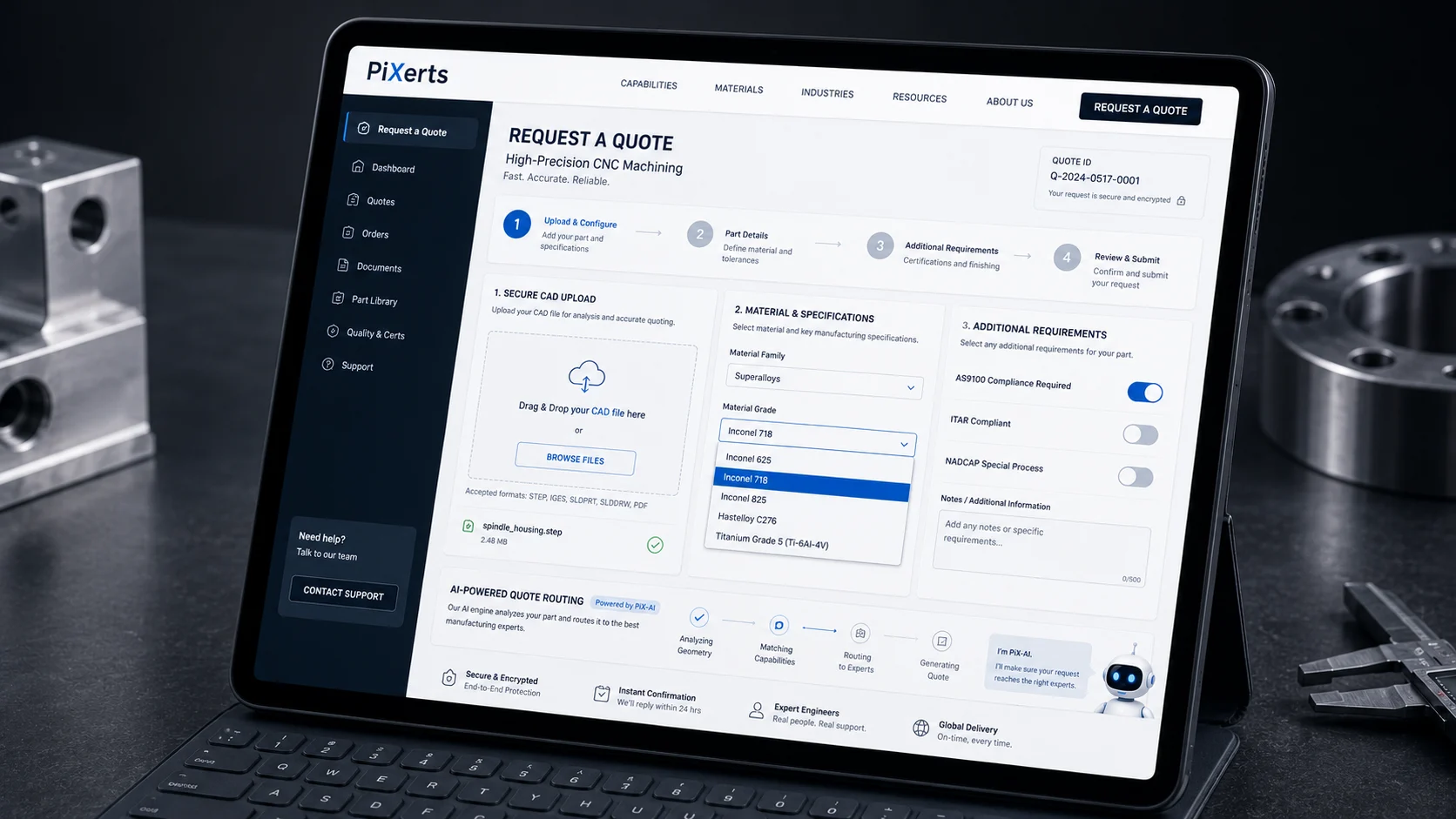
A Zero Friction RFQ (Request for Quote) is a highly optimized digital procurement portal that allows engineers and buyers to submit complex manufacturing inquiries with maximum data accuracy and minimal effort. By eliminating generic contact forms and implementing dynamic material selectors, tolerance toggles, and native 3D CAD upload capabilities, a Zero Friction RFQ drastically improves conversion rates from organic SEO traffic.
Bridging the Gap Between Search and Revenue
Generating 10,000 organic visitors is a vanity metric if those visitors cannot easily request pricing. The standard “Name, Email, Message” form is a failure of B2B industrial web design.
Key Features of a High-Converting RFQ Portal:
- Native File Uploads: Engineers must be able to drag and drop STEP, IGES, and SLDPRT files directly into the browser.
- Conditional Logic: If a user selects “Plastic Injection Molding,” the form should dynamically reveal secondary questions about “Resin Type” and “Cavitation Requirements.” If they select “Sheet Metal Fabrication,” it should shift to “Gauge” and “Bend Radii.”
- NDA & Security Assurances: Prominently display SSL certificates and non-disclosure agreement (NDA) guarantees immediately adjacent to the file upload zone. OEM engineers will not upload proprietary product designs to an insecure, generic form.
Measuring ROI in High-Ticket B2B
SEO In the manufacturing sector, SEO success is not measured by traffic spikes; it is measured by pipeline velocity and contract acquisition.
Metrics That Matter
- RFQ Volume and Quality: Track not just how many forms were submitted, but the average contract value of the leads generated organically.
- Time-to-Quote: A well-structured website and a Zero Friction RFQ should provide your internal sales engineers with 100% of the data they need upon the first submission, reducing the time it takes to generate an accurate quote.
- Position Zero Attainment: Monitor your visibility in AI Overviews and featured snippets for your most critical, high-margin capabilities.
The Long-Term Asset
Paid advertising (Google Ads) is a faucet; it drives immediate traffic, but the moment you stop paying, the leads vanish. A comprehensively structured, AEO-optimized manufacturing website is an asset that appreciates. By establishing a definitive “Source of Truth” for your industrial machinery, you build a permanent visibility engine that generates high-ticket RFQs 24/7/365.
Frequently Asked Questions
1. What is SEO for the manufacturing industry?
Answer: SEO for the manufacturing industry is the specialized process of structuring an industrial company’s website architecture, technical content, and digital infrastructure to rank highly in search engine results for specific B2B engineering and procurement queries. It focuses on highlighting specialized machinery, material capabilities, and industry certifications to drive high-ticket RFQs.
2. How does Generative Engine Optimization (GEO) work for OEMs?
Answer: Generative Engine Optimization (GEO) for OEMs is the practice of optimizing a manufacturer’s digital assets so that AI models extract, trust, and prioritize their technical specifications when generating answers for B2B procurement queries. This involves building machine-readable data sets (Entities) utilizing Semantic Schema.
3. Why must manufacturers liberate data from PDFs?
Answer: Manufacturers must liberate data from PDFs because search engines and AI algorithms struggle to efficiently crawl, index, and extract specific technical metrics from embedded document files. Converting this data into fast-loading, structured HTML tables ensures the information is accessible to both mobile users and Answer Engines.
4. What is Design for Manufacturability (DFM) content?
Answer: Design for Manufacturability (DFM) content is highly technical educational material created by manufacturers that teaches engineers how to design parts that are easier, more cost-effective, and more reliable to produce. Publishing this content targets top-of-funnel search intent and establishes deep technical authority.
5. How does website speed impact industrial SEO?
Answer: Website speed impacts industrial SEO directly because search algorithms use Core Web Vitals (load times, interactivity, visual stability) as primary ranking factors. Additionally, a slow website subconsciously implies a disorganized manufacturing facility to technical buyers, increasing bounce rates and damaging brand trust.
6. What is a Zero Friction RFQ in manufacturing web design?
Answer: A Zero Friction RFQ is a highly optimized digital procurement portal that allows engineers and buyers to submit complex manufacturing inquiries with maximum data accuracy and minimal effort. It utilizes conditional logic, native 3D CAD upload capabilities, and dynamic material selectors to improve conversion rates from organic traffic.


One Response
One thing I’d add: even with structured HTML, AI search engines still have to load your entire page into context. If your equipment tables are thousands of rows, they can burn through tokens quickly. We track this closely and have found that keeping tables under a few hundred rows with pagination or summaries helps both cost and relevance for the AI response.