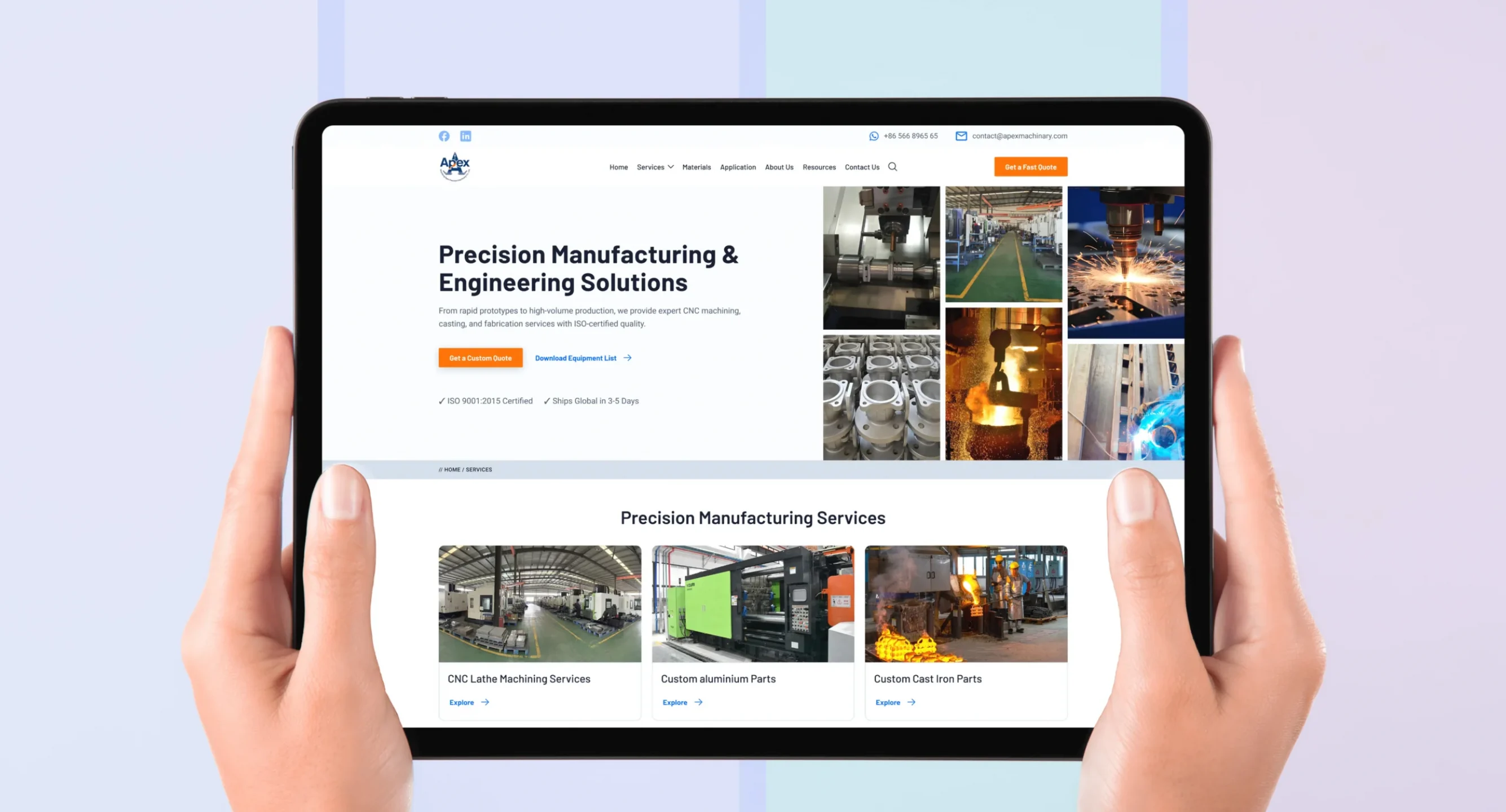
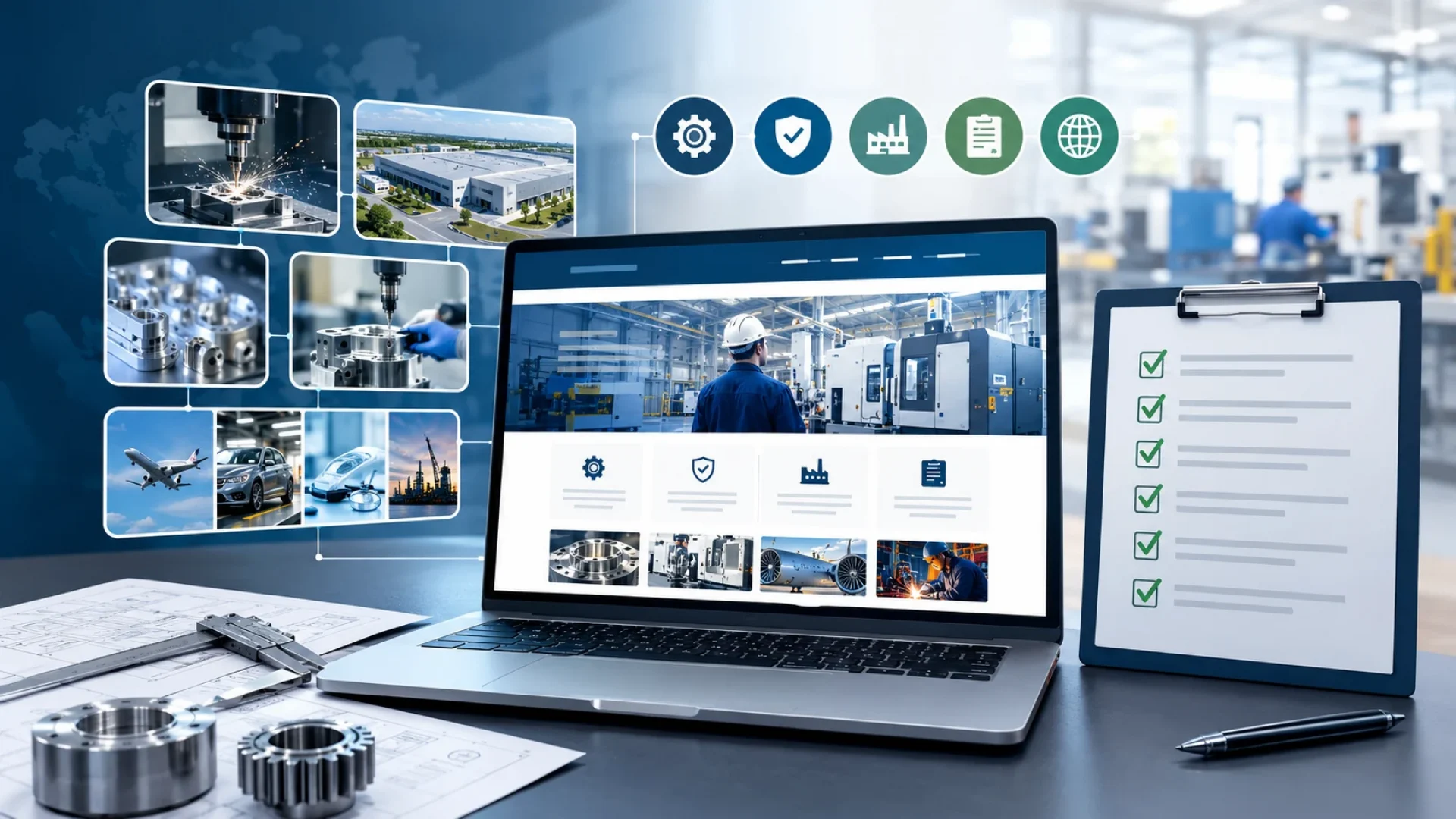
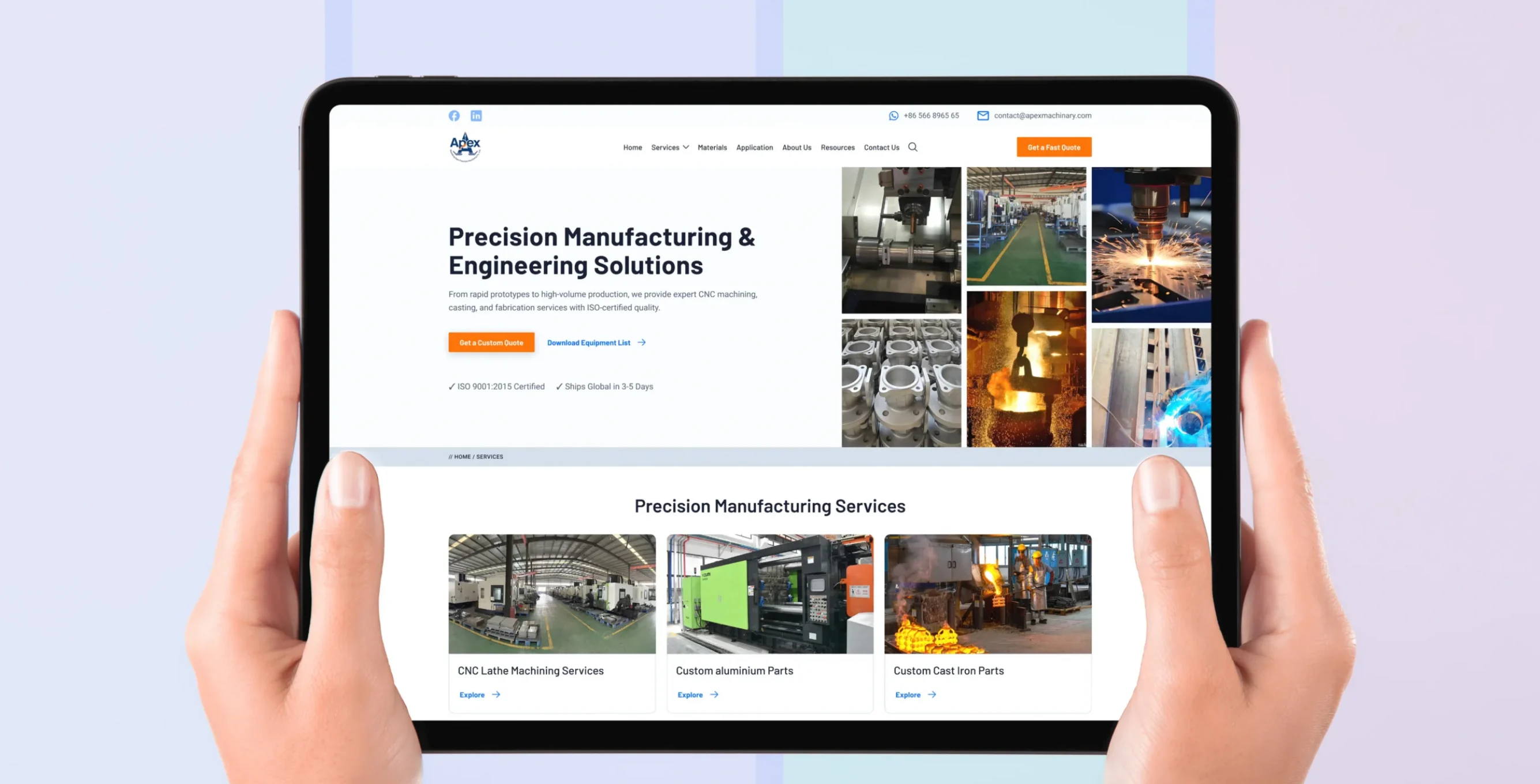
Introduction
Your manufacturing website is no longer just an online brochure. It has become one of your most important sales assets. This insight is covered in the full guide, What Should a Manufacturing Website Include.
Today’s engineers, procurement managers, sourcing specialists, and OEM buyers complete most of their research before contacting a supplier. They compare capabilities, certifications, production capacity, quality systems, and technical expertise—all from your website. If they cannot quickly determine whether your company meets their requirements, they’ll move on to a competitor.
Unfortunately, many manufacturing websites still rely on generic messaging such as “Providing Quality Solutions Since 1995.” While this may communicate longevity, it doesn’t answer the questions buyers actually ask.
Modern industrial buyers want specifics:
- Can you manufacture my product?
- What industries do you serve?
- Which materials can you machine?
- What tolerances can you hold?
- Are you ISO certified?
- Can I upload CAD files?
- How quickly can I receive a quotation?
Most competitor articles cover these basics but stop there. They rarely explain how each element supports the buyer journey, contributes to SEO, or influences conversion rates.
This guide fills those gaps by combining UX, industrial marketing, technical SEO, and B2B buying behavior into a practical framework. Instead of simply listing website features, you’ll learn why they matter and how they work together to attract qualified traffic, build trust, and generate more RFQs.
Whether you’re planning a new website or improving an existing one, this guide will help you create a manufacturing website that serves as a true sales and marketing engine.
Why Manufacturing Websites Matter More Than Ever
Manufacturing purchases are rarely impulse decisions. Buyers often spend weeks or months evaluating suppliers before making contact. During that time, your website acts as your digital sales representative—available 24/7 to answer questions, demonstrate expertise, and establish credibility.
Unlike consumer websites, manufacturing websites serve highly informed audiences who expect technical depth. Engineers want specifications, procurement teams need proof of compliance, and executives look for evidence of stability and experience.
A modern manufacturing website should support every stage of this journey:
- Discovery through search engines and AI-powered search
- Evaluation of capabilities and expertise
- Validation through certifications, case studies, and testimonials
- Conversion via an easy-to-use RFQ process
- Ongoing engagement through resources, technical content, and support
When designed correctly, your website reduces sales friction, shortens buying cycles, and improves lead quality—not just lead quantity.
1. A Clear Value Proposition Above the Fold
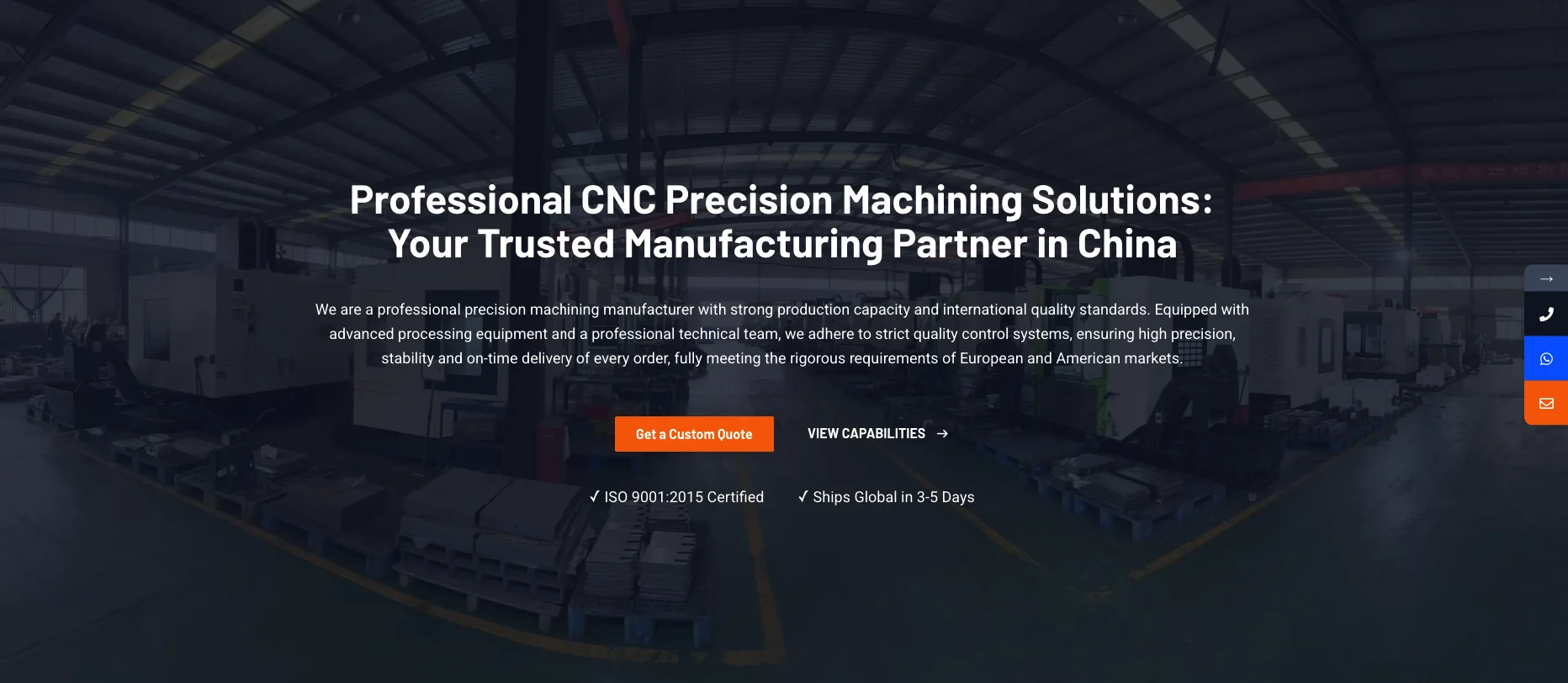
The first few seconds determine whether visitors stay or leave.
Instead of generic slogans, clearly communicate:
- What you manufacture
- Who you serve
- Your core capabilities
- What differentiates your business
For example:
❌ “Delivering Excellence Since 1998.”
✅ “Precision CNC machining services for aerospace, medical, and industrial manufacturers with ±0.005 mm tolerances.”
This level of clarity immediately helps visitors determine whether you’re a suitable supplier while also improving keyword relevance for search engines. Competitor analyses consistently identify vague homepage messaging as one of the biggest reasons manufacturing websites lose potential inquiries.
2. Dedicated Capability Pages
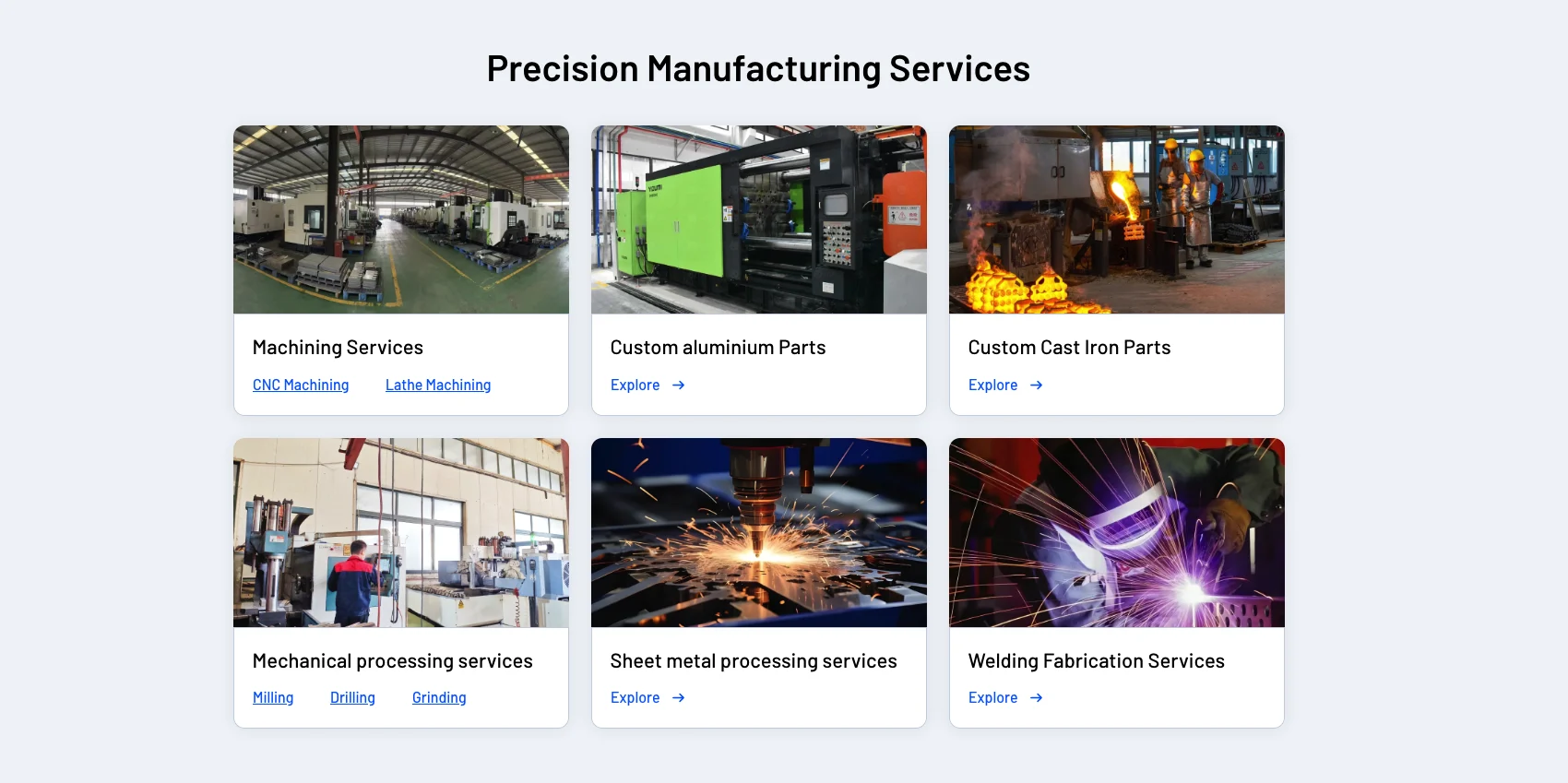
Instead of placing every service on one page, create individual pages for each capability.
Examples include:
- CNC Machining (Check our project)
- Sheet Metal Fabrication
- Injection Molding
- Industrial Automation
- Plastic Extrusion
- Metal Stamping
- Welding
- Assembly
- Surface Finishing
Each page should explain:
- Processes
- Equipment
- Materials
- Tolerances
- Production volumes
- Lead times
- Industries served
- FAQs
- Related case studies
Dedicated pages improve both SEO and usability because buyers often search for specific manufacturing processes rather than company names.
3. Industry-Specific Landing Pages
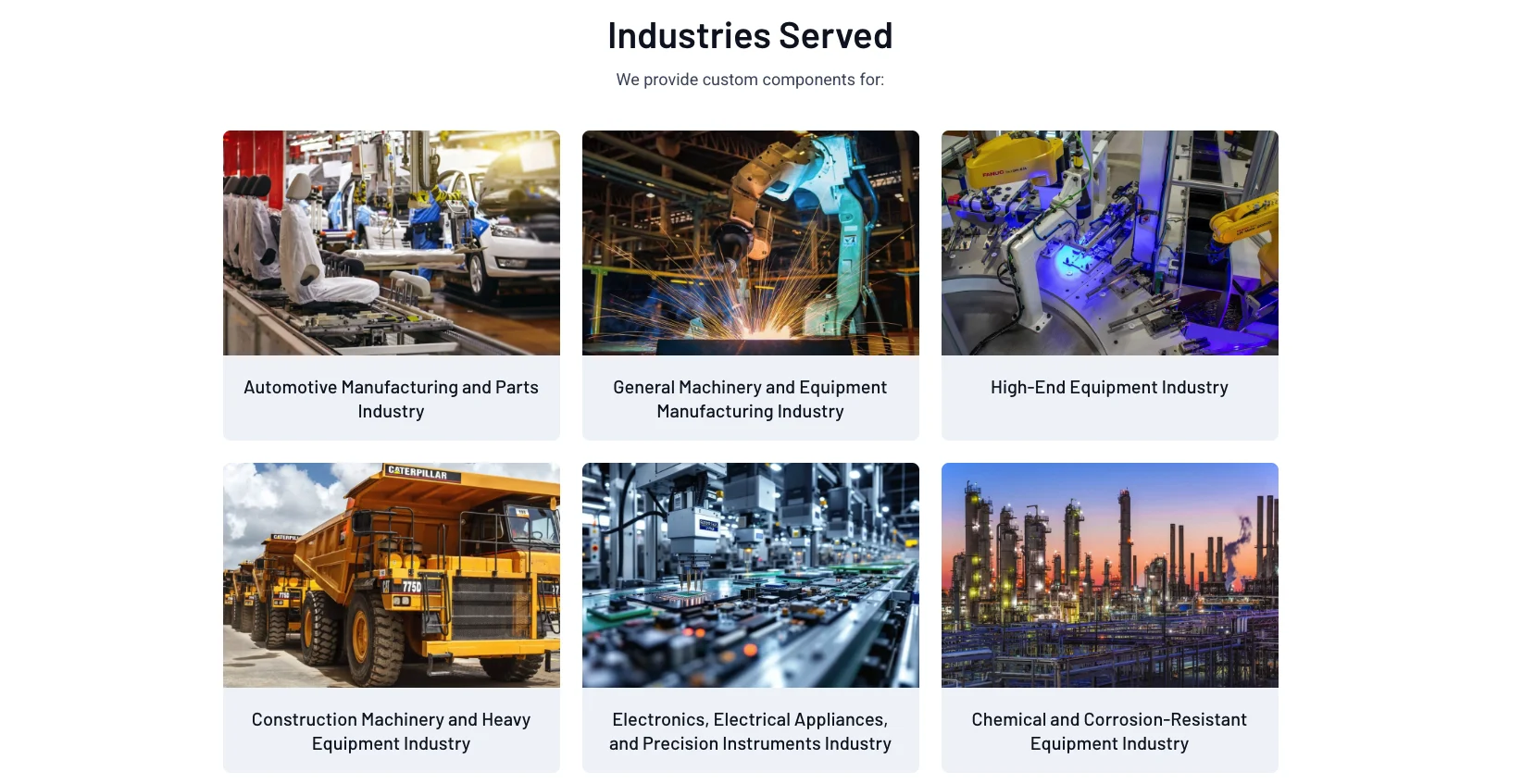
One of the biggest content gaps among competitors is failing to speak directly to different industries.
Instead of a generic services page, create dedicated pages for sectors such as:
- Aerospace
- Automotive
- Medical Devices
- Food Processing
- Electronics
- Construction
- Renewable Energy
- Oil & Gas
- Agriculture
- Defense
These pages should explain:
- Industry regulations
- Typical applications
- Materials
- Quality standards
- Relevant certifications
- Past projects
Industry pages help buyers see themselves in your content while expanding your visibility for long-tail searches like “medical device CNC machining” or “food-grade stainless steel fabrication.”
4. Showcase Your Equipment, Facilities, and Manufacturing Capacity
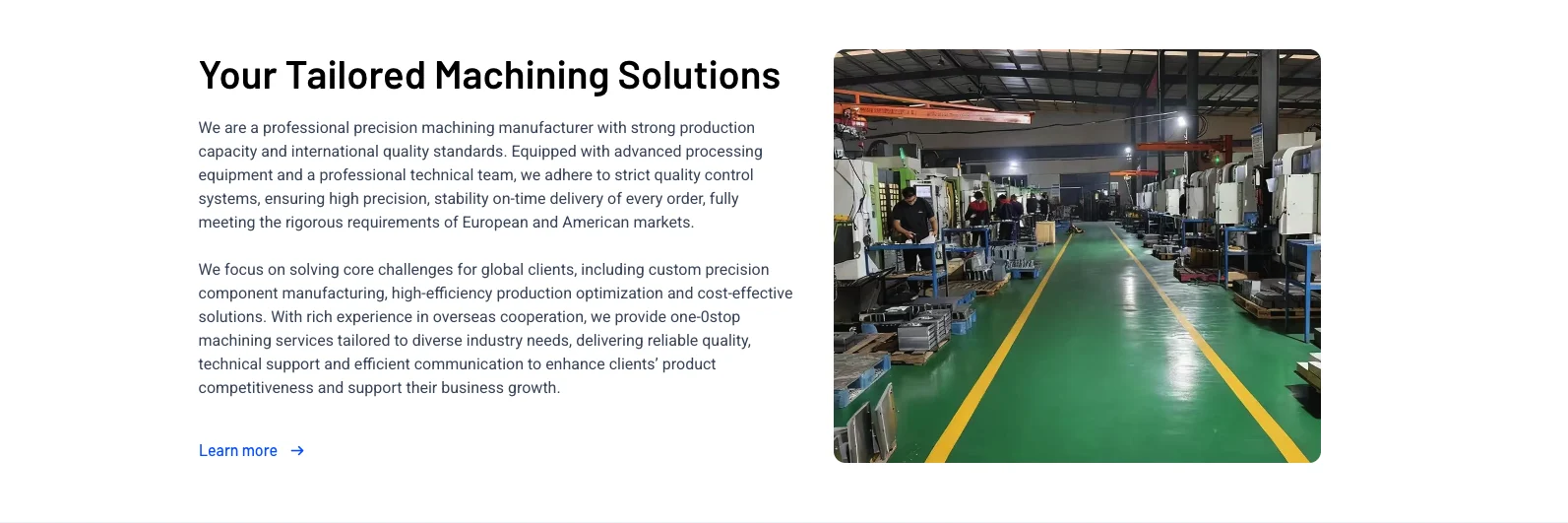
One of the biggest mistakes manufacturing companies make is assuming buyers already know what they’re capable of. In reality, engineers and procurement teams want evidence—not assumptions.
A dedicated Equipment & Facilities page is often one of the most visited sections on a manufacturing website because it answers a critical question:
“Can this supplier actually manufacture my product?”
Instead of simply stating that you have “advanced machinery,” provide concrete details such as:
- Machine brands and models
- Manufacturing processes
- Maximum part dimensions
- Production capacity
- Axis count
- Materials supported
- Inspection equipment
- Automation systems
- Facility size
- Production shifts
For example:
| Weak | Strong |
|---|---|
| Modern CNC Machines | 12 CNC machining centers including Haas VF-4, Mazak Integrex i-200, and DMG MORI 5-axis machining centers capable of ±0.005 mm tolerances. |
Specific information allows buyers to self-qualify before contacting your sales team, saving time for both parties. Competitor research consistently highlights that detailed equipment information improves buyer confidence and reduces unnecessary sales conversations.
Best Practices
Include:
- Factory photographs
- Production videos
- Machine specifications
- Inspection room
- Warehouse
- Assembly line
- Automation systems
- Quality lab
Avoid using stock factory images whenever possible. Authentic visuals establish trust far more effectively than generic industrial photography.
5. Display Certifications and Quality Standards Prominently
For many manufacturers, certifications are not just trust signals—they’re purchasing requirements. If your company is ISO 9001 certified, but visitors must search multiple pages to find the certificate, you’ve already introduced unnecessary friction.
Create a dedicated Quality & Certifications page that includes:
- ISO 9001
- ISO 13485
- AS9100
- IATF 16949
- ITAR Registration
- CE Compliance
- FDA Compliance
- RoHS
- REACH
- Industry-specific approvals
For each certification, explain:
- What it covers
- Why it matters
- Certification scope
- Expiration date (if applicable)
- Accrediting body
Even better, include downloadable certificates and explain how your quality management system supports production.
Additional Trust Signals
Your quality page should also include:
- Inspection process
- Incoming material inspection
- First Article Inspection (FAI)
- Statistical Process Control (SPC)
- PPAP
- Material traceability
- Calibration procedures
- Final inspection workflow
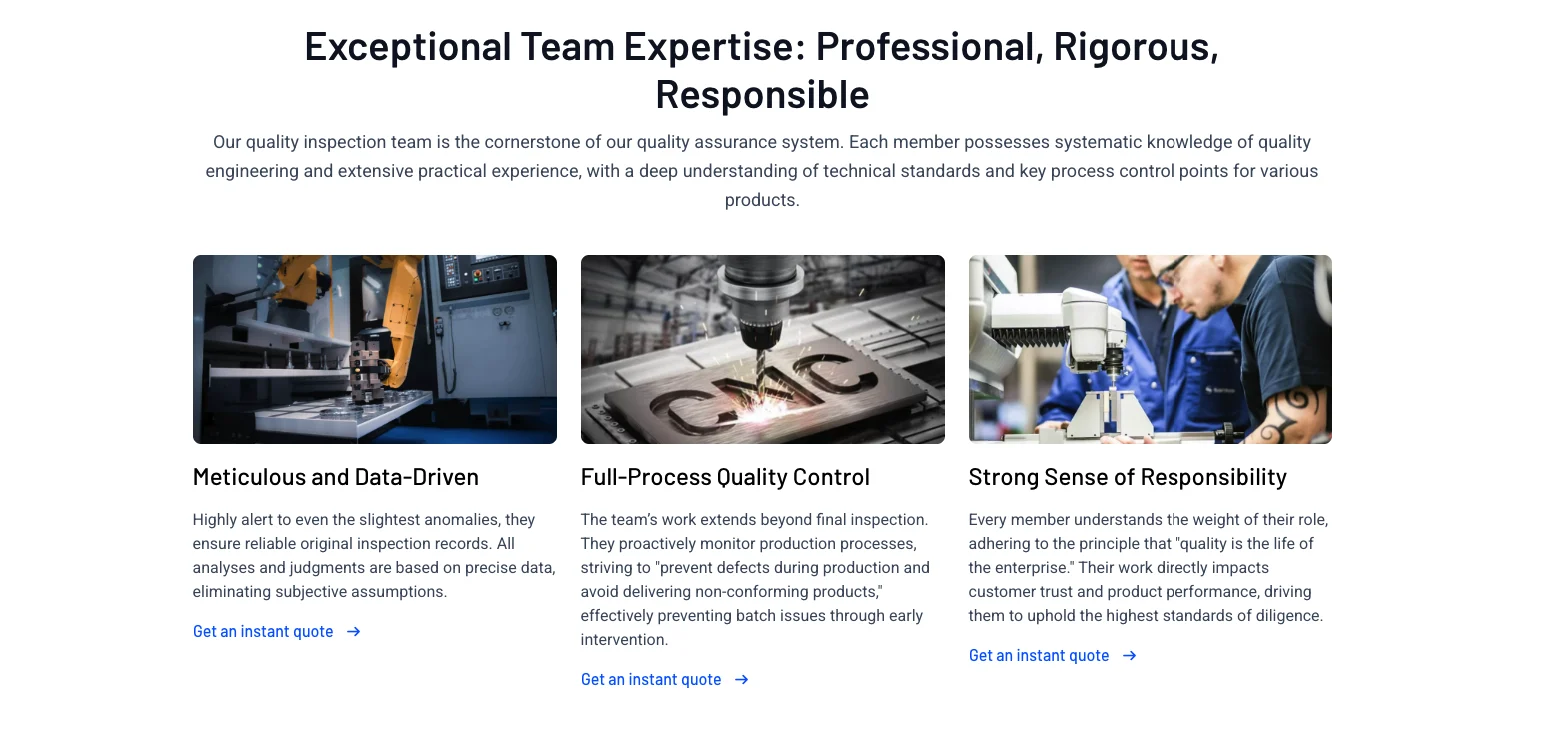
Most competitors stop after listing certification logos. Few explain how these quality systems benefit customers, leaving an opportunity to differentiate through education and transparency.
6. Create Detailed Product Pages (Not Just Catalog Pages)
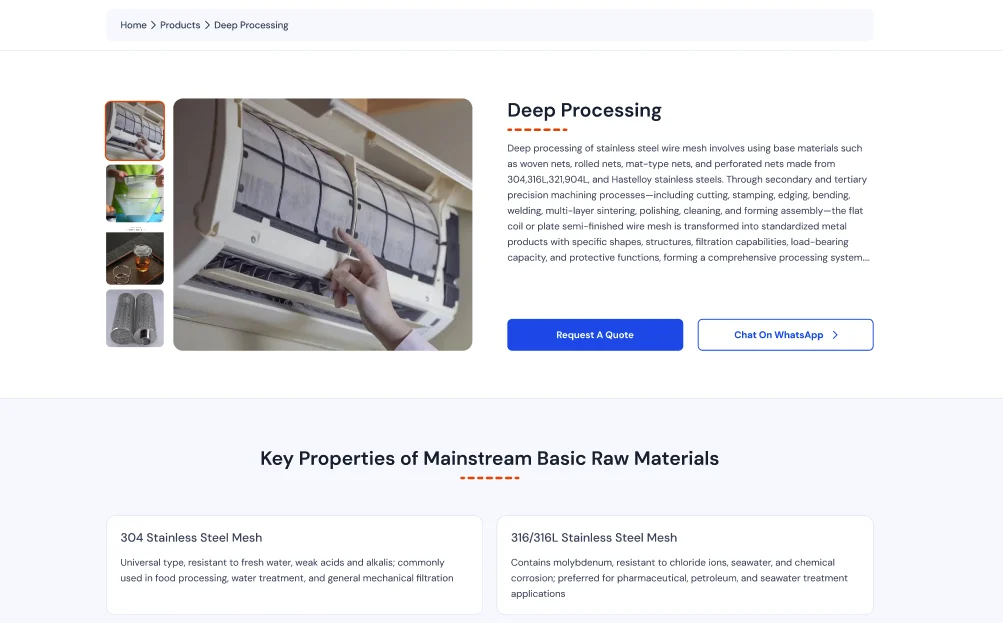
Many manufacturing websites organize products like a printed brochure. While this may look tidy, it doesn’t satisfy technical buyers—or search engines.
Each product should have its own dedicated landing page containing:
Technical Specifications
- Materials
- Dimensions
- Weight
- Tolerances
- Finishes
- Standards
- Operating conditions
Applications
Explain where the product is used. Examples:
- Automotive
- Aerospace
- Medical
- Oil & Gas
- Food Processing
- Construction
Benefits
Don’t simply describe the product.
Explain:
- Why customers choose it
- Problems it solves
- Performance advantages
- Expected lifespan
Downloads
Include:
- CAD Files
- STEP Files
- IGES Files
- Datasheets
- Installation Manuals
- Maintenance Guides
- Related Products
Cross-link similar products to improve navigation while strengthening internal linking for SEO.
7. Publish Real Case Studies Instead of Generic Testimonials
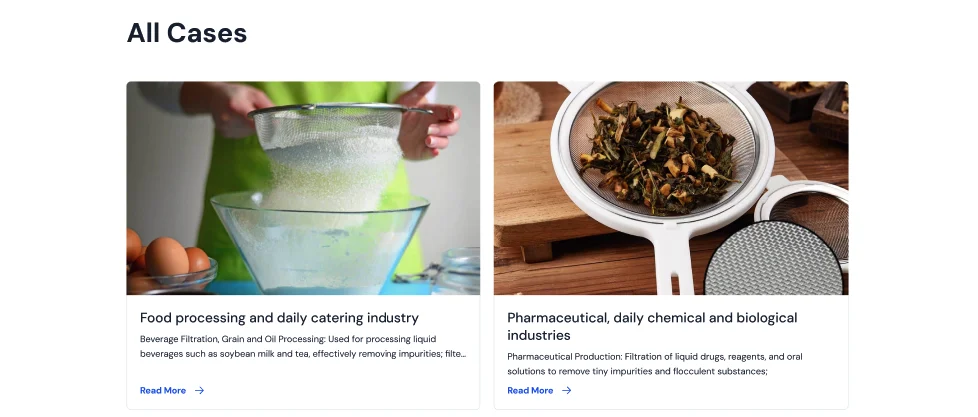
A testimonial saying, “Great company,” has very little persuasive power.
A manufacturing buyer wants evidence.
Instead, create detailed case studies using a consistent framework:
- Problem: What challenge did the customer face?
- Solution: How did your engineering or manufacturing expertise solve it?
- Process: Materials, Production methods, Engineering decisions, Testing, Quality checks
- Results: Use measurable outcomes whenever possible.
Examples:
- Reduced machining time by 35%
- Increased production capacity by 50%
- Reduced part weight by 18%
- Improved durability by 22%
- Delivered 250,000 components with a 99.8% on-time rate
Numbers build credibility far more effectively than marketing language. Competitor articles increasingly recommend quantitative case studies, but few explain how to structure them or connect them to buyer decision-making.
8. Make Requesting a Quote Effortless
Every manufacturing website has one primary conversion goal:
Generate qualified RFQs.
Yet many websites unintentionally make this process difficult by asking for excessive information.
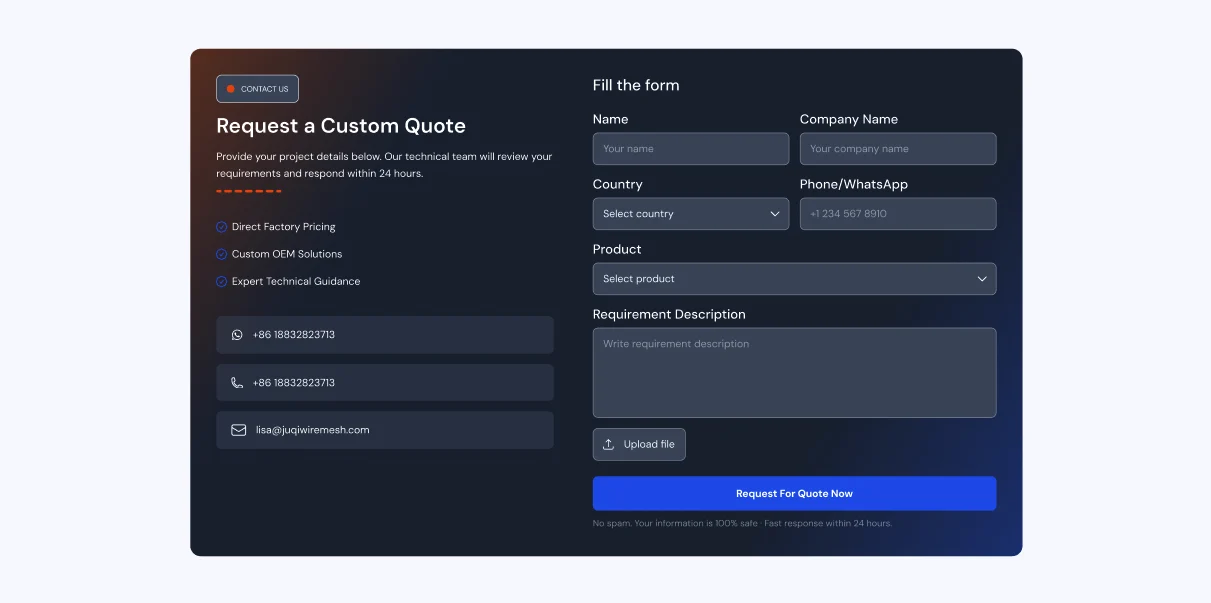
An effective RFQ form should request only what’s necessary to begin the conversation:
- Name
- Company
- Phone (optional)
- Project description
- Quantity
- Material
- Timeline
- Drawing upload (PDF, STEP, DWG, DXF, etc.)
After submission, reassure users by displaying:
- Confirmation message
- Expected response time
- Next steps
- Alternative contact options
For larger projects, consider allowing multiple file uploads or integrating secure document sharing.
Add Multiple Calls-to-Action
Rather than relying on a single “Contact Us” button, place relevant CTAs throughout the site:
- Request a Quote
- Upload Your CAD File
- Talk to an Engineer
- Download Product Catalog
- Book a Consultation
- Discuss Your Project
The easier it is for buyers to take the next step, the more likely they are to convert. Research across manufacturing websites consistently identifies a streamlined RFQ process as one of the highest-impact improvements for lead generation.
9. Build Trust Beyond Certifications
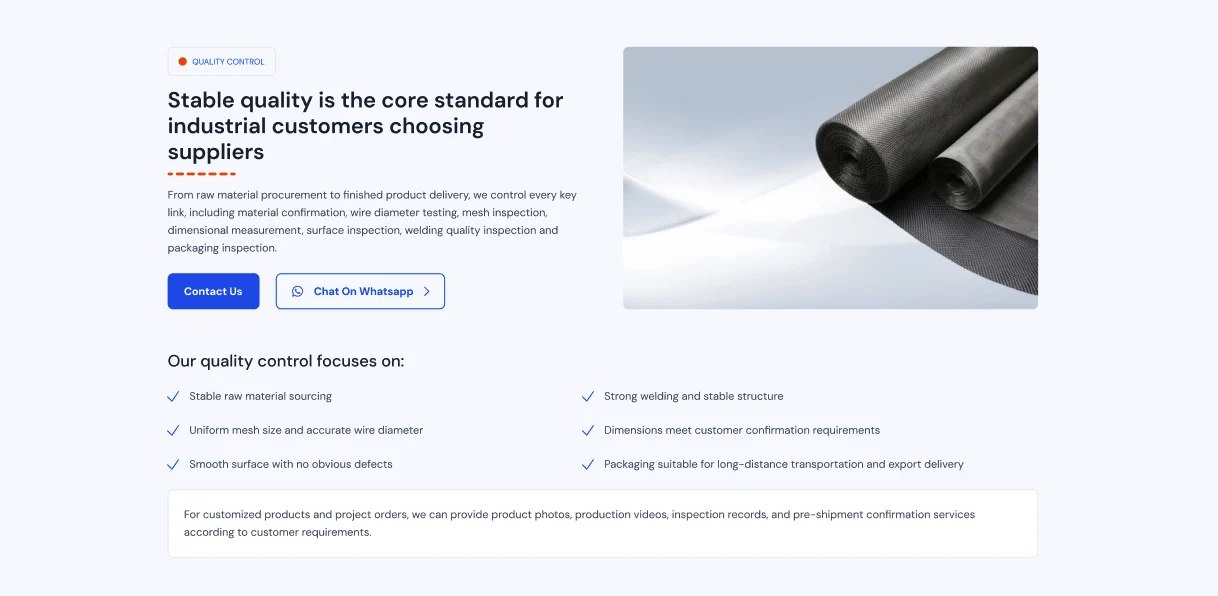
Buyers evaluate suppliers using many subtle signals.
Strengthen credibility by including:
- Years in business
- Leadership team
- Company history
- Factory location
- Global export markets
- Industry memberships
- Awards
- Customer logos (with permission)
- Client testimonials
- Sustainability initiatives
- Safety statistics
- Supplier partnerships
A dedicated About Us page should communicate not only who you are but also why customers can rely on you for long-term partnerships.
10. Optimize for Search Engines and Answer Engines (SEO + AEO)
Getting your website live is only half the battle. If buyers can’t find it when searching for suppliers, it won’t generate consistent RFQs.
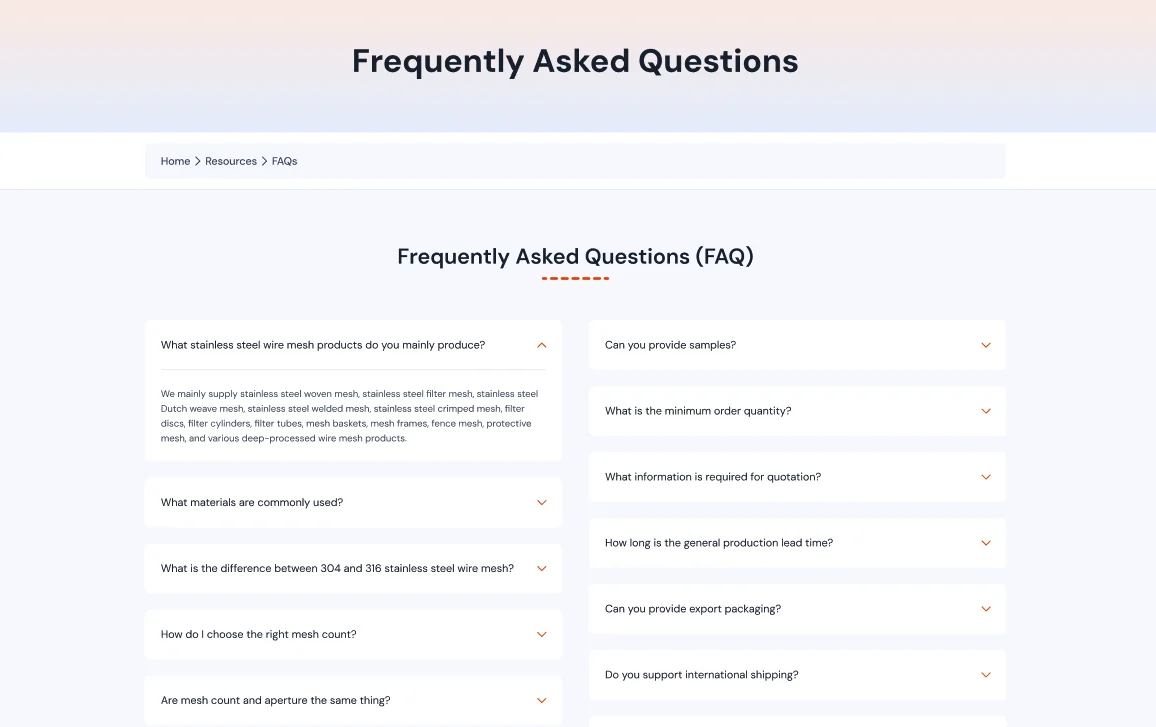
Traditional SEO is still essential, but manufacturing companies now need to optimize for Answer Engine Optimization (AEO) and AI-powered search as well. Engineers increasingly ask conversational questions in Google, AI assistants, and enterprise search tools instead of typing short keywords. Content that answers these questions clearly is more likely to appear in featured snippets and AI-generated responses.
Traditional SEO Essentials
Every manufacturing website should include:
- Keyword-optimized page titles
- Unique meta descriptions
- Logical heading structure (H1–H3)
- Internal linking
- Image alt text
- Optimized URLs
- XML sitemap
- Robots.txt
- Canonical URLs
Instead of targeting broad keywords like:
Manufacturing Company
Target high-intent searches such as:
- CNC machining services UK
- Stainless steel fabrication company
- Plastic injection molding manufacturer
- Custom sheet metal fabrication
- Industrial automation solutions
These keywords align with how buyers actually search for suppliers.
Create Helpful Content Around Buyer Questions
Many competitors focus only on service pages, leaving a major opportunity to rank for informational searches.
Examples include:
- How to choose a CNC machining supplier
- What tolerances should a machine shop guarantee?
- What is contract manufacturing? CNC machining vs casting
- How to prepare CAD files for manufacturing
- How long does injection molding take?
These articles attract engineers earlier in the buying journey and position your company as a trusted resource—not just another supplier.
11. Design Around the Buyer’s Journey, Not Your Organization Chart
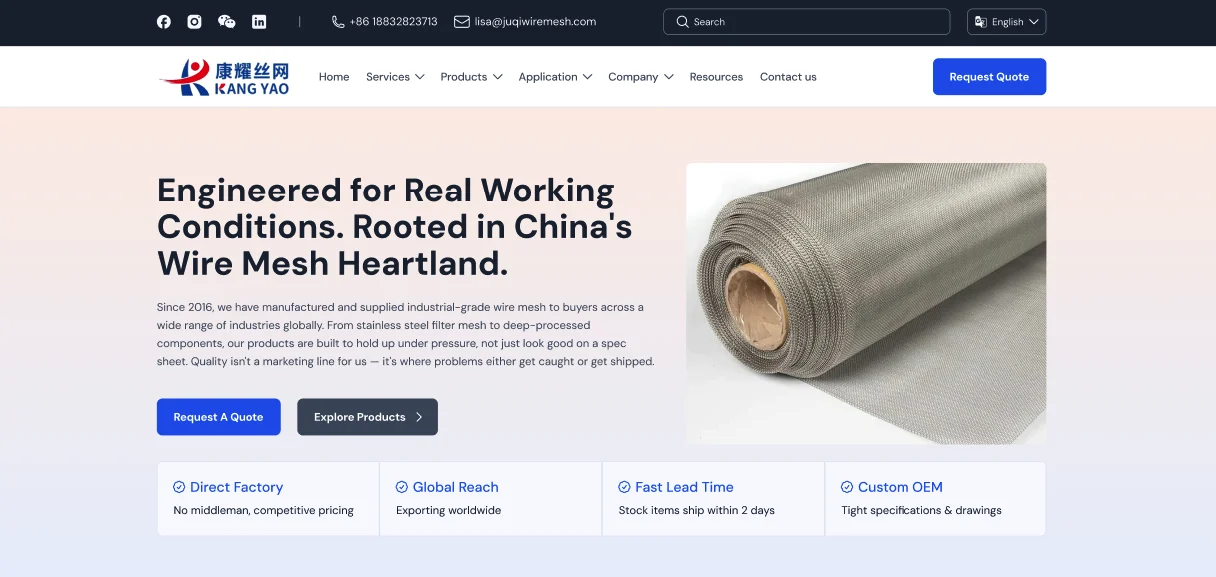
A common weakness among manufacturing websites is organizing navigation around internal departments rather than customer needs.
For example:
Poor Navigation
- Company
- Operations
- Engineering
- Sales
- Resources
This structure reflects the business—not the visitor.
A buyer thinks differently:
- Can you make my product?
- Have you worked with my industry?
- Can I trust your quality?
- How do I request a quote?
Your navigation should mirror those questions.
Recommended Navigation
- Home
- Capabilities
- Industries
- Products
- Quality
- Resources
- Case Studies
- About
- Contact
- Request a Quote
This reduces cognitive effort and helps visitors find answers faster, improving both user experience and conversions.
12. Ensure Excellent Mobile Performance and Accessibility
Although manufacturing is a B2B industry, decision-makers aren’t always sitting at a desktop.
Buyers often review suppliers:
- During plant visits
- While traveling
- At trade shows
- Between meetings
- On factory floors
A slow or difficult-to-use mobile website can cost valuable opportunities.
Performance Checklist
Aim for:
- Mobile-first responsive design
- Fast page load times
- Optimized images (WebP/AVIF)
- Lazy loading
- Clean code
- Passing Core Web Vitals
Accessibility Matters
Accessibility improves usability for everyone and can support SEO.
Include:
- High color contrast
- Descriptive alt text
- Keyboard navigation
- Readable typography
- Clear button labels
- Proper heading hierarchy
- Accessible forms
Accessible websites are easier to use, easier to crawl, and often convert better because they reduce friction.
13. Support Global Buyers with Localization
Many manufacturers serve customers across multiple countries, yet their websites remain tailored to a single market.
If you export internationally, consider:
- Multiple language options
- Localized contact details
- Regional certifications
- Metric and imperial units
- Local currencies (where relevant)
- Export documentation
- Shipping information
Localized content also creates opportunities to rank in international search results.
14. Integrate Your Website with Sales and Marketing Tools
A manufacturing website shouldn’t operate in isolation. Connecting it with your sales ecosystem creates a smoother buyer experience and reduces manual work.
Useful integrations include:
- CRM platforms (e.g., HubSpot or Salesforce)
- Marketing automation
- Live chat
- Meeting scheduling
- RFQ management
- Analytics dashboards
- Email marketing
- ERP integration (where appropriate)
For example, an RFQ submission can automatically:
- Create a CRM contact.
- Notify the sales team.
- Trigger a confirmation email.
- Assign the lead to the correct estimator.
- Start follow-up workflows.
Automation shortens response times and helps prevent missed opportunities.
15. Continuously Measure and Improve
Launching a website is the beginning—not the end. High-performing manufacturing websites evolve based on real user behavior.
Monitor metrics such as:
- Organic traffic
- RFQ submissions
- Conversion rate
- Bounce rate
- Time on page
- Scroll depth
- Top-performing pages
- Exit pages
- Search Console queries
- Heatmaps and session recordings
Regular audits help identify new opportunities and ensure your website continues to align with changing buyer expectations.
Manufacturing Website Checklist
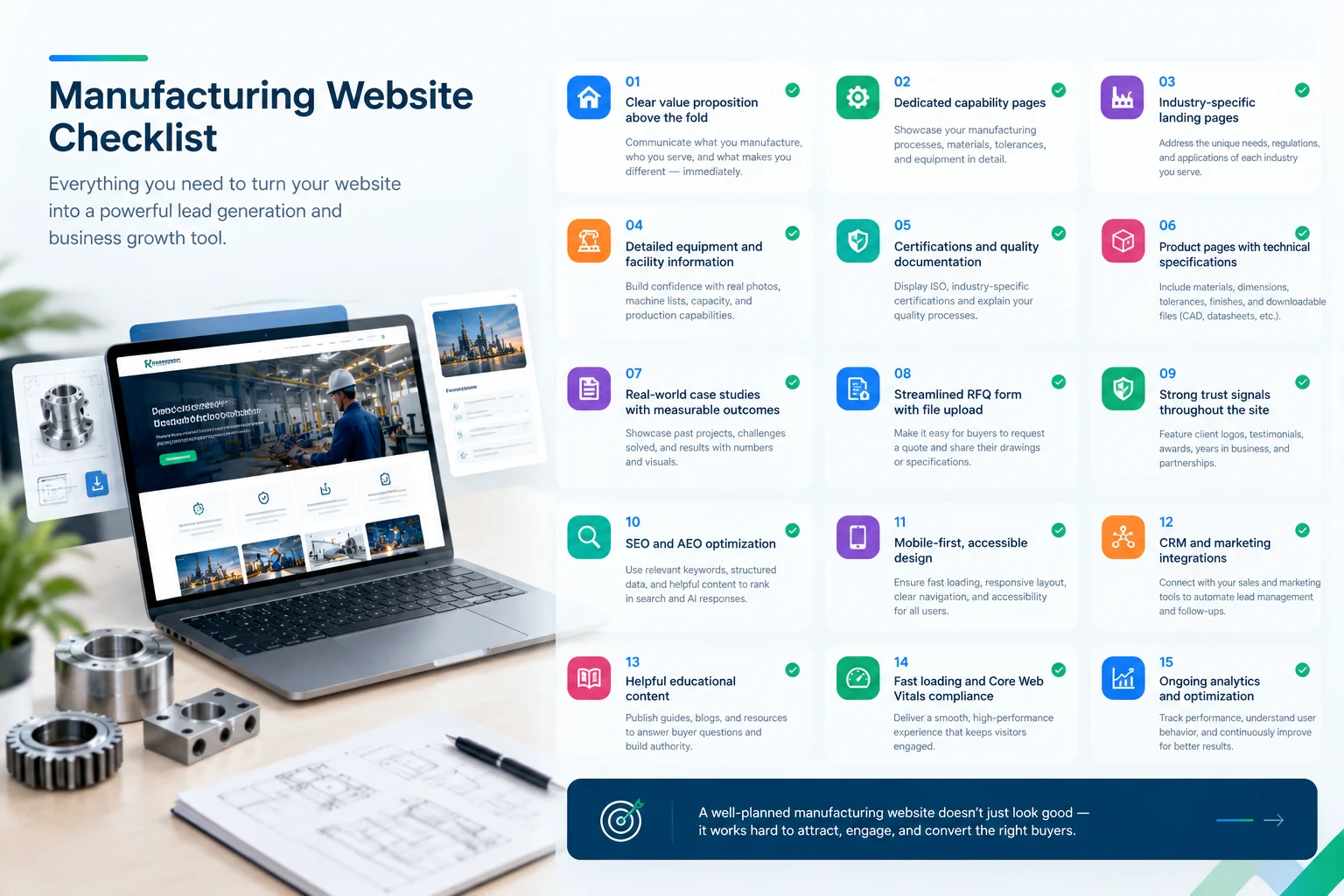
Before publishing or redesigning your website, make sure you can confidently check off each of the following:
- Clear value proposition above the fold
- Dedicated capability pages
- Industry-specific landing pages
- Detailed equipment and facility information
- Certifications and quality documentation
- Product pages with technical specifications
- Real-world case studies with measurable outcomes
- Streamlined RFQ form with file upload
- Strong trust signals throughout the site
- SEO and AEO optimization
- Mobile-first, accessible design
- CRM and marketing integrations
- Helpful educational content
- Fast loading and Core Web Vitals compliance
- Ongoing analytics and optimization
Conclusion
The most effective manufacturing websites don’t win. They look the most modern—they win because they answer buyer questions better than competitors.
Every page should reduce uncertainty, demonstrate expertise, and move visitors one step closer to requesting a quote. From detailed capability pages and certifications to technical resources, case studies, and a frictionless RFQ process, each element contributes to building confidence with engineers, procurement managers, and decision-makers.
As search evolves, manufacturers must also prepare for AI-driven discovery by publishing authoritative, structured, and genuinely helpful content. Companies that invest in user experience, technical SEO, and trust-building today will be better positioned to attract qualified traffic, generate more RFQs, and strengthen long-term customer relationships.
A manufacturing website should no longer be viewed as a digital brochure. It should function as a high-performing business development tool—one that works around the clock to educate buyers, showcase expertise, and support sustainable growth.
Frequently Asked Questions
1. What should a manufacturing website include?
A manufacturing website should include clear capability pages, industry-specific content, product specifications, certifications, case studies, equipment information, an easy-to-use RFQ form, contact details, trust signals, and a strong SEO foundation. These elements help buyers evaluate your company and confidently request a quote.
2. What is the most important page on a manufacturing website?
Capability pages are typically the most important because they explain your manufacturing processes, materials, tolerances, equipment, and expertise. They help engineers and procurement teams determine whether you’re the right supplier for their project.
3. Why are case studies important for manufacturing companies?
Case studies provide measurable proof of your expertise. They demonstrate how you’ve solved real customer challenges, highlight technical capabilities, and build confidence through tangible results rather than generic marketing claims.
4. How can manufacturers improve their website’s SEO?
Focus on creating dedicated pages for each capability, optimizing technical SEO, publishing educational content that answers buyer questions, improving page speed, implementing structured data, and maintaining a logical internal linking strategy.
5. How often should a manufacturing website be updated?
Review your website at least quarterly. Update equipment lists, certifications, case studies, capabilities, and technical content whenever your business changes. Regular content updates also help maintain search visibility and ensure buyers always see accurate information.