

3D Machine Animation Services: Industrial 3D Animation for Machinery and Engineering Products
Industrial machinery is becoming more advanced, automated, and technically complex. From CNC machining centres and packaging systems to robotic production lines, hydraulic equipment, processing machinery, and precision-engineered components, modern industrial products often contain sophisticated mechanisms that are difficult to explain through conventional marketing materials.
A product photograph can show what a machine looks like. A technical drawing can communicate dimensions. A product brochure can list specifications. But none of these formats can fully demonstrate how a machine operates, how its internal components interact, or how its engineering creates value for the customer.
This is where 3D machine animation services become an important part of industrial marketing and technical communication.
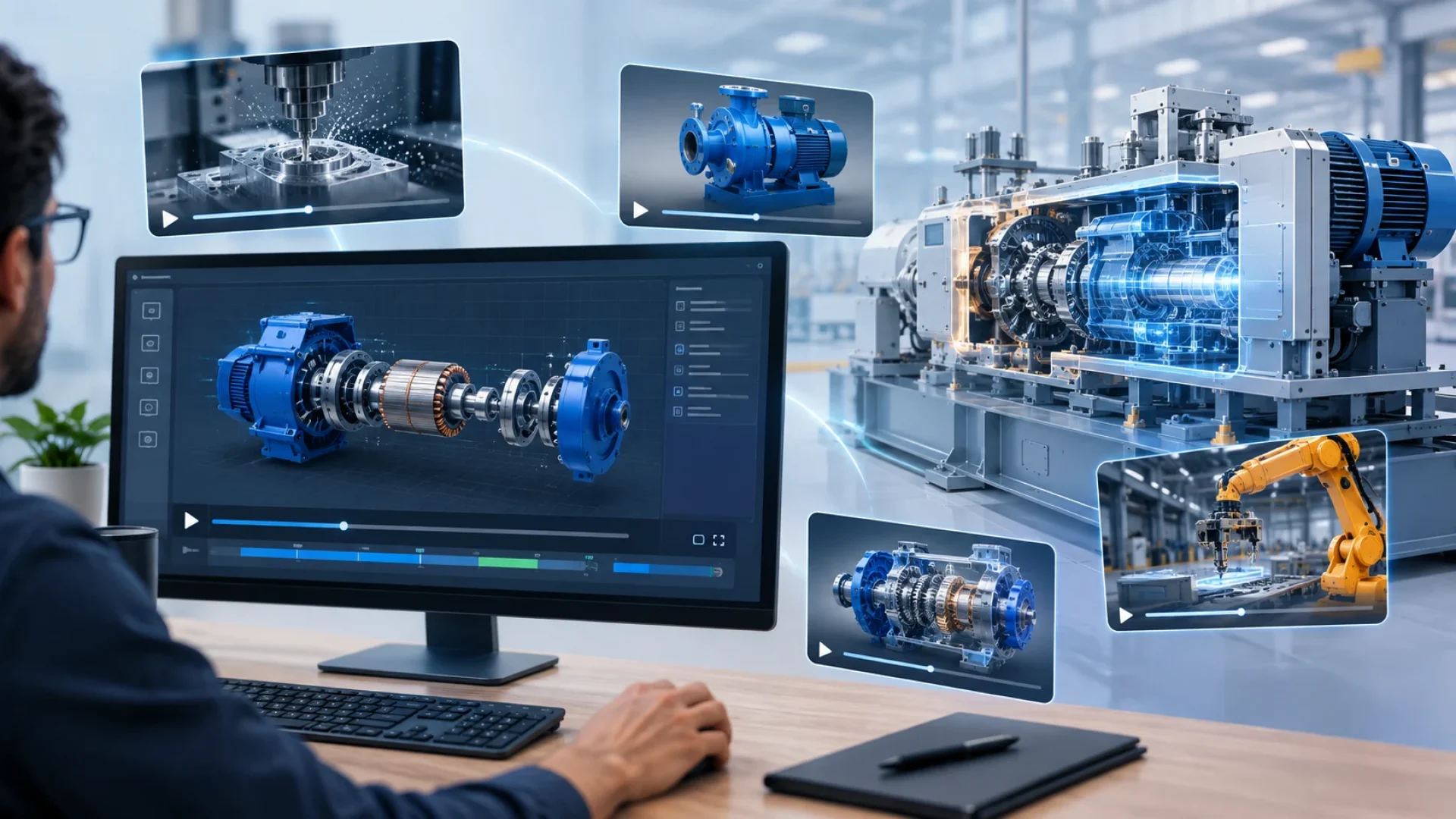
Industrial 3D animation helps manufacturers, engineering companies, OEMs, and industrial equipment suppliers turn complex machinery into clear, engaging, and technically accurate visual experiences. Through realistic movement, internal cutaways, exploded views, process simulations, and carefully planned storytelling, animation can explain products that would otherwise require lengthy technical explanations or physical demonstrations.
Whether the goal is to launch a new machine, explain an engineering process, demonstrate an internal mechanism, support a sales presentation, improve a manufacturing website, or train customers on equipment operation, industrial animation provides a powerful way to communicate technical value.
This guide explores what 3D machine animation services involve, how industrial animation differs from ordinary product animation, where manufacturers use it, what makes an effective technical animation, and how to choose the right production partner.
What Are 3D Machine Animation Services?
3D machine animation services involve the creation of digitally modelled and animated representations of industrial machinery, mechanical equipment, engineered products, production systems, or technical components. These animations are designed to demonstrate how a product looks, functions, operates, moves, or interacts with other systems.
Unlike traditional video production, industrial animation does not always require a physical machine to be available for filming. A manufacturer can create a detailed animation from CAD files, engineering drawings, technical specifications, assembly diagrams, photographs, and reference videos.
This makes the process especially valuable for products that are still under development, difficult to transport, too large to film properly, enclosed in protective housings, or impossible to demonstrate safely in a conventional environment.
For example, a manufacturer of industrial pumps may want to show how fluid enters the system, how the impeller rotates, how pressure is generated, and how the fluid exits through the discharge line. These processes may be impossible to observe from the outside. With 3D animation, the housing can become transparent, internal components can be separated, and the entire operating sequence can be presented in a way that engineers, buyers, distributors, and non-technical audiences can understand.
The purpose is not simply to create an attractive digital model. The real purpose of industrial machine animation is to make complex technical information easier to understand and more persuasive.
A successful animation answers important questions such as:
- What does the machine do?
- How does it work?
- What happens inside it?
- Why is its design important?
- How does it improve the customer’s operation?
- What makes it different from alternative solutions?
When these questions are answered visually, manufacturers can communicate more efficiently across marketing, sales, engineering, training, and customer support.
Why Industrial Machinery Needs More Than Static Images
Industrial products are fundamentally different from ordinary consumer products. Their value is often hidden inside their construction, operating principles, precision, automation, reliability, or integration capabilities.
A consumer product may be easy to understand from a photograph. A complex industrial machine may not be.
Imagine a manufacturer selling an automated filling and packaging system. A photograph of the machine might show its stainless-steel frame, conveyors, control panels, and production area. However, a potential buyer may still not understand how bottles enter the line, how filling is controlled, how caps are applied, how inspection takes place, or how the system maintains production consistency.
A 3D machine animation can explain the complete process from beginning to end. It can show the movement of products through the line, the interaction between different modules, and the relationship between mechanical, electrical, and automated systems.
This is particularly important in B2B manufacturing because purchasing decisions are rarely based on appearance alone. Buyers need to understand performance, compatibility, reliability, maintenance, production capacity, and technical suitability.
Industrial animation helps bridge the gap between technical complexity and commercial understanding.
It gives manufacturers the ability to communicate the product at several levels simultaneously. Engineers can appreciate the operating mechanism, procurement managers can understand the system’s value, executives can see the overall production benefit, and distributors can use the animation to explain the product to their own customers.
That makes animation more than a marketing asset. It becomes a shared communication tool across the entire buying journey.
1. Industrial Machinery Animation
Industrial machinery animation is one of the most important applications of 3D animation for manufacturing and engineering companies. It focuses on showing how machinery operates, how components move, and how different systems work together to complete a task.
A machinery animation may begin with a complete exterior view of the equipment before gradually revealing its internal mechanisms. The camera may move through the machine, highlight critical components, demonstrate material flow, or show the sequence of operations in a production environment.
For example, a CNC machine animation could demonstrate how raw material is positioned, how the spindle moves, how cutting tools interact with the workpiece, and how the finished component is produced. A hydraulic system animation could show fluid movement, pressure generation, cylinder motion, and the interaction between valves and actuators.
The value of this approach is that it allows the audience to understand the machine as a working system rather than simply as a physical object.
Industrial machinery animation is commonly used for CNC equipment, packaging machinery, food processing systems, pharmaceutical equipment, industrial automation, robotic cells, conveyor systems, pumps, valves, hydraulic machinery, textile equipment, agricultural machinery, construction equipment, and heavy industrial systems.
For manufacturers, this type of animation is particularly useful when the product’s competitive advantage depends on its operating process rather than its exterior appearance.
A machine that performs a complicated task faster, more accurately, or more efficiently needs to demonstrate that advantage clearly. Animation makes it possible to show the complete operating sequence without requiring the viewer to visit a factory or attend a live demonstration.
2. Industrial Product Animation for Engineering Components
Industrial animation is not limited to complete machines. Many manufacturers produce smaller engineered products that also benefit from detailed 3D visualization.
These may include valves, pumps, motors, bearings, gearboxes, industrial sensors, hydraulic cylinders, mechanical assemblies, filtration systems, precision components, industrial tools, and electrical equipment.
For these products, animation can demonstrate internal construction, movement, installation, assembly, and functionality.
Consider a manufacturer of industrial valves. A standard product photograph may show the external body and connection points, but it cannot explain how the internal sealing mechanism works or how fluid flow is controlled. A 3D product animation can reveal the internal components, demonstrate the opening and closing sequence, and show the direction of fluid movement.
This type of visual explanation is particularly valuable when the product is technically specialized and the buyer needs to understand its operation before making a purchasing decision.
Industrial product animation can also be used to demonstrate product advantages that are difficult to communicate through written specifications alone. For example, a manufacturer may want to show reduced friction, improved sealing, optimized airflow, better heat dissipation, or a more efficient internal design.
Rather than relying exclusively on technical language, animation gives the viewer a visual understanding of the engineering principle.
This is especially useful for manufacturers selling through distributors, international partners, technical sales teams, or digital channels where the product may not be physically available for demonstration.
3. Technical Animation for Complex Mechanical Systems
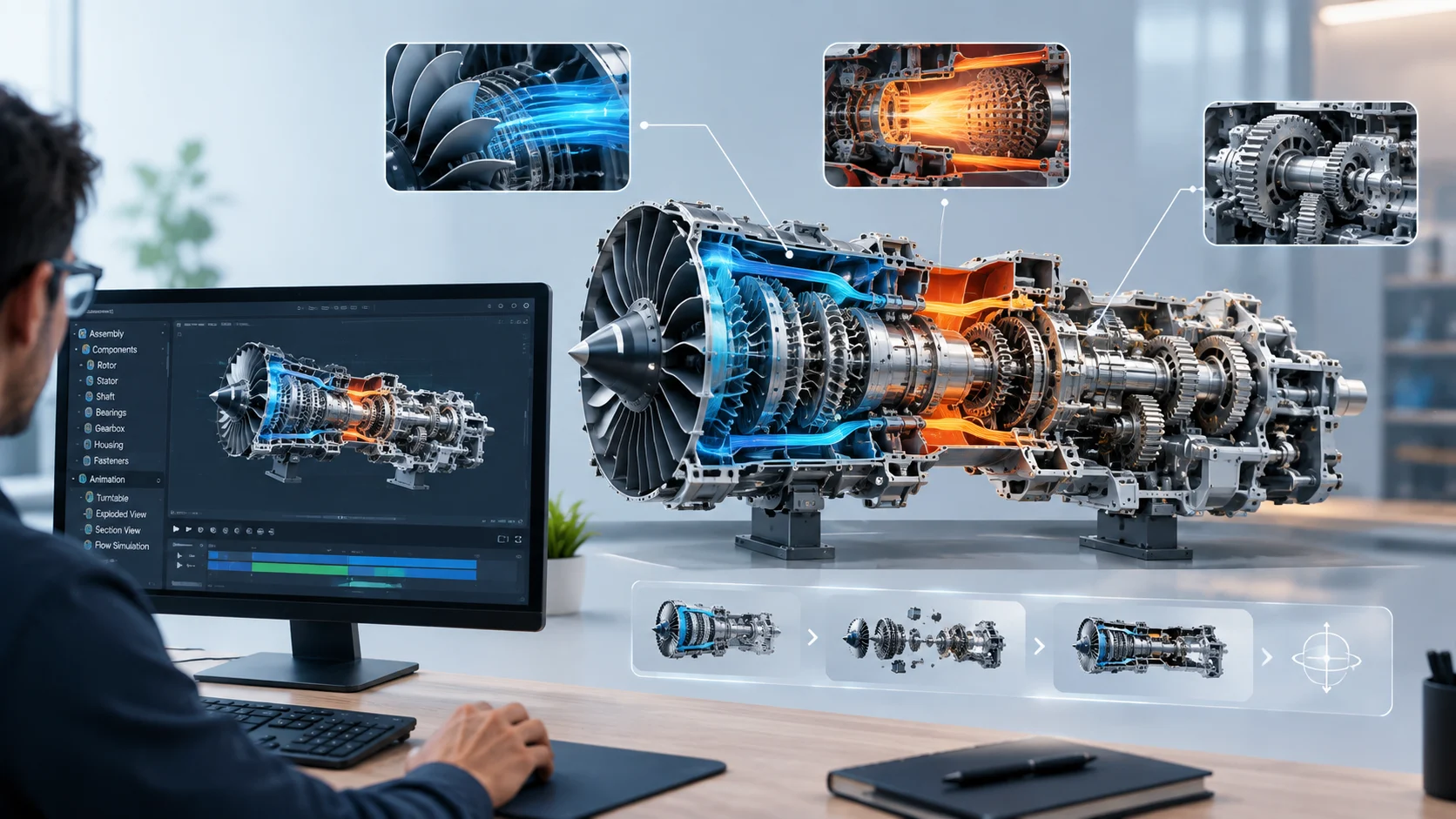
Technical animation focuses on explaining how a product or system works rather than simply presenting its appearance. It is often used when the audience needs to understand a mechanism, process, or engineering concept in detail.
A technical animation may use section views, transparent surfaces, exploded assemblies, component highlights, motion paths, flow simulations, and controlled camera movements to explain the product’s functionality.
The most effective technical animations are not overloaded with visual effects. Instead, they carefully direct attention toward the components and processes that matter.
For example, an animation explaining an industrial compressor might show air entering the system, moving through internal stages, being compressed, and exiting at a higher pressure. The animation can isolate individual components while maintaining a clear understanding of the complete system.
This approach is useful because technical products often involve relationships that are difficult to explain verbally. A component may influence another component, a sequence may depend on timing, or a process may involve multiple stages operating simultaneously.
Technical animation simplifies these relationships without necessarily simplifying the engineering itself.
The distinction between cinematic animation and technical animation is important. Cinematic animation prioritizes visual impact, brand presentation, and emotional appeal. Technical animation prioritizes clarity, accuracy, and understanding.
For industrial manufacturers, the strongest results often come from combining both approaches. A visually engaging opening can attract attention, while the main body of the animation provides technically accurate explanations.
4. Exploded View and Cutaway Animation
One of the most powerful advantages of 3D machine animation services is the ability to reveal internal structures that cannot normally be seen.
Exploded view animation separates a product into its individual components and shows how those components fit together. Cutaway animation removes selected sections of the product to expose internal mechanisms while maintaining the context of the overall assembly.
These techniques are particularly valuable for mechanical products with complex internal construction.
A gearbox manufacturer, for example, can use an exploded animation to demonstrate the relationship between the housing, gears, shafts, bearings, seals, and lubrication system. A pump manufacturer can show how the impeller, casing, shaft, and sealing components interact during operation.
This type of animation helps viewers understand not only what the product contains but also why its construction matters.
Exploded views are commonly used in product marketing, engineering presentations, technical documentation, assembly instructions, maintenance training, distributor education, and customer support materials.
They can also help manufacturers communicate product quality. When a company is confident in its internal engineering, showing the construction of the product can reinforce the perception of technical competence and transparency.
However, exploded animation should be used strategically. Showing every component may create unnecessary complexity. The animation should emphasize the parts that are relevant to the intended audience and the message being communicated.
5. Manufacturing Process and Production Line Animation
Manufacturing process animation explains how materials, components, or products move through a production system. It is especially useful for manufacturers whose value depends on automation, workflow efficiency, production integration, or large-scale processing.
A production line may involve several machines working together. Each machine may perform a separate function, but the overall value comes from how the entire system operates as one coordinated process.
A process animation can demonstrate material input, processing, assembly, inspection, packaging, sorting, and final output in a single continuous sequence.
For example, a pharmaceutical packaging line may include product feeding, filling, sealing, labelling, inspection, and carton packaging. A brick manufacturing animation may show clay preparation, extrusion, cutting, drying, kiln firing, sorting, and palletizing.
These systems are often difficult to explain using isolated photographs because the viewer needs to understand the relationship between stages.
A well-produced industrial process animation makes the entire workflow visible. It helps buyers understand how the system improves production efficiency, reduces manual handling, minimizes waste, or increases output.
This is particularly useful for companies selling complete production lines, automation systems, factory integration, processing equipment, and turnkey manufacturing solutions.
Process animation can also support factory presentations, investor communications, trade shows, website landing pages, and international sales discussions where a physical site visit may not be immediately possible.
6. CAD-to-Animation Services
Most industrial manufacturers already possess detailed engineering data in the form of CAD models, assemblies, and technical drawings. These assets can become the foundation for an accurate 3D machine animation.
CAD-to-animation services involve transforming existing engineering models into presentation-ready visual assets. Common source formats may include STEP, IGES, SolidWorks, Autodesk Inventor, CATIA, Fusion 360, and other 3D engineering formats.
Using existing CAD data can reduce modelling time and improve technical accuracy. However, engineering models are not automatically ready for animation.
CAD files are generally created for manufacturing, engineering, assembly, and production purposes. They may contain excessive detail, complex internal geometry, hidden components, or structures that are not optimized for efficient rendering.
An animation team must prepare the model for visual communication. This may involve simplifying unnecessary geometry, organizing component hierarchies, assigning materials, separating moving parts, correcting model structures, and preparing the assembly for animation.
The process requires more than technical modelling ability. It requires an understanding of how engineering information should be presented visually.
A good CAD-to-animation workflow preserves the important technical details while removing unnecessary complexity that could distract the audience.
It also allows manufacturers to create multiple visual assets from the same engineering model. A single CAD assembly may become a complete operating animation, an exploded view, product renders, technical illustrations, website graphics, and short promotional clips.
This makes CAD-based animation a highly efficient way to extend the value of existing engineering assets.
7. Industrial Product Launch Animation
Launching a new industrial machine or engineered product often requires substantial investment. Manufacturers may spend months or years on product development, testing, prototyping, certification, and production preparation before the product reaches the market.
However, marketing often needs to begin before the physical product is fully available.
This is where product launch animation becomes valuable.
A 3D animation can introduce a new machine before it is installed at a customer site or available for professional photography. It can demonstrate the product’s design, operating principles, key features, and intended applications while the physical product is still being prepared.
This is particularly useful for prototypes, new equipment platforms, industrial innovations, custom engineering solutions, and products that are difficult to transport or demonstrate.
A product launch animation can be used on the company website, at trade shows, in sales presentations, through email campaigns, on LinkedIn, and in product announcement materials.
It also allows the manufacturer to control how the product is presented. Important features can be highlighted in a specific sequence, internal mechanisms can be revealed, and the product can be shown in an ideal environment without the limitations of physical filming.
For industrial brands, this creates a more consistent and professional product introduction.
8. Industrial Animation for Sales and Marketing
Industrial buying decisions often involve multiple stakeholders and long evaluation cycles. A technical sales representative may need to explain the same machine to engineers, procurement managers, plant managers, distributors, and business owners, each with different priorities.
A 3D machine animation helps standardize that explanation.
Instead of relying entirely on verbal descriptions, sales teams can use animation to demonstrate the machine’s operating principle, product advantages, integration process, or production workflow.
This is particularly useful when the product is technically complex or when the sales team is working with international buyers who may not be able to visit the facility.
An animation can be embedded into a sales presentation, included in a proposal, shared through email, displayed during a customer meeting, or used as part of a product demonstration.
It can also help reduce the time required to explain repetitive technical concepts. Once the animation has established the basic operating principle, the sales discussion can move toward the buyer’s specific requirements, application, capacity, pricing, and implementation.
This makes industrial animation a valuable sales enablement tool rather than simply a promotional video.
9. Trade Show and Exhibition Animation
Industrial trade shows are highly competitive environments. Manufacturers often display similar machinery, similar brochures, and similar product photographs. A strong animation can help a company attract attention and communicate its product more effectively.
Trade show animation is usually designed to work in a different environment from a website video. It may need to operate without sound, loop continuously, communicate from a distance, and remain understandable even when a salesperson is not immediately available.
For this reason, exhibition animation often relies on strong visual sequences, clear product movement, large-scale presentation, and minimal dependence on narration.
A machine operating on a large display can attract visitors who may not stop to read a brochure. Once the animation captures attention, the booth team can begin a more detailed conversation.
Trade show animations are particularly effective for large machinery, automated production lines, robotics, industrial equipment, and systems with visually impressive operating sequences.
They can also be used as continuous background content that reinforces the brand’s technical positioning throughout the event.
10. Training, Installation, and Maintenance Animation
Industrial 3D animation also has important applications beyond marketing. Manufacturers can use technical animation to explain installation, assembly, maintenance, servicing, and operating procedures.
This is especially useful for machinery that is complex, expensive, dangerous, or installed across multiple countries.
A maintenance animation can demonstrate how a component is removed, replaced, inspected, and reassembled. An installation animation can show the correct order of assembly and the relationship between different parts. An operating animation can explain the correct sequence for starting or shutting down a system.
These visual instructions can be easier to understand than text-heavy manuals, especially when the procedure involves multiple steps or internal components that are difficult to photograph.
However, training and maintenance animations must be technically validated by the manufacturer’s engineering or service team. Visual clarity is important, but accuracy is essential when the content relates to equipment operation, safety, or maintenance.
The most effective approach is to combine animation with approved technical documentation and clear procedural instructions.
11. What Makes a High-Quality Industrial 3D Animation?
A high-quality industrial animation is not defined only by realistic rendering or impressive camera movements. Its success depends on whether it communicates the intended technical and commercial message accurately.
The first requirement is engineering accuracy. Components must move correctly, assemblies must maintain their relationships, and the animation must not demonstrate impossible mechanical behaviour. Even small inaccuracies can damage trust when the audience includes engineers or technical buyers.
The second requirement is clarity. The viewer should understand what is happening without needing to interpret every frame. The animation should have a logical sequence, clear visual hierarchy, and purposeful transitions.
The third requirement is appropriate detail. Industrial products can contain hundreds or thousands of components, but not every component needs to be shown. The animation should emphasize the parts that matter to the intended message.
The fourth requirement is realistic material and lighting treatment. Steel, aluminium, rubber, glass, plastic, painted surfaces, and other industrial materials should be represented credibly. This does not mean every animation must be photorealistic, but the visual treatment should support the product’s professional and technical character.
Finally, the animation must be built around the audience. A video designed for engineers may require detailed internal views, while a video designed for executives may focus more on production benefits, efficiency, and business outcomes.
The best industrial animations balance technical accuracy with understandable storytelling.
12. Common Mistakes in Industrial Machine Animation
One of the most common mistakes is creating an animation that looks impressive but does not explain anything meaningful. A rotating machine with dramatic lighting may attract attention, but it may not help the viewer understand how the product works or why it matters.
Another common mistake is showing too much information at once. Industrial products are already complex, so adding excessive labels, camera movements, effects, and component highlights can make the animation difficult to follow.
Some projects also fail because they are created without a clear audience or purpose. An animation intended for a trade show should not necessarily be identical to one designed for a technical training manual. Each format requires a different communication strategy.
Technical inaccuracies are another serious problem. If a machine’s components move incorrectly or a process is shown in an unrealistic sequence, technically knowledgeable viewers may lose confidence in the product.
Finally, manufacturers often fail to plan how the animation will be reused. Producing only one long video can limit its value. A better approach is to create a primary animation along with shorter clips, still renders, product sections, and alternative formats for websites, social media, presentations, and exhibitions.
13. The Industrial 3D Animation Production Process
A professional industrial animation project begins with discovery rather than rendering. The animation team first needs to understand the product, its operating principle, the intended audience, and the purpose of the animation.
The discovery stage typically involves reviewing CAD files, engineering drawings, product specifications, reference videos, existing documentation, and information about where the animation will be used.
After that, the team develops a storyboard and visual plan. This determines the sequence of scenes, camera angles, product reveals, internal cutaways, exploded views, labels, transitions, and narration requirements.
The next stage involves preparing the 3D model. Existing CAD data may need to be simplified, reorganized, and optimized for animation. Moving components must be separated and structured correctly.
Once the model is ready, the animation team creates the mechanical movement, operating sequences, process simulations, and technical demonstrations. Lighting, materials, environments, and rendering are then developed according to the intended visual style.
Before final delivery, the animation should undergo a technical review. The manufacturer’s engineering or product team should verify that the movement, component relationships, operating sequence, and technical information are accurate.
The final stage involves exporting the animation in the formats required for its intended applications. These may include a full-length video, website version, social media clips, trade show loop, presentation format, and still image renders.
A structured workflow reduces revisions, improves accuracy, and ensures that the final animation serves a clear purpose.
14. How Much Do 3D Machine Animation Services Cost?
The cost of 3D machine animation services depends on the complexity of the product, the amount of modelling required, the animation duration, and the level of technical detail.
A simple industrial component rotating against a clean background requires considerably less work than a complete automated production line with internal mechanisms, multiple moving parts, and several operating stages.
Important cost factors include the availability of CAD files, modelling requirements, number of components, animation duration, internal cutaway detail, environment design, technical validation, number of revisions, narration, sound design, and final delivery formats.
Projects based on accurate existing CAD data may be more efficient than projects that require complete modelling from photographs and engineering drawings. However, complex CAD assemblies may also require substantial preparation before they can be used effectively.
Rather than comparing providers only by price, manufacturers should evaluate the scope of work, technical expertise, modelling quality, revision process, and intended commercial use.
A well-produced animation can become a long-term asset used across websites, sales presentations, trade shows, product launches, training, and marketing campaigns. Its value should therefore be considered in terms of business applications rather than production cost alone.
15. How to Choose the Right Industrial Animation Company
Choosing an industrial animation provider requires more than reviewing a visually impressive showreel. A studio may be excellent at general product animation but lack the technical understanding required for industrial machinery.
The first thing to evaluate is whether the provider has experience with engineering products, manufacturing equipment, mechanical systems, or industrial processes. Relevant experience indicates that the team understands the importance of accuracy, component relationships, and technical communication.
The second consideration is whether the studio can work with CAD files and engineering documentation. This is important because industrial animation often depends on accurate source data.
The third factor is technical storytelling. The provider should be able to explain complex mechanisms clearly rather than simply create attractive visuals.
Manufacturers should also ask about the review process. A professional industrial animation project should include opportunities for technical feedback and validation before final delivery.
Another important consideration is whether the provider can deliver multiple formats. A single animation may need to be adapted for a website, presentation, trade show, LinkedIn campaign, and product page.
Finally, the studio should understand the business objective. The provider should ask what the animation needs to achieve, who will watch it, and what the audience should understand after viewing it.
The right partner combines 3D production expertise with engineering understanding, communication strategy, and commercial awareness.
16. Why Pixerts for Industrial 3D Animation Services?
At Pixerts, we approach industrial animation as a technical communication and business-development challenge, not simply a rendering project.
Industrial products often contain valuable engineering details that are difficult to communicate through traditional marketing materials. Our approach turns those details into clear, engaging, and commercially useful visual experiences.
We work with industrial machinery, manufacturing equipment, engineered products, automated systems, mechanical assemblies, industrial components, and production processes.
The objective is to help manufacturers communicate what their products do, how they work, why they matter, and what makes them different.
Our approach combines engineering understanding, purposeful storytelling, technical visualization, and marketing integration. Depending on the project, this may involve CAD-to-animation workflows, internal cutaways, exploded views, operating sequences, process simulations, product demonstrations, and industrial environments.
Manufacturers can use the final animation for websites, product pages, sales presentations, trade shows, product launches, technical resources, and digital campaigns.
For manufacturers, the value is not simply a visually attractive video. It is a reusable communication asset that helps customers understand complex products faster and more confidently.
17. Where Can Manufacturers Use Industrial 3D Animation?
The versatility of industrial animation is one of its greatest advantages. A single well-planned animation can support several business functions.
On a manufacturing website, animation can be used in homepage hero sections, product pages, capability pages, industry landing pages, and technical resource sections. It can help visitors understand complex machinery before they contact the company.
In sales, animation can be integrated into presentations, proposals, product demonstrations, and customer meetings. It can help sales teams explain the same technical concepts consistently across different audiences.
In marketing, animation can support LinkedIn campaigns, email marketing, product launches, digital advertising, and industry-specific landing pages.
At trade shows, animation can operate on large screens and demonstrate machinery continuously, even when the booth team is occupied with other visitors.
In training and documentation, animation can explain installation, maintenance, assembly, operating procedures, and technical workflows.
This multi-purpose value makes industrial animation more effective than a one-time promotional video. When planned correctly, it becomes a long-term visual asset that supports the manufacturer’s entire communication ecosystem.
18. The Future of Industrial 3D Animation
Industrial products are becoming increasingly complex, while buyers are becoming more digitally dependent. Engineers, procurement managers, distributors, and business decision-makers increasingly research suppliers online before beginning a conversation.
This creates a growing need for visual communication that can explain products clearly without requiring a physical demonstration.
Industrial 3D animation is also becoming more closely connected with interactive product visualization, digital twins, augmented reality, virtual factory tours, product configurators, and web-based technical experiences.
These technologies let manufacturers to move beyond passive videos toward more interactive product communication.
However, the underlying principle remains the same: the easier a buyer can understand a product, the easier it becomes to evaluate its value.
Manufacturers that invest in accurate, useful, and strategically designed industrial animation will be better positioned to communicate complex products in competitive markets.
Conclusion
Industrial machinery is often difficult to market because its most important value exists beneath the surface.
The real differentiator may be an internal mechanism, an automated process, a precision movement, a complex assembly, or a system that cannot be easily demonstrated through conventional photography.
3D machine animation services make those invisible advantages visible.
By combining engineering data, technical visualization, realistic movement, and purposeful storytelling, manufacturers can explain complex products in ways that photographs, brochures, and technical descriptions often cannot.
Whether the objective is to launch a new machine, demonstrate a production process, explain an internal mechanism, support a sales presentation, or improve a manufacturing website, industrial 3D animation offers a practical and powerful way to communicate technical value.
The most effective animation is not necessarily the one with the most dramatic effects. It is the one that helps the viewer understand the product clearly and confidently.
At Pixerts, we help manufacturers and industrial companies transform complex engineering into clear, engaging, and commercially useful visual experiences.
Your machinery is engineered to perform. Your animation should make that performance impossible to misunderstand.
Frequently Asked Questions
Q: What are 3D machine animation services?
A: 3D machine animation services involve creating digital animations that demonstrate how industrial machinery, mechanical products, or engineering systems look, operate, and function. These animations may include realistic product presentations, internal mechanisms, exploded views, cutaways, process simulations, and technical explanations.
Q: What is industrial 3D animation used for?
A: Industrial 3D animation is used for product marketing, machinery demonstrations, product launches, sales presentations, trade shows, technical training, maintenance instructions, manufacturing process explanations, and website content.
Q: Can a 3D animation be created from CAD files?
A: Yes. Industrial animation studios can often use CAD files such as STEP, IGES, SolidWorks, Inventor, CATIA, and other engineering formats as the foundation for the animation. The files are usually prepared and optimized before animation begins.
Q: What is the difference between machine animation and product animation?
A: Machine animation generally focuses on the operation, movement, and internal mechanisms of industrial equipment. Product animation may focus more on the appearance, features, benefits, and presentation of an engineered product. The two can overlap depending on the project.
Q: Can industrial animation show internal machine components?
A: Yes. Internal components can be revealed through cutaways, transparent materials, exploded views, section animations, and internal camera movements. This is one of the major advantages of 3D animation over conventional photography.
Q: How long does an industrial animation project take?
A: The timeline depends on the complexity of the machinery, availability of CAD files, modelling requirements, animation duration, technical detail, number of scenes, and revision requirements. A simple product animation may take significantly less time than a complex production-line simulation.
Q: Is industrial 3D animation useful for manufacturing websites?
A: Yes. Animation can help manufacturing websites explain machinery, production systems, capabilities, and technical products more effectively. It is particularly useful for homepage hero sections, product pages, landing pages, and technical content.
Q: What should I provide to an animation studio?
A: Useful materials include CAD files, technical drawings, product specifications, assembly diagrams, operating sequences, product photographs, reference videos, engineering documentation, brand guidelines, and information about the intended audience and purpose of the animation.