

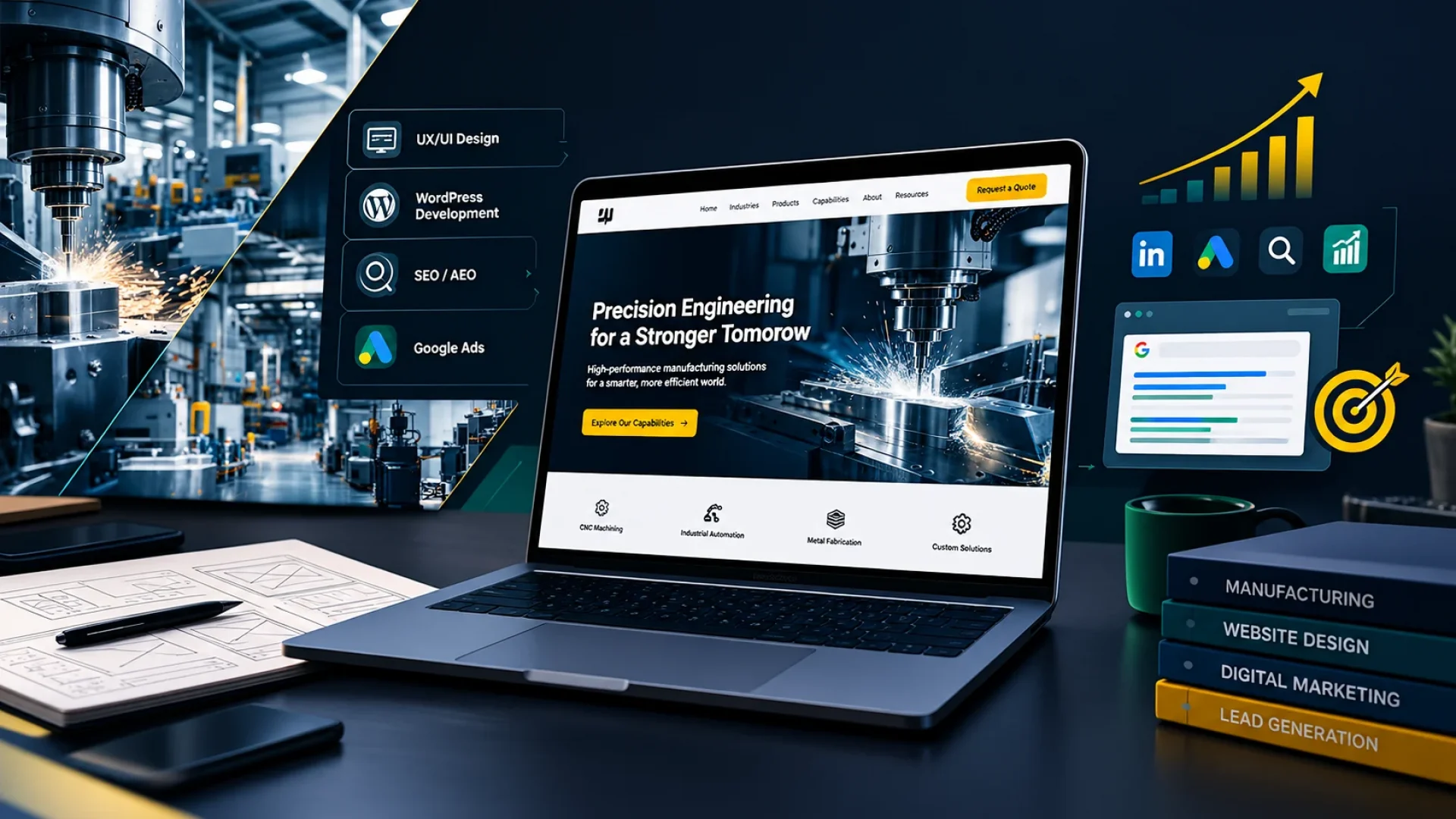
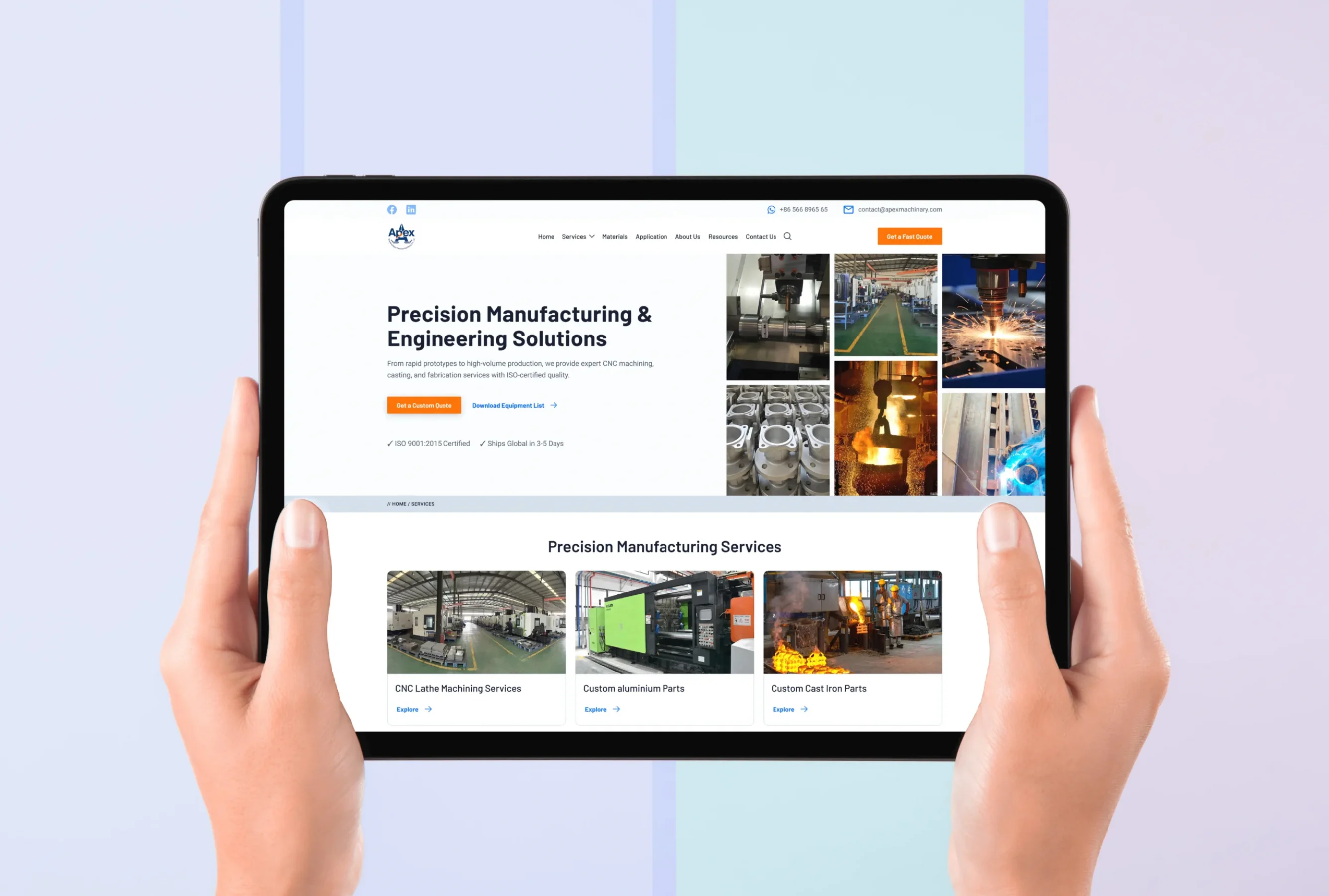
Manufacturing Web Design Agency: The Complete Guide for Industrial Growth
Manufacturing companies no longer compete only through product quality, pricing, production capacity, or delivery timelines. They also compete through how easily potential buyers can discover, understand, evaluate, and contact them online.
Before contacting a supplier, modern industrial buyers often research manufacturing capabilities, compare suppliers, review certifications, examine equipment, explore technical documentation, evaluate industries served, and search for evidence of previous work. Engineers, procurement managers, OEMs, distributors, and business owners increasingly expect a manufacturer’s website to answer important questions before a sales conversation ever begins.
This is why choosing the right manufacturing web design agency has become a strategic business decision rather than a simple website development task.
However, website design alone is not enough. A manufacturer may have a modern website but receive very little qualified traffic. Another company may invest in SEO but send visitors to an outdated website with confusing navigation and weak RFQ functionality. Some businesses publish content without understanding technical search intent, while others run advertising campaigns that generate inquiries from visitors who are not commercially relevant.
The strongest solution combines specialized website design with specialized manufacturing marketing.
A capable manufacturing web design agency builds the digital foundation, while a manufacturing marketing agency makes that foundation visible, useful, discoverable, and commercially productive. Together, these services help industrial companies attract qualified buyers, communicate technical capabilities, increase RFQ submissions, strengthen credibility, and create a more predictable sales pipeline.
What Is a Manufacturing Web Design Agency?
A manufacturing web design agency is a specialized digital agency that designs, develops, and optimizes websites for manufacturers, industrial suppliers, engineering firms, OEMs, machine shops, fabricators, distributors, and other B2B industrial businesses.
Unlike a general web design company, a manufacturing-focused agency understands that industrial websites must communicate complex information clearly. A manufacturer may need to present dozens of capabilities, multiple materials, different production processes, industry-specific applications, quality certifications, equipment specifications, technical documents, and facility information.
The agency’s role is not limited to choosing colors, creating layouts, or building pages. It must understand the commercial and technical structure of the business.
A specialized manufacturing web design agency typically works across:
- Manufacturing website strategy
- Industrial UX and information architecture
- B2B website design
- Technical content organization
- Capability and industry page development
- RFQ and lead-generation systems
- Technical SEO
- Website development
- CRM and marketing automation integration
- Conversion rate optimization
- Performance and accessibility
- Ongoing website growth
The agency should understand how an engineer searches for a supplier, how a procurement manager evaluates risk, how an OEM compares manufacturing partners, and how a sales team follows up with a potential customer.
The objective is to create a website that supports actual industrial buying behavior rather than simply presenting a polished digital brochure.
What Is a Manufacturing Marketing Agency?
A manufacturing marketing agency helps industrial companies attract attention, reach qualified audiences, generate demand, and convert digital interest into business opportunities.
Manufacturing marketing is different from general digital marketing because industrial businesses often sell technical products or services through long and complex buying cycles. The buyer may need to review specifications, consult engineering teams, compare suppliers, obtain internal approval, and request multiple quotations before making a decision.
A manufacturing marketing agency may provide:
- Manufacturing SEO
- Technical content marketing
- Industrial keyword research
- Search engine optimization
- Paid search campaigns
- LinkedIn marketing
- Account-based marketing
- Lead generation
- Email marketing
- Marketing automation
- Case study development
- Technical resource marketing
- Conversion optimization
- Brand positioning
- Sales enablement
- Analytics and reporting
The best results happen when the marketing strategy is connected directly to the website. Traffic should not be sent to random pages. Each campaign, keyword, article, landing page, and advertisement should support a specific commercial objective.
This is where the combination of a manufacturing web design agency and manufacturing marketing agency becomes especially valuable.
Why Manufacturers Need Both Website Design and Marketing
Many manufacturers treat website development and marketing as two separate projects. They hire one company to build the website and another company to generate traffic. In many cases, neither team fully understands what the other is doing.
This creates several problems.
The website may not be structured around the keywords that marketing wants to target. Marketing campaigns may direct users to pages that do not communicate the company’s capabilities properly. The website may lack dedicated landing pages for profitable services. The RFQ form may be difficult to complete. Technical content may be buried inside PDFs. Analytics may not track qualified inquiries accurately.
A website is the infrastructure of digital marketing. Marketing is the activity that brings the right people to that infrastructure.
A specialized manufacturing web design agency should therefore consider marketing requirements before designing the website. At the same time, a manufacturing marketing agency should understand the website’s structure, conversion paths, technical content, and business goals.
When both functions work together, the company gains a connected digital growth system instead of a collection of disconnected activities.
How Industrial Buyers Research Manufacturers Online
Manufacturing buyers rarely make decisions after viewing only one page. Their research process usually involves several stages.
An engineer may begin with a technical question such as whether a particular material can be machined to a specific tolerance. A procurement manager may search for suppliers with ISO certification and suitable production capacity. An OEM may look for a contract manufacturer with experience in a particular industry. A distributor may need product catalogs, technical documentation, and reliable delivery information.
During this process, buyers may review:
- Capability pages
- Product pages
- Industry applications
- Equipment information
- Certifications
- Technical specifications
- Case studies
- Facility photographs
- Product catalogs
- CAD files
- Quality processes
- Contact details
- RFQ forms
- Company locations
- Customer references
A manufacturing web design agency must design for this research behavior. The website should not force every visitor through the same generic journey.
Different users should be able to enter through different routes and still find relevant information quickly.
For example, one visitor may enter through “CNC machining services,” another through “aerospace manufacturing,” another through “aluminum components,” and another through a specific product page. Each entry point should guide the user toward relevant proof and a clear next action.
The Website Must Be Organized Around Manufacturing Capabilities
One of the most important responsibilities of a manufacturing web design agency is building a capability-based website structure.
Manufacturers often make the mistake of placing every service into one general page called “Our Services.” This approach creates a weak user experience, limits SEO visibility, and prevents individual capabilities from receiving the attention they deserve.
A better structure gives each major capability its own page.
Depending on the business, this may include:
- CNC machining
- CNC turning
- 5-axis machining
- Sheet metal fabrication
- Injection molding
- Metal stamping
- Die casting
- Welding
- Industrial assembly
- Surface finishing
- Powder coating
- Anodizing
- Engineering design
- Prototyping
- Contract manufacturing
- Industrial automation
- Packaging
- Tool and die manufacturing
Each capability page should explain more than the service name. It should cover the process, available materials, tolerances, equipment, applications, industries served, quality standards, typical project types, and relevant next steps.
For example, a CNC machining page could explain machine types, materials, dimensional capabilities, production volumes, inspection processes, and industries served. This gives users meaningful information while creating opportunities to rank for more specific search queries.
Industry-Specific Website Pages
A manufacturer serving several industries should not rely on one generic “Industries” page.
Aerospace, automotive, medical, energy, electronics, construction, defense, and industrial automation buyers all evaluate suppliers differently. Each industry has different technical, regulatory, quality, and operational expectations.
A manufacturing website should create dedicated industry pages that explain:
- Relevant capabilities
- Common applications
- Industry-specific challenges
- Quality and compliance requirements
- Typical materials
- Production expectations
- Relevant case studies
- Certifications
- Why the company is suitable for that sector
For example, an aerospace page may discuss tight tolerances, traceability, AS9100, complex geometries, and inspection requirements. A medical manufacturing page may focus on validation, clean production, biocompatibility, documentation, and regulatory standards.
A manufacturing web design agency should use these industry differences to create more relevant landing pages for both users and search engines.
Manufacturing UX and Information Architecture
Manufacturing UX design is not the same as designing a consumer-facing website.
Industrial users are often searching for precise information rather than entertainment or emotional inspiration. They need to find specifications, capabilities, documentation, certifications, and contact options quickly.
A strong manufacturing website should provide:
- Clear navigation
- Logical page hierarchy
- Searchable technical content
- Predictable page layouts
- Relevant internal links
- Easy access to certifications
- Visible RFQ calls to action
- Simple technical document downloads
- Clear product categorization
- Mobile-friendly interactions
- Fast-loading pages
The information architecture should reflect how buyers think about the business.
A capability-led manufacturer may use:
Capabilities → Industries → Materials → Equipment → Quality → Resources → Request a Quote
A product-led manufacturer may use:
Products → Categories → Applications → Technical Resources → Support → Request a Quote
A distributor may require:
Products → Brands → Industries → Resources → Availability → Contact Sales
There is no single correct structure. The role of a manufacturing web design agency is to research the company’s offerings and customer journeys before defining the website architecture.
RFQ-Focused Website Design
For many manufacturers, the most important website conversion is not a generic contact submission. It is a qualified request for quotation.
An RFQ form should be designed around the information the sales or engineering team needs to evaluate a project.
Depending on the business, the form may include:
- Name and company
- Email address
- Phone number
- Part or product name
- Required quantity
- Material
- Manufacturing process
- Application
- Required delivery date
- Tolerance requirements
- Surface finish
- Certification needs
- Project description
- CAD or drawing upload
- File attachments
- Shipping location
A manufacturing web design agency should avoid making the RFQ process unnecessarily complicated. The form should collect useful qualification information while remaining easy to complete.
For technical manufacturers, CAD upload functionality can be particularly valuable. Visitors may want to submit STEP, STP, IGES, PDF, DWG, or other technical files for review.
The RFQ experience should also connect to internal business systems. Leads may need to be routed to a sales representative, assigned by industry, sent to a CRM, or categorized by manufacturing capability.
A website that generates many low-quality submissions may be less valuable than one that produces fewer but more relevant RFQs.
Technical SEO for Manufacturing Companies
Manufacturing SEO requires a specialized approach because industrial search terms are often highly specific and commercially valuable.
A general keyword such as “manufacturing company” may have limited commercial usefulness. More targeted searches often reveal stronger intent.
Examples include:
- 5-axis CNC machining services
- Aluminum precision machining supplier
- Aerospace sheet metal fabrication
- Medical device contract manufacturer
- Stainless steel laser cutting
- ISO-certified injection molding company
- Custom industrial valve manufacturer
- CNC machining for automotive components
- Precision engineering company
- Industrial automation equipment manufacturer
A manufacturing marketing agency should organize the SEO strategy around multiple keyword categories:
Capability Keywords
These describe the manufacturing process or service.
Examples include CNC machining, injection molding, fabrication, stamping, welding, and assembly.
Material Keywords
These target searches involving aluminum, stainless steel, titanium, plastics, composites, rubber, or other materials.
Industry Keywords
These connect services with target sectors such as aerospace, automotive, medical, energy, defense, and electronics.
Application Keywords
These describe the specific products, parts, components, or use cases the company supports.
Certification Keywords
These target searches involving ISO, AS9100, IATF 16949, NADCAP, FDA-related compliance, or other standards.
Location Keywords
These include country, region, city, or service-area combinations where relevant.
A strong manufacturing web design agency builds the website structure to support these keyword groups instead of trying to rank every service on one homepage.
Manufacturing Content Marketing Must Be Technically Useful
Manufacturing content marketing should not consist of generic articles that could apply to any industry.
Industrial buyers need useful, technically relevant content that helps them make decisions.
Strong manufacturing content topics may include:
- How to choose between CNC milling and CNC turning
- What materials are suitable for high-temperature applications
- How to reduce manufacturing costs through design optimization
- What tolerances are realistic for a specific process
- How to prepare CAD files for quotation
- What certifications are required in aerospace manufacturing
- Differences between injection molding and compression molding
- How surface finishing affects component performance
- What to consider when selecting a contract manufacturer
- How to evaluate an industrial supplier
- How manufacturing lead times are calculated
- What information should be included in an RFQ
This content attracts early- and mid-stage buyers while demonstrating technical knowledge.
The best manufacturing marketing agency does not simply publish content for search engines. It transforms the knowledge of engineers, production managers, quality teams, and technical specialists into useful resources that support sales.
Manufacturing Website Content Should Support E-E-A-T
Manufacturing websites need to demonstrate real-world experience and credibility.
Search engines and users should be able to understand that the company actually has the capabilities it claims to offer.
Trust-building content may include:
- Facility photographs
- Equipment lists
- Quality certifications
- Production process explanations
- Engineering team information
- Case studies
- Customer industries
- Technical documentation
- Inspection procedures
- Manufacturing videos
- Product demonstrations
- Factory tours
- Project examples
- Company history
- Quality-control systems
Generic statements such as “we deliver excellence” are not enough. Manufacturers should show evidence of operational competence.
A manufacturing web design agency should help organize this evidence into a clear digital experience rather than hiding it in an outdated company profile page.
Case Studies That Convert Industrial Buyers
Manufacturing case studies should focus on technical challenges and measurable outcomes.
A weak case study may simply say that the company completed a project successfully. A stronger case study explains what made the project difficult and how the manufacturer solved the problem.
A useful case study structure includes:
- Customer industry
- Project background
- Technical challenge
- Required specifications
- Materials or processes
- Quality requirements
- Production constraints
- Solution provided
- Final outcome
- Business or engineering benefits
Potential outcomes may include:
- Reduced production time
- Improved component consistency
- Lower material waste
- Reduced assembly steps
- Better product performance
- Faster delivery
- Improved quality control
- Lower total production cost
- Successful compliance approval
Case studies help buyers visualize how the manufacturer may solve similar problems for their own projects.
Manufacturing Marketing Beyond SEO
SEO is important, but it should not be the only marketing channel for manufacturers.
A complete manufacturing marketing agency may combine several channels depending on the company’s audience, sales cycle, and market.
LinkedIn Marketing
LinkedIn can be effective for reaching engineering leaders, procurement professionals, operations managers, OEM decision-makers, and industrial executives.
Useful content may include:
- New equipment announcements
- Factory expansion updates
- Technical process videos
- Engineering insights
- Case studies
- Product launches
- Certification announcements
- Employee expertise
- Manufacturing problem-solving content
Paid Search
Google Ads can capture high-intent searches for specific capabilities, services, and products. Campaigns should lead to dedicated landing pages rather than generic homepages.
Account-Based Marketing
For manufacturers targeting a limited number of high-value accounts, account-based marketing can combine research, personalized content, LinkedIn campaigns, email, sales outreach, and landing pages.
Email Marketing
Email campaigns can support distributors, existing customers, dormant leads, prospects, and technical subscribers. Useful campaigns may include new capabilities, product updates, technical resources, and industry-specific information.
Sales Enablement
Marketing should create assets that sales teams can use during the buying process, including:
- Capability brochures
- Technical presentations
- Case studies
- Product comparisons
- Certification documents
- Industry-specific landing pages
- Product videos
- Technical guides
- RFQ follow-up materials
Website Redesign Versus Marketing-Led Website Development
A website redesign is not always enough to solve a manufacturer’s digital problems.
If the existing website is outdated but the underlying strategy is strong, a redesign may improve usability and appearance. However, if the website has poor information architecture, weak content, unclear positioning, missing capability pages, and no SEO strategy, simply changing the visual design will not produce meaningful growth.
A marketing-led website project begins with questions such as:
- Which services generate the highest margins?
- Which industries are most valuable?
- Which products have the strongest demand?
- Which search terms attract qualified buyers?
- What questions prevent prospects from contacting the company?
- Which pages generate RFQs?
- Which content is missing?
- What information does sales repeatedly explain manually?
- What makes the company different from competitors?
A manufacturing web design agency should use these answers to build a website that supports both marketing and sales objectives.
Manufacturing Website Integrations
Industrial websites often need more advanced integrations than ordinary brochure websites.
Potential integrations include:
- CRM systems
- ERP platforms
- Product information management systems
- Marketing automation tools
- Quotation platforms
- Product databases
- Customer portals
- Distributor portals
- Document libraries
- Inventory systems
- Email marketing platforms
- Analytics systems
- Live chat
- Lead-routing tools
For example, a product catalog may need to pull information from a centralized database. An RFQ submission may need to enter a CRM automatically. A distributor portal may require login-based access to pricing and technical documentation.
The website should be designed with these requirements in mind from the beginning.
Measuring Manufacturing Website and Marketing Performance
Traffic alone is not enough to measure success.
A manufacturer should evaluate whether the website and marketing strategy are producing commercially meaningful outcomes.
Important metrics include:
- Qualified RFQ submissions
- Sales-qualified leads
- RFQ conversion rate
- Organic traffic to capability pages
- Conversion rate by landing page
- CAD upload submissions
- Contact form completion rate
- Technical document downloads
- Product page engagement
- Search visibility for high-intent keywords
- Cost per qualified lead
- Lead-to-opportunity rate
- Assisted conversions
- Returning visitors
- Organic traffic by industry
- Revenue influenced by marketing
A manufacturing marketing agency should report on business outcomes rather than only impressions, clicks, and page views.
The goal is not simply to increase website traffic. The goal is to attract the right traffic and convert it into opportunities that the sales team can pursue.
Common Mistakes When Hiring a Manufacturing Web Design Agency
One of the most common mistakes is selecting an agency based only on visual design. A website may look modern but still fail to communicate capabilities, technical details, certifications, or RFQ pathways.
Another mistake is hiring a generalist agency without manufacturing experience. The agency may not understand industrial terminology, technical buyer expectations, complex product structures, or long sales cycles.
Manufacturers also frequently provide insufficient content. They assume visitors understand their services, but potential buyers may not know which process, material, or capability is suitable for their project.
Another problem is creating one broad services page instead of dedicated pages for important capabilities. This limits both SEO opportunities and user understanding.
Some companies also separate website development from marketing completely. The website launches without proper keyword research, conversion tracking, landing pages, or content architecture.
A further mistake is relying on generic AI-generated content that lacks technical accuracy, firsthand experience, or industry-specific insight. Manufacturing content must be trustworthy, useful, and connected to real capabilities.
How to Choose a Manufacturing Web Design and Marketing Agency
When evaluating a potential agency, manufacturers should look beyond portfolio screenshots.
The agency should be able to explain how it will improve the company’s digital presence and commercial performance.
Ask the agency:
Does It Understand Manufacturing?
Look for evidence of work with manufacturers, industrial suppliers, OEMs, engineering companies, machine shops, or technical B2B businesses.
Can It Explain the Buyer Journey?
The agency should understand how engineers, procurement managers, plant managers, and executives use the website differently.
Can It Build Technical Information Architecture?
Ask how it will organize capabilities, products, industries, materials, applications, certifications, and resources.
Does It Understand RFQ Conversion?
The agency should explain how it will improve quote requests, technical forms, CAD uploads, lead qualification, and sales handoff.
Does It Integrate SEO From the Start?
SEO should influence the site map, URL structure, page templates, content hierarchy, internal linking, and technical development.
Can It Create Technical Content?
The agency should have a process for converting engineering knowledge into useful web pages, case studies, guides, and technical resources.
Does It Offer Ongoing Marketing?
A website requires continuous growth through SEO, content, campaigns, analytics, conversion optimization, and new landing pages.
Does It Measure Qualified Leads?
The agency should connect marketing performance with RFQs, opportunities, and sales outcomes instead of reporting only traffic.
Why Pixerts Can Serve as a Manufacturing Web Design Agency and Marketing Agency
Pixerts can position itself as a specialized digital partner for industrial and manufacturing companies that need both a stronger website and a more effective marketing foundation.
The opportunity is to move beyond the traditional agency model where website design, SEO, content, and marketing are delivered as disconnected services.
Pixerts can communicate a more integrated approach built around:
- Manufacturing website strategy
- Industrial UX/UI design
- Technical information architecture
- B2B website development
- Manufacturing SEO
- Capability and industry landing pages
- RFQ-focused conversion design
- Technical content strategy
- Industrial brand positioning
- Case studies and sales enablement
- Search visibility
- AEO and structured content
- Lead-generation systems
- Ongoing website optimization
The strongest positioning statement could be:
Pixerts is a manufacturing web design agency and marketing partner helping industrial companies turn complex capabilities into clear digital experiences, stronger search visibility, and qualified business opportunities.
Another possible positioning statement is:
Pixerts combines industrial website design, technical SEO, content strategy, and lead-generation marketing to help manufacturers attract, educate, and convert high-intent buyers.
This positioning is more valuable than presenting the company as a generic creative studio because it connects design activity with industrial business outcomes.
The Future of Manufacturing Web Design and Marketing
Manufacturing websites are becoming more intelligent, structured, and interactive.
Future-focused industrial websites may include:
- AI-powered technical search
- Product configurators
- Interactive 3D models
- Digital twin experiences
- Automated RFQ qualification
- Personalized industry content
- ERP-connected product catalogs
- AI-assisted customer support
- Dynamic technical documentation
- Advanced product filtering
- Interactive facility tours
- Automated lead scoring
- Search experiences optimized for AI platforms
- Digital sales rooms
- Real-time product availability
- Advanced buyer-intent analytics
However, technology should serve a practical purpose.
A product configurator is useful when buyers need to select complex options. A CAD upload system is valuable when engineering files are central to quoting. AI search is useful when a website contains hundreds of technical resources. Interactive 3D animation can help explain internal mechanisms that are difficult to understand through static images.
The right manufacturing web design agency will not add technology simply to appear innovative. It will connect each feature to a real buyer need or measurable business objective.
Final Thoughts
Manufacturers need more than an attractive website and more than generic digital marketing.
They need a connected digital growth system that communicates technical capabilities, supports industrial buyers, improves search visibility, generates qualified RFQs, strengthens trust, and helps sales teams convert opportunities.
A specialized manufacturing web design agency creates the website architecture, user experience, technical content structure, conversion pathways, and digital foundation required for industrial growth. A manufacturing marketing agency then uses SEO, content, paid campaigns, LinkedIn, case studies, analytics, and lead-generation systems to attract the right audience and move prospects toward commercial action.
The most successful manufacturing websites are built around the real needs of engineers, procurement teams, OEMs, distributors, and industrial decision-makers. They make capabilities easy to understand, technical information easy to find, certifications easy to verify, and RFQs easy to submit.
Manufacturers should therefore choose an agency based on more than design quality. They should evaluate industry knowledge, technical understanding, information architecture, SEO expertise, RFQ strategy, marketing capability, integration experience, and the ability to measure qualified business outcomes.
When website design and marketing work together, the result is not merely a better website. It becomes a searchable technical resource, a trust-building platform, a sales enablement tool, and a consistent source of qualified industrial opportunities.
That is the real value of partnering with a specialized manufacturing web design agency and manufacturing marketing agency.
Frequently Asked Questions
Q: What does a manufacturing web design agency do?
A: A manufacturing web design agency designs, develops, and optimizes websites for manufacturers, industrial suppliers, engineering companies, OEMs, machine shops, and other technical B2B businesses. Its work may include website strategy, UX design, capability pages, industry pages, technical SEO, RFQ forms, CAD uploads, content architecture, integrations, and conversion optimization.
Q: What does a manufacturing marketing agency do?
A: A manufacturing marketing agency helps industrial companies attract qualified buyers through SEO, technical content marketing, paid search, LinkedIn marketing, lead generation, case studies, account-based marketing, email campaigns, and conversion optimization.
Q: Why should manufacturers combine web design and marketing?
A: A website and marketing strategy are closely connected. Marketing needs a strong website structure, relevant landing pages, clear messaging, technical content, and effective conversion paths. Combining both services creates a more consistent and measurable digital growth system.
Q: What should a manufacturing website include?
A: A manufacturing website should include detailed capability pages, industry-specific content, product or application pages, materials, equipment, certifications, technical specifications, case studies, facility information, technical resources, clear calls to action, RFQ forms, and mobile-friendly navigation.
Q: How can a manufacturing website generate better RFQs?
A: A website can improve RFQ quality through dedicated capability pages, clear calls to action, technical qualification fields, CAD and drawing uploads, relevant landing pages, strong trust signals, industry-specific content, and a streamlined form experience connected to the sales process.
Q: Is manufacturing SEO different from ordinary SEO?
A: Yes. Manufacturing SEO often targets combinations of processes, materials, industries, applications, certifications, equipment, and product types. It requires technical content, detailed landing pages, strong internal linking, structured data, and a clear understanding of industrial search intent.
Q: Should a manufacturing company invest in content marketing?
A: Yes, particularly when the content answers technical questions and supports real buyer decisions. Useful manufacturing content can attract engineers, procurement teams, OEMs, and industrial buyers while demonstrating the company’s expertise and improving organic search visibility.
Q: How do I choose the right manufacturing web design agency?
A: Review the agency’s manufacturing experience, technical understanding, UX process, SEO capabilities, RFQ strategy, content expertise, integration capabilities, reporting structure, and ability to measure qualified leads rather than only website traffic.
Q: How much does manufacturing website design cost?
A: The cost depends on website size, technical complexity, number of capabilities, product catalog requirements, integrations, RFQ functionality, content production, SEO scope, and ongoing marketing requirements. A basic brochure website costs much less than a complete industrial growth platform.
Q: Can a manufacturing web design agency also manage ongoing marketing?
A: Some specialized agencies provide both website design and ongoing marketing services. This combined model can be beneficial because the same team understands the website architecture, target audience, technical content, conversion paths, and long-term growth objectives.