

Manufacturing SEO: Turning Search Visibility Into Industrial Leads
Manufacturing companies have a unique challenge when it comes to organic search.
A typical consumer website may compete for thousands of short, high-volume searches. An industrial manufacturer often targets far more specific queries: a product type, technical specification, application, material, certification, manufacturing process, or purchasing requirement.
That difference is exactly why manufacturing SEO needs a different approach.
For industrial companies, ranking for the right searches can put a manufacturer in front of an engineer researching a component, a procurement manager comparing suppliers, a technical buyer looking for specifications, or a business owner searching for a new production partner.
The commercial value of those visits can be much higher than the raw traffic number suggests.
A manufacturing SEO strategy should therefore focus on relevance, technical accuracy, buyer intent and conversion paths rather than simply publishing large quantities of generic articles.
For example, a page targeting “industrial equipment” may attract visitors with very different requirements. A well-structured page targeting a specific industrial product, application or manufacturing problem can attract a much smaller audience while producing more meaningful enquiries.
That is the central idea behind effective manufacturing SEO.
What Is Manufacturing SEO?
Manufacturing SEO is the process of improving an industrial company’s website so that its products, services, expertise and resources can be discovered through relevant search queries.
It combines traditional SEO with manufacturing-specific content and website requirements.
A manufacturing SEO strategy may include:
- Keyword and search-intent research
- Technical SEO
- Product page optimisation
- Industrial website structure
- Manufacturing content development
- Application-based content
- Industry and solution pages
- Internal linking
- Technical documentation
- Case studies
- Conversion optimisation
- Local and international SEO
- Search visibility for long-tail technical queries
The objective is not simply to make a website rank.
The objective is to make the website discoverable when a potential customer is looking for exactly what the company can provide.
That distinction matters.
A manufacturer could receive thousands of visitors every month and generate very few useful leads if those visitors are searching for unrelated information. Conversely, a manufacturer could receive a smaller amount of highly relevant organic traffic and generate a steady flow of RFQs.
Good manufacturing SEO prioritises the second outcome.
Why SEO Matters for Manufacturing Companies
Industrial buyers increasingly research suppliers online before contacting them.
They may search for a specific product, technical specification, material, process, application or supplier capability. They may compare several companies before submitting an enquiry.
That means the website often becomes part of the sales process before a salesperson ever speaks with the buyer.
Manufacturing SEO helps companies become visible during that research process.
Imagine a company manufacturing CNC components.
A prospective buyer could search:
- CNC machining supplier
- precision CNC machining manufacturer
- CNC machining for aerospace components
- stainless steel CNC machining
- CNC machine manufacturing capabilities
- high-precision CNC machining services
Each query represents a slightly different stage of the buying journey.
A company that has useful, relevant pages for those searches has more opportunities to introduce its capabilities to potential customers.
This is one reason manufacturing SEO is often more about search intent and topic coverage than chasing large keyword volumes.
The Difference Between Manufacturing SEO and General SEO
The underlying search principles are similar, but industrial websites have different information requirements.
A consumer website might focus on product benefits, price and convenience.
A manufacturing buyer may want to know:
- Technical specifications
- Materials
- Tolerances
- Applications
- Industries served
- Certifications
- Manufacturing capabilities
- Production capacity
- Delivery regions
- Quality standards
- Technical documentation
- Relevant case studies
- Minimum order information
- Customisation options
- Request-a-quote information
This is why manufacturing SEO needs close coordination between SEO, website design, content, and technical knowledge.
A generic SEO page may explain what a product is.
A strong manufacturing page should help a technical buyer understand whether the company can actually meet their requirements.
That is a much more useful search experience.
Start With Industrial Search Intent
Keyword research is important, but keywords should not be treated as isolated phrases.
Manufacturing SEO becomes more effective when keywords are grouped according to the problem the searcher is trying to solve.
Consider these four types of industrial searches.
1. Informational searches
Examples include:
- What is CNC machining?
- What is an RFQ in manufacturing?
- What is the difference between stainless steel grades?
- How does injection moulding work?
These searches usually happen earlier in the research journey.
2. Commercial research searches
Examples include:
- Best CNC machining companies
- CNC machining supplier UK
- industrial equipment manufacturers
- manufacturing SEO services
The searcher is beginning to evaluate options.
3. Product and service searches
Examples include:
- precision CNC machining
- custom metal fabrication
- industrial automation equipment
- stainless steel components manufacturer
These searches are often much closer to commercial action.
4. Transactional or enquiry searches
Examples include:
- CNC machining quote
- request a quote manufacturer
- industrial equipment supplier
- custom component manufacturer
These are especially valuable for manufacturing SEO because they can lead directly to sales conversations.
A strong strategy should cover all four groups rather than publishing only informational content.
Build Your Keyword Strategy Around Products, Applications and Industries
One of the biggest opportunities for manufacturers is the specificity of industrial search.
Instead of creating one broad page titled “Our Products,” build a logical content architecture around:
Products → Product Categories → Individual Products → Applications → Industries → Technical Resources
For example:
Industrial Pumps
could lead to:
- Centrifugal pumps
- Chemical pumps
- High-pressure pumps
- Food processing pumps
- Pharmaceutical pumps
- Pump applications
- Pump materials
- Pump specifications
- Pump maintenance resources
This approach creates a much stronger foundation for manufacturing SEO because each page can satisfy a distinct search intent.
It also creates opportunities for internal links between closely related topics.
Optimize Manufacturing Product Pages
Product pages are some of the most commercially important pages on an industrial website.
Yet many manufacturing websites make the same mistake: they provide only a short product description, a few images and a contact button.
That leaves significant search opportunity unused.
An effective manufacturing product page should answer questions such as:
What is the product?
Give the buyer a clear explanation of what the product is and what it does.
Who is it for?
Explain the industries, applications or buyer types that typically use it.
What are the specifications?
Include dimensions, materials, capacities, tolerances, operating conditions and other relevant technical information where appropriate.
What problems does it solve?
Explain the practical application rather than simply describing the product.
What options are available?
Where relevant, explain sizes, configurations, grades, finishes, customisation or other variants.
What evidence supports the claims?
Use certifications, case studies, project examples, technical documents or other legitimate evidence.
How can the buyer take the next step?
Provide an obvious route to request a quote, ask a technical question or contact the sales team.
This combination makes product pages useful to both people and search systems.
Technical Content Is a Major SEO Opportunity
Manufacturing companies often possess enormous amounts of valuable knowledge that never makes it onto their websites.
Engineers, production managers, sales teams and technical specialists may answer the same questions repeatedly.
Those questions can become excellent SEO content.
For example:
- What is the difference between two materials?
- Which manufacturing process is suitable for this application?
- What tolerance can your process achieve?
- What certifications are required?
- How should a particular component be specified?
- What information should be included in an RFQ?
- What affects the cost of manufacturing?
- How long does production typically take?
- What testing is available?
When these questions are answered clearly on the website, the content can help attract searchers before they are ready to contact a supplier.
This is where manufacturing SEO and sales enablement can work together.
The content is not merely designed for rankings. It helps potential customers understand the subject and become more confident about the supplier.
Create Content for the Manufacturing Buying Journey
A manufacturing buyer rarely moves from a generic Google search directly to a purchase.
The journey can look more like this:
Problem → Research → Specification → Supplier Discovery → Comparison → Technical Validation → RFQ → Negotiation → Purchase
Manufacturing SEO should support each stage.
At the research stage, educational articles may be useful.
During specification, technical guides and product information become more important.
During supplier comparison, case studies, certifications, capabilities and customer evidence matter.
During the RFQ stage, the website should make it extremely easy to submit the required information.
This is why a manufacturing SEO strategy should not consist only of blog posts.
It should connect informational content with commercial pages.
Make RFQs a Core Part of Your SEO Strategy
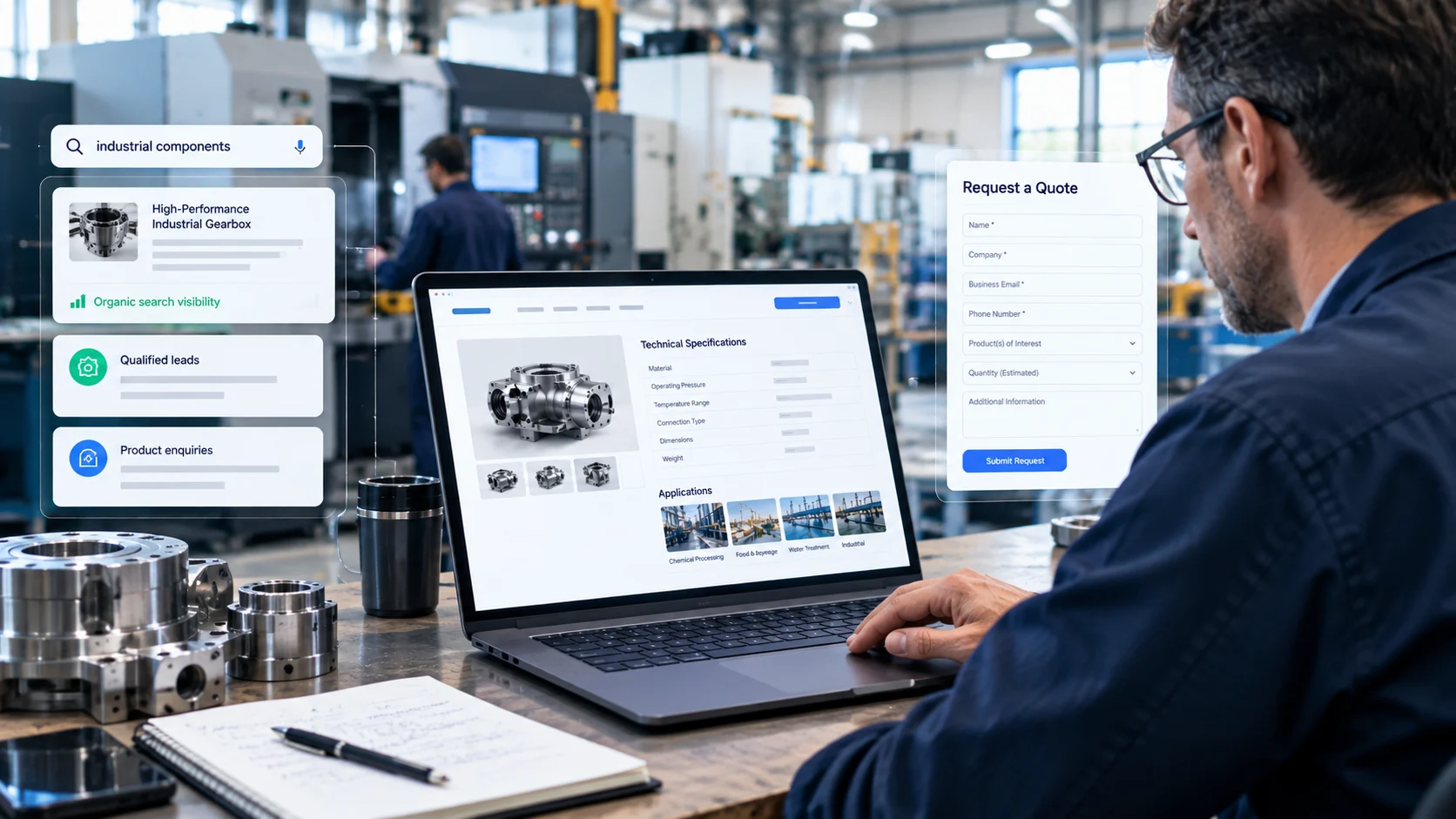
For many manufacturers, the most valuable conversion is not an online purchase.
It is a request for quotation.
That means the website needs an RFQ path that is easy to find and easy to use.
A strong manufacturing SEO strategy should therefore consider RFQ conversion from the beginning.
Your website might include:
- Request a Quote buttons
- Product-specific enquiry forms
- Drawing or file uploads
- Product or part numbers
- Quantity fields
- Required technical specifications
- Target delivery information
- Application details
- Contact information
The form should collect enough information to support the sales process without becoming unnecessarily complicated.
A visitor who arrives on a highly relevant product page should not have to search through the website to discover how to request a quote.
Manufacturing SEO attracts the visitor. Good website UX helps turn that visitor into an enquiry.
Build an Industrial Content Cluster
Rather than publishing disconnected articles, manufacturers should organise related content into topic clusters.
For example, a company that manufactures industrial valves could build a cluster around:
Industrial Valves
Then create supporting resources covering:
- Types of industrial valves
- Ball valve vs gate valve
- Valve materials
- Valve pressure ratings
- Valve applications
- Chemical processing valves
- Pharmaceutical valves
- Valve maintenance
- Valve selection guide
- Industrial valve specifications
The primary product or service page can link to the supporting educational content. The supporting articles can link back to the commercial page.
This creates a clearer topical relationship throughout the website. It also gives search engines more context about the company’s areas of expertise.
Manufacturing SEO and Technical SEO
Content alone cannot compensate for a technically weak website. Manufacturing websites frequently contain large product catalogues, filters, downloads, PDFs, images and complex navigation. Technical SEO helps ensure that search engines can efficiently discover and understand the important pages.
Key areas include:
Crawlability: Important pages should be accessible to search engine crawlers.
Indexation: Only pages that provide genuine search value should generally be candidates for indexing.
Site architecture: The hierarchy should clearly connect products, categories, industries, applications and resources.
Page speed: Large product images, scripts and unnecessary resources should not create avoidable performance problems.
Mobile usability: Technical buyers may research suppliers on mobile devices even if they ultimately contact the company from a desktop.
Canonicalization: Duplicate or near-duplicate pages should be managed carefully.
Structured data: Relevant structured data can help search engines understand certain page types and entities.
Internal linking: Important commercial pages should not be buried several layers deep without strong contextual links.
A technically sound website gives manufacturing SEO a much stronger foundation.
Create a Logical Manufacturing Website Architecture
Website structure has a direct relationship with SEO.
An industrial website might use an architecture such as:
Home
→ Products
→ Product Categories
→ Product Pages
→ Industries
→ Applications
→ Capabilities
→ Resources
→ Case Studies
→ About
→ Contact
→ Request a Quote
The exact structure will depend on the company, but the principle is consistent.
A buyer should quickly understand:
- What do you manufacture?
- Who do you manufacture for?
- Where are your products used?
- What makes your company capable?
- How can I contact you?
Manufacturing SEO becomes easier when those answers are reflected clearly in the website architecture.
Use Long-Tail Keywords
Industrial searches are often highly specific.
A manufacturer may not need to compete for a broad term if a more specific phrase better describes the product and customer.
For example, instead of focusing only on:
industrial machinery
a company might target:
pharmaceutical packaging machinery manufacturer
or:
stainless steel processing equipment supplier
Long-tail keywords often reveal stronger intent.
They also provide opportunities to create pages that answer very specific customer questions.
For manufacturers, specificity can be an advantage.
Manufacturing SEO for International Markets
Many industrial companies sell across multiple countries. International manufacturing SEO introduces additional considerations.
A company may need separate strategies for:
- UK
- Europe
- United States
- Middle East
- Asia
- Other export markets
Depending on the business model, useful international pages may include:
- Country-specific service pages
- Regional supplier pages
- International shipping information
- Local terminology
- Regional applications
- Country-specific certifications
- Language-specific content
International SEO needs to be handled carefully. Creating near-identical pages with only a country name changed can create weak content. A better approach is to provide genuine local value.
Case Studies Can Support Manufacturing SEO
Case studies are particularly useful for industrial businesses because they combine expertise with evidence.
A strong case study can show:
- The customer’s challenge
- The application
- The manufacturing requirements
- The solution
- Technical considerations
- Implementation
- Results
- Lessons learned
For example:
How We Manufactured a Custom Component for a High-Pressure Industrial Application
This could attract searches related to the manufacturing process while also demonstrating capability to prospective customers. Case studies can therefore serve both SEO and sales purposes.
Use Images as Part of Manufacturing SEO
Industrial websites often contain valuable visual assets. Do not treat images as decoration only.
Useful images can include:
- Product photographs
- Factory images
- Machinery
- Manufacturing processes
- Technical diagrams
- Finished installations
- Product details
- Engineering drawings where appropriate
- Application photographs
Descriptive file names, relevant alt text and surrounding page context can help search engines understand the image.
More importantly, useful images improve the customer’s understanding of the product. For industrial buyers, seeing the machinery, product, process or application can remove uncertainty.
Manufacturing SEO and AI Search
Search is increasingly becoming an environment where users receive synthesized answers rather than only traditional lists of links. That makes content structure increasingly important.
Current Bing guidance specifically highlights clarity, depth, descriptive headings, concise sections, evidence, freshness and consistency as useful qualities when content is considered for AI-generated answers.
Google has similarly expanded its guidance around generative AI search experiences while continuing to emphasise that established SEO fundamentals remain relevant. For a manufacturing company, this creates a practical opportunity.
Write content that is:
- Clear
- Specific
- Accurate
- Well structured
- Demonstrably useful
- Supported by evidence where appropriate
- Easy to quote or understand in isolation
For example, instead of writing:
Our company offers high-quality industrial solutions for many industries.
write something more useful:
We manufacture stainless steel components for food-processing applications, with options available for different grades, dimensions and production requirements.
The second statement contains information that both a buyer and an AI system can understand more easily.
Don’t Write for Search Engines Alone
One of the biggest mistakes in manufacturing SEO is allowing the keyword to become more important than the reader.
A page should not feel like a list of search terms. It should answer the user’s question. It should explain the subject. It should provide useful context. It should guide the reader to a relevant next step.
And it should contain information that is genuinely useful beyond what could be copied from ten competing pages.
Google’s current spam guidance specifically warns against keyword stuffing and scaled content created primarily to manipulate rankings.
That means simply creating dozens of near-identical manufacturing articles is not a sustainable strategy. Quality matters.
How to Build a Manufacturing SEO Strategy
A practical manufacturing SEO programme can be broken into eight stages.
Step 1: Audit the existing website
Review the existing:
- Product pages
- Service pages
- Industry pages
- Applications
- Technical resources
- Blog content
- Internal links
- Metadata
- Indexation
- Website structure
Find pages that already have impressions but few clicks.
These pages may reveal opportunities that new keyword research alone would miss.
Step 2: Map keywords to search intent
Group keywords into:
- Informational
- Commercial
- Product
- Application
- Industry
- Transactional
Avoid assigning ten extremely similar keywords to ten separate pages.
Step 3: Build the commercial architecture
Decide which pages represent:
- Products
- Services
- Industries
- Applications
- Capabilities
- Locations
These become the core of the SEO strategy.
Step 4: Develop supporting content
Create articles, guides, FAQs, case studies and technical resources around the questions buyers ask.
Step 5: Improve existing pages
SEO opportunities often already exist on the website.
Improve:
- Titles
- Headings
- Product descriptions
- Technical information
- Images
- Internal links
- CTAs
- Metadata
- Structured data
Step 6: Strengthen internal linking
Link from educational content to relevant products and services.
Link from product pages to useful guides.
Link from industry pages to relevant applications.
Create a connected information system rather than isolated pages.
Step 7: Improve conversion paths
Make sure organic visitors can easily:
- Request a quote
- Contact sales
- Download technical documents
- Ask a question
- Call the business
- Submit specifications
- Find a local office
Step 8: Measure leads, not only traffic
Traffic is useful, but manufacturing SEO should ultimately be measured against business outcomes.
Track:
- Organic impressions
- Organic clicks
- Keyword visibility
- Organic enquiries
- RFQ submissions
- Calls
- Form submissions
- Qualified leads
- Sales opportunities
A page that brings 100 highly relevant visitors may be more commercially valuable than one that brings 10,000 unrelated visitors.
How to Choose a Manufacturing SEO Agency
Manufacturers considering manufacturing SEO services should look beyond generic ranking promises.
Ask a potential manufacturing SEO agency:
- Have you worked with industrial or B2B websites?
- How do you research technical keywords?
- How do you handle large product catalogues?
- How do you approach product page SEO?
- How do you structure technical content?
- How do you measure RFQ conversions?
- How do you handle international SEO?
- How do you approach internal linking?
- How do you distinguish informational traffic from commercially valuable traffic?
- How do you report organic leads?
The right manufacturing SEO agency should understand that industrial SEO is not simply about publishing blog posts.
It should connect technical information, website architecture, search demand and business objectives.
Manufacturing SEO Services: What Should They Include?
A comprehensive manufacturing SEO service may include:
SEO strategy: Define target markets, products, services, industries and search opportunities.
Keyword research: Identify valuable product, service, application and technical searches.
Technical SEO: Improve crawlability, performance, indexation, architecture and other technical foundations.
On-page SEO: Optimize headings, titles, descriptions, content, internal links and relevant page elements.
Product page SEO: Build useful pages around individual products and product categories.
Content strategy: Develop guides, articles, FAQs, application pages and technical resources.
Conversion optimisation: Improve RFQ forms, enquiry paths and calls to action.
Measurement: Track visibility, engagement, conversions and lead quality.
The exact scope depends on the organisation, but the central principle is the same: manufacturing SEO should support revenue, not operate independently from the business.
What Results Should Manufacturers Expect?
SEO rarely works like paid advertising.
A manufacturer may publish a page today and see gradual growth over time as search engines discover, understand and evaluate it.
Results depend on factors including:
- Existing website strength
- Competition
- Search demand
- Content quality
- Technical performance
- Market
- Website history
- Product relevance
- Backlink profile
- Search intent
For that reason, a good manufacturing SEO programme should use measurable stages.
Early indicators may include:
- More indexed pages
- Improved rankings
- More impressions
- More organic clicks
- More visibility for long-tail searches
Later indicators can include:
- More enquiries
- More RFQs
- More qualified leads
- More sales opportunities
The important point is to measure progress against commercial goals rather than promising an arbitrary ranking position.
A Practical Manufacturing SEO Checklist
Before publishing a new page, ask:
- Is the search intent clear?
- Does this page provide information that a real industrial buyer would find useful?
- Is the product, service or manufacturing capability clearly explained?
- Are technical details accurate?
- Does the page use natural language rather than forcing keywords?
- Does it link to relevant products, services or resources?
- Is there an obvious next step?
- Are images useful and properly described?
- Can search engines crawl and understand the page?
- Would a sales team be comfortable sending a prospective customer to this page?
That last question is particularly valuable. If the sales team would not use the article because it is vague, generic or inaccurate, it probably needs improvement before publication.
The Future of Manufacturing SEO
Manufacturing SEO is becoming less about writing pages simply because a keyword exists and more about building a useful body of information around what an industrial company actually knows.
The strongest websites are likely to be those that can explain their products, applications, processes and expertise clearly. They answer real customer questions. They provide evidence. They organise information logically. They make technical information easier to understand.
They create a clear path from research to enquiry. They also provide content that can be understood and referenced across increasingly AI-assisted search experiences. For manufacturers, that is an opportunity rather than a threat.
The companies that invest in useful digital information can make their expertise discoverable long before a buyer fills out an RFQ.
Final Thoughts
Manufacturing SEO should not be treated as a traffic-generation exercise.
It is a long-term digital sales asset.
When product pages, technical resources, industry pages, applications, case studies and enquiry pathways work together, organic search can become a consistent source of qualified B2B traffic.
The most effective approach is usually straightforward:
- Understand what buyers search for.
- Create genuinely useful answers.
- Build strong commercial pages.
- Connect the pages through a logical website structure.
- Make it easy for visitors to request information or a quote.
- Measure qualified leads rather than traffic alone.
That is how manufacturing SEO can move from a marketing task to a meaningful part of an industrial company’s lead-generation strategy.
FAQs
What is manufacturing SEO?
Manufacturing SEO is the process of improving a manufacturer’s website so that its products, services, technical resources and expertise can appear for relevant search queries. It combines technical SEO, keyword research, product page optimisation, manufacturing content, website architecture and conversion optimisation.
Why is SEO important for manufacturing companies?
SEO can help manufacturers become visible when engineers, procurement teams, distributors and other B2B buyers research products and suppliers online. A strong strategy can attract relevant visitors and create opportunities for enquiries, RFQs and sales conversations.
What keywords should manufacturers target?
Manufacturers should target a combination of product, service, application, industry, technical and transactional keywords. Long-tail searches can be especially useful because they often describe a specific product, application or purchasing requirement.
How long does manufacturing SEO take to produce results?
The timeframe varies according to the website, market, competition, content quality and technical condition of the site. Some changes may produce improvements relatively quickly, while broader organic growth generally requires consistent optimisation and content development over time.
What should a manufacturing SEO strategy include?
A complete strategy can include technical SEO, keyword research, product page optimisation, content strategy, industrial website architecture, internal linking, industry and application pages, case studies, conversion optimisation and performance measurement.
Is manufacturing SEO different from normal SEO?
The fundamental SEO principles are similar, but manufacturing websites often require much more technical and product-specific information. Industrial buyers may need specifications, applications, certifications, materials, documentation and RFQ functionality before they are prepared to contact a supplier.
Can manufacturing SEO generate RFQs?
Yes. A well-designed strategy can target high-intent product and service searches and direct visitors toward relevant request-a-quote pages or product-specific enquiry forms. The SEO work and the website’s conversion experience need to work together.
What are manufacturing SEO services?
Manufacturing SEO services can include SEO strategy, industrial keyword research, technical SEO, product page optimisation, manufacturing content, internal linking, industry pages, application content, international SEO and conversion optimisation.
Should manufacturers create a blog?
A blog can be useful, but manufacturing companies should not publish articles simply to increase page count. The strongest content usually answers real customer questions, explains technical subjects, supports product research or helps buyers evaluate manufacturing options.
Does AI change manufacturing SEO?
AI is changing how search experiences retrieve and present information, but useful, accurate and well-structured website content remains important. Clear headings, focused topics, evidence, helpful explanations and strong website structure can make manufacturing information easier for both people and AI-powered search systems to understand.